Saturday, 5 December 2015

Wanted a change June 15, 1895.

*THE WORKER*
BRISBANE, JUNE 15, 1895.


Wanted, a Change.

ED. WORKER – The deplorable condition of the colony through class legislation and class administration is standing disgrace to our present Government and the Governments which have preceded them. They who should be the guardians of the public welfare have through incompetence or culpable neglect permitted the affairs of the colony to drift into a hopeless mess, and I venture to think there are few people who will deny that the time has arrived when we should have – when we must have – a change in our administrators and in our administration.
We have a colony of vast area, with a rich soil capable of producing almost everything necessary for the comfort and well-being of the people – a colony in which both temperate and tropical crops can be raised in the greatest abundance; in which magnificent timbers of various kinds are obtainable in almost unlimited quantities; in which, on the testimony of the most competent geologists and mineralogist there exists enormous mineral wealth. Yet in face of those well-known facts, there are vast numbers of people who are idle through no fault of their own, and very many families who are being fed, or partly fed, at the public expense, undoubtedly to their ultimate injury and loss of independence.
We want a change!
We want economic freedom and we want political freedom. But before we have economic freedom we must secure the enfranchisement of every eligible person, males and females, in the colony. Of the males adults there are fully 50,000 out of about 130,000 who have no votes, and of the females there about 76,000 who are entirely outside the pale of the constitution. Thus we have the lamentable spectacle of something like 126,000 grown men and women without a voice in the making of the laws all are expected to obey, the colony being governed by about 70,000 persons who posses from one to six or more votes. Two-thirds of the manhood and womanhood of Queensland absolutely denied a voice in the government of the colony!
We want a change!
It is now evident from the late utterances and conduct of our present Premier we are not likely to have reform at his hands or the hands of his followers. His reply to the deputation at Longreach is sufficient to show that he has no sympathy with electoral reform, and his action in accepting the presidency and doing the work of the notorious Queensland Political Association proves that in the interests of the pampered and privileged class to which he belongs he is prepared to outrage all the laws of common political decency known in other lands, and by surreptitious means to so use the present unequal electoral law that he may secure a further lease of power.
To insure a change in the administration of the country's affairs, it is necessary that the number of labour members in the legislature be increased. Seventeen men out of seventy-two is not a fair representation of the views of the brain and hand workers of Queensland. Sufficient Labour representatives must be returned to the Legislative Assembly to force the placing on the Statute book of a number of wise and just laws in keeping with the spirit of modern progress and the best interests of every man, woman, and child in the community.
In order that the number of Labour representatives may be increased at the next general election, which may take place within a few months, and which must take place within twelve months, funds must be forthcoming to meet the necessary expenditure incurred in running Labour candidates. I would suggest (and I may say I do so with some hesitation, for I know too well the extreme poverty that exists) that an Elections Fund be established by means of weekly subscriptions of 1d. per week. Persons who can afford more need not confine their contributions to 1d. per week. Persons who cannot afford 1d. per week need not subscribe at all. I would suggest that committees be formed in every township in each electorate, with a central committee in the town in which the poll is declared. Persons desirous of subscribing to such a fund, who are in the Government service or in the employ of private firms likely to victimise them on account of their sympathy with the Reform Movement, would, I am sure, have their names kept in the strictest confidence.
I make these suggestions believing that it is time something was done to prepare for the coming contest – a contest which will no doubt be a very severe one, but which, if we act with promptness, courage, and decision, may result in the election of a Reform Parliament conferring great happiness on our young nation – Yours, &c., THOMAS GLASSEY. 
P.S. - Should such a fund as I have suggested be established, I shall have much pleasure in at once contributing as much as my moderate means will permit. - T.G.

States can take lead over climate change, South Australian Premier Jay Weatherill says

Extract from ABC

Updated 52 minutes ago
States and regions have the ability to tackle climate change even if national governments find it difficult to reach agreements, South Australia's Premier Jay Weatherill has said.
Mr Weatherill and other provincial leaders met UN secretary-general Ban Ki-moon in Paris on Friday as talks continued in the French capital on a global climate deal.
He said sub-national governments were a leading force in tackling climate change.
"Territory and regional governments are investing in their transport systems, their energy systems, and their waste systems," Mr Weatherill said.
"It falls to state and regional governments and cities to take these steps because there's been so much paralysis at an international level in action on global warming."
South Australia is one of the chairs of the Climate Group States and Regions Alliance, which includes Victoria, New South Wales, the ACT, as well as several Canadian provinces, American states and European regions.
Mr Weatherill said the meeting was told of South Australia's plan to become carbon neutral by 2050.
"We're already out there doing it, and if there are difficulties in national governments reaching these agreements, then we can reach agreements at a sub-national government level and get on with the business of actually taking on global warming."
Mr Weatherill's delegation will be in Paris until Tuesday, and he will be speaking at other international forums.

"We want to offer ourselves as a test bed for new technologies and new ideas that will not only lead us in the fight against global warming, but create the jobs of the future," he said.

Are rich countries selling the developing world short on climate change?

Extract from The Guardian

Rich countries say they are on track to beating the $100bn climate fund target, but poorer countries criticise the unfair burden of loans and a stark lack of money for adaptation
The problem of the $100bn is not whether it will be reached – it almost certainly will – but how. Photograph: Patrick Aventurier/Getty Images


Friday 4 December 2015 23.55 AEDT


Poor countries at climate talks in Paris have railed against an attempt to water down assistance promised to help them overcome the climate crisis they did not cause.
Rich countries are committed to provide $100bn (£66bn) to developing countries by 2020. More than any other, this figure will decide the fate of the talks billed to stop climate change.
On Wednesday, US special envoy for climate change Todd Stern had told a press conference that donor countries were “well on the way to beating that pledge”.
Stern said a “conservative” report compiled by the Organisation for Economic Co-operation and Development (OECD), a thinktank sponsored by the richest countries on Earth, in October “showed on the basis of 2014 numbers we are around $62bn, probably a little bit more than that”.
For the period between now and 2020, he said: “There have since that time been a number of pledges made both by individual countries... I think if you look at all of those pledges, plus what the OECD have already totalled up... we are at a pretty high number, both where we are now and where we’ll be over the next few years.”
And yet the problem of the $100bn is not whether it will be reached – it almost certainly will – but how. There is an almighty gap between how the developing and developed worlds define what counts as adequate climate assistance.
Within the monies the OECD counted as climate finance was a vast range of loans, grants and aid relabelled as climate-related, much of which developing countries do not see as assistance but investment. On top of this, the OECD model adds in the private capital “mobilised” by the trickle of public cash.
For example, Germany and France have promised to increase their 2020 finance to $4.47bn and $4bn respectively. Yet despite the similar numbers, grant-making Germany is seen as a leader and money-lending France a villain.
For developing countries, loans are a particularly problematic aspect of this methodology. Gambia’s environment minister, and representative of the least developed countries group, Pa Ousman Jarju said: “We cannot take loans to pay for climate change and take that as climate finance. For us it needs to be grant-based finance because we are not responsible for what is happening.”
Stern’s upbeat analysis was scorned by Nozipho Mxakato-Diseko, the South African chair of the Group of 77 and China, who speaks for the poorest 134 countries in the negotiations. She called the OECD report a “mirage” that was being used to create the illusion of a finance process on the right track.
“We had been asking for work to be done by the [UN] standing committee on finance. An institution of the convention. And every time we asked, those requests were refused,” said Mxakato-Diseko.
Instead, she said, wealthy countries had elevated the methodology of a thinktank to de facto UN climate policy, without consultation.
“We woke up to find that we had a report that was telling us that we were accomplishing [$100bn]. We were not aware of that report. We were not aware that countries had mandated that report,” she said.
Oxfam’s climate policy adviser Jan Kowalzig said: “It’s deeply concerning that a donor-driven methodology like that of the OECD is being used to champion rich country climate funding [as being] at a pivotal stage in sealing a climate deal. The system is far from perfect and, critically, is based on donor countries’ choices on what and how to count, allowing funding levels to look higher than they actually are.”
There is just one day of talks left before negotiators must hand over a workable draft to their various ministers for the second phase of deal-making. For the US, using the OECD methodology puts the talismanic $100bn within reach, defusing an issue insiders say has become utterly intransigent.
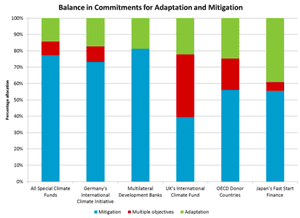
A second tortured sore is the balance between funding for “adaptation” – coping with the effects of climate change – and “mitigation”, carbon cutting interventions. Mitigation tends to attract vastly more finance because its profile – renewable energy, forestry, agriculture - comes with readymade business models and can convince private capital to provide additional help. Because of this, mitigation attracts roughly three quarters of all climate finance.

Adaptation and mitigation in climate finance
Adaptation and mitigation in climate finance Photograph: WRI

Adaptation, much of which involves improving infrastructure, offers no such ready profit model and generally requires grants. The African negotiating bloc has called for adaptation finance to reach $32bn a year by 2020. But Kowalzig said that even with new pledges, public adaptation money was only likely to amount to $5-8bn per year in 2020.
“If today’s public adaptation finance were divided among the world’s 1.5 billion smallholder farmers in developing countries, they would get around $3 each year to cope with climate change – the price of a cup of coffee in many rich countries,” he said.


Paris climate talks: pressure mounts on countries to produce working text

Extract from The Guardian

France and UN want draft deal to be ready by weekend, but differences remain over details as negotiations reach half way point
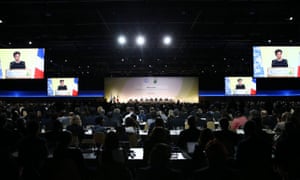
Christiana Figueres, UN climate chief, addresses delegates from 195 countries at the COP21 conference in Paris. Photograph: Carl Court/Getty Images

Fiona Harvey in Paris
Saturday 5 December 2015 02.03 AEDT

Delegates from 195 countries at climate change talks in Paris are under pressure to produce a working text of a deal by Friday, exposing sticking points and fault lines nearly halfway through the UN negotiations.
Developed countries, along with the French hosts and the UN, were mostly optimistic about signing a deal in advance of the landmark summit.
World leaders met on the first day, an unprecedented gathering of the heads of state and government of 150 countries, pledging their commitment to a legal outcome that would reaffirm the world’s collective action on greenhouse gas emissions.
Developed countries – or most of them – came to the Paris climate change conference with a few clear priorities. They wanted to validate the emissions targets made by nearly all of the world’s governments; prove to developing countries that the flows of finance, mostly from the private sector, would be sufficient for the assistance they need; and ensure that the mechanisms for review, transparency, and accountability in meeting the emissions targets are sound.
On the emissions targets, the omens were good. Nearly every country, developed and developing, produced a national plan – known as Intended Nationally Determined Contributions (INDC) – on curbing their emissions beyond 2020, when current commitments, agreed at Copenhagen in 2009, run out.

Analysis Are rich countries selling the developing world short on climate change?

Rich countries say they are on track to beating the $100bn climate fund target, but poorer countries criticise the unfair burden of loans and a stark lack of money for adaptation
Read more
Although rich countries have been criticised for not doing enough to keep global emissions below the levels likely to lead to dangerous climate change, they were fortified by analyses of the INDCs that the “emissions gap” could be met, with additional contributions from “non-state actors” such as cities, regional governments and businesses.
In addition, they were proposing a mechanism of five-yearly reviews at which commitments could be ratcheted up, which would enable the target of limiting temperature rises to 2C to be met in future years.
However, while the principle of five-yearly reviews was widely regarded as a useful and workable innovation, some countries have raised concerns. These include China, India, Middle Eastern countries and some of Latin America.
For these countries, a five-year “stock take”, at which progress on targets could be discussed, is the preferred option. They argue that, as most have 2030 targets, these should be allowed to stand. But for countries such as the US, which has offered a 2025 target, a five-year review would be appropriate.
Developed countries are resistant, still asking for a full review process rather than a mere stock take. “It’s about having a level playing field,” one delegate told the Guardian. “That’s an important principle.”
Another said: “We don’t want to lock in modest ambition [by dropping five-year reviews].”
This issue, along with the mechanisms for reporting and verifying that emissions reductions have truly been made, could yet provoke more controversy in the pressure-cooker atmosphere of the talks.
On finance, reports from the Organisation for Economic Co-operation and Development (OECD) and the World Resources Institute have suggested that climate finance is flowing to the poor at levels needed to meet the Copenhagen pledge of $100bn a year by 2020. Most of this is likely to come from the private sector, but rich country governments and international development banks, such as the World Bank, have fortified the prospects with raised pledges on finance, such as the UK’s promise of £5.8bn over this parliament.
Critics say some of this money is being taken from other development aid budgets. The finance issue is likely to continue to be wrangled over into the closing days of the talks, as developing countries seek further assurances.
Developed countries are holding firm on another controversial matter: loss and damage. This, according to the rich nations, is the principle that poor countries struck by disasters of climate-related extreme weather should receive special assistance, and they will commit to that.
However, for some poor nations and NGOs, loss and damage is interpreted as being compensation owed to the developing world from the industrialised countries that have historically been most responsible for emissions.
“We are not signing up to anything on compensation or liability,” one EU official said. The US is understood to take the same stance.
Finally, a key risk as the talks grind on is that yet again, as at Copenhagen, they become bogged down in wrangles over details in the text. The draft text contains thickets of square brackets, denoting issues where wording has not yet been resolved, or where several options still remain to be decided upon.
If these cannot be resolved in time, a text may not be ready for agreement, and the talks could fail. The French hosts, and the UN, have tried to avoid this by demanding the text be ready at an early stage – this weekend – before being passed to ministers for the political discussions that still need to be had among countries.
To this end, they have introduced novel forums for discussion among delegates, such as a system of “informal informals” by which small groups of officials take passages of the text – often just a paragraph – and try to beat it into a shape acceptable to all.
“France is acutely aware of the risks of process failure,” the EU official said. Getting a text into a workable format is now the top priority.
Whether the compromises that are still possible will be enough to satisfy developing countries cannot yet be discerned. Some countries, including some Latin American, African and Middle Eastern delegations, have been privately indicating they are not happy with the way the talks have gone in their first week and may step up their rhetoric in the second week.
India, which was late to produce its INDC and whose president, Narendra Modi, has been outspokenly critical of western countries, has been the subject of a charm offensive, including meetings with President Obama, David Cameron, and other high-ranking developed country officials, and from NGOs.
At Durban, in 2011, the UN climate talks carried on until dawn on the final Sunday, some 36 hours after they were supposed to end, after a mammoth non-stop negotiating session. What was at stake was in fact whether the Paris conference would take place, and indeed the entire future of the UN process. Taking place in the shadow of the 2009 Copenhagen summit, which produced a deal but no legal agreement and ended in scenes of chaos, the Durban conference was unusually fraught, even by the standards of these long-running annual negotiations.
The EU had assembled a “coalition of ambition” at Durban, made up of most of the poorest countries on the planet, as well as the richest, to push for a new round of talks that would culminate in 2015, aimed at forging a legal agreement to come into force from 2020.
Late into Saturday night, only two countries were holding out against that proposed timetable: China and India. In the end, they agreed to it. In the intervening years, China has re-gauged its stance, most notably in forming an unprecedented alliance last year with the US to announce joint commitments on emissions. But the interests of Delhi and Beijing are far from identical.

Paris talks creep towards agreement in final week, but deal could be 'watered down'

Negotiators now focused on forging some kind of accord between nations amid impasse over key issues, such as monitoring of emissions reduction pledges
US special envoy for climate change Todd Stern
US special envoy for climate change Todd Stern at the conference in Paris. Stern says a ‘high-ambition coalition’ was emerging at the talks. Photograph: Thibault Camus/AP

A weak agreement remains the greatest danger for the Paris climate talks, with negotiators confident some kind of deal will be reached before next weekend despite little concrete progress and continued trenchant disagreements on most issues.
The Paris summit is now entering its final week – when ministers and high level officials take over the negotiating lead under the French presidency.
The final agreement will be a political trade-off over the issues that have been dividing negotiators – so the document that will be handed to the French on Saturday remains to the lay-observer a hopeless scramble of options in brackets, indicating disagreement.
But the senior negotiators believe there will be a way through.
US special envoy for climate change Todd Stern said “a high-ambition coalition” was emerging, which “includes many countries” but not all of the 195 countries in the talks.
He said the United States was now “really focused on getting that kind of strong agreement that is not watered down and does not kind of go to a lowest-common denominator or a minimalist agreement.”
And Christiana Figueres, the executive secretary of the UN convention on climate change, said the talks were “where we thought they could be”.
One impasse in the talks so far is about whether the document should mention that the latest science says the world should be aiming to limit global warming at 1.5 degrees, with Saudi Arabia and India flatly refusing attempts to even “reference” a UN study saying a 1.5 degree target was safer than 2 degrees.
There are also divisions over suggestions big developing countries should join rich countries to make financial contributions to help poor countries reduce their emissions and cope with the impacts of locked-in climate change.
Stern told reporters some countries had “overread” the issue. He said it was about recognising what was already happening - China pledged US$3.1 billion in support to developing countries, when president Xi met president Obama at the White House - rather introducing any requirement he said.
There is also intense disagreement over the agreement is worded in a way that would bind rich countries to specific continued investments, beyond the deal struck in Copenhagen for $100bn a year in public and private money to flow by 2020. (An OECD review said around $60bn was already committed, but poor countries dispute the calculations)
But Stern said the US believed clear rules for monitoring and verifying where countries were meeting their greenhouse gas reduction targets “was an an enormously important part of this agreement, really one of the central parts of this agreement.”
“When you think we have 184 targets put forward ... the transparency regime is the thing that will allow everyone to have trust that others are acting ... transparency is vital,” he said.
Some countries, including China and India, have also raised concerns about the idea of five yearly reviews of countries’ targets – the mechanism that it is hoped will help increase their ambition to meet even the goal of containing global warming to 2 degrees.
The final deal is likely to be a trade-off between the rich countries demands for monitoring and oversight of all countries’ efforts and the developing world’s need for financing.
The French foreign minister, Laurent Fabius, said he had appointed high level ambassadors to try to move things forward before negotiators hand over the text containing what agreement they have managed to achieve.
China was widely blamed for the failure of the 2009 Copenhagen meeting, but in Paris Fabius said China had “so far played an extremely positive role.”
This time Saudi Arabia is taking its traditional hard line stance and India is playing what one negotiator described as a “blocking role”.

The 'red line' issue that exposes deep divisions in the Paris climate talks

Extract from The Guardian

Calls by the US and Australia for tougher requirements on how developing countries’ emissions are reported on and checked have met with fierce resistance
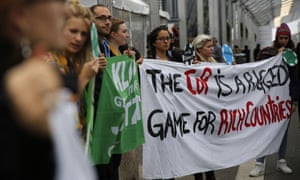
Protesters outside the COP 21 climate talks in Paris holding a sign claiming the process is rigged in favour of rich countries. A divide between the demands of developing and developed nations is emerging over emissions reporting and checking rules. Photograph: Christophe Ena/AP

Lenore Taylor in Paris
Friday 4 December 2015 07.01 AEDT

Buried in the detail of the Paris Accord could be some innocuous-looking words that will have a powerful impact on whether it ever delivers the greenhouse gas reductions it promises.
The words could “paper over” deep divisions about whether countries ever have to properly report and account for the promised emission reductions that collectively limit global warming to the already-dangerous 2.7 degrees.
Key to the negotiations will be a trade off between developing countries’ demands for financing to reduce their own emissions and adapt to locked-in climate change and the insistence by both rich nations like the United States and climate-vulnerable countries like the small island states that every country should be required to at least work towards the same rules for reporting and checking their emission reductions.
Since the pledges in the Paris Accord will not be legally binding and the more stringent rules applied to developed countries under the Kyoto Protocol are almost certain to lapse in five years, the direction set for this new set of reporting and checking rules is important to ensure the agreement delivers what it promises for the climate.
Countries like India claim the existing rules under the overarching UN framework convention on climate change are fine.
Dr Ajay Mathur, director general of the Bureau of Energy Efficiency in Delhi, said there was “no need to spend time again negotiating new reporting guidelines and rules when we already have rules that apply to everybody and give necessary flexibility to developing countries.”
But those rules have far softer requirements for how and what developing countries report about their emission reductions. They do not require comprehensive reporting and do not force countries to detail how they are tracking towards the target they have pledged or to project their future greenhouse gas emissions. And the system for “expert review” of developing country reports is far less onerous than the in-country checking for developed nations.
Bill Hare, chief executive of Climate Analytics, said allowing the current system to continue was “not feasible” and would represent a “complete failure at the Paris talks”.
“It would mean we couldn’t check or track what developing countries are doing,” he said. “There would be no way of knowing what was happening.”
Transparency is a “red line” issue for countries like the United States and Australia. They are willing for common requirements to be phased in and for poor countries to get extra help to develop the systems they need to comply with the new rules, but are determined that the goal must be a common system.
It would not include penalties or have any means to force compliance, but it would – eventually – provide a reasonably clear picture of what emissions reductions each country had achieved.
And that, in turn, would create the trust necessary for countries to increase the ambition of their emission reduction targets over time, to bring global emissions to the level that might contain warming to 2 degrees or lower.
President Obama made America’s position clear in his Paris speech.
“Here in Paris, let’s agree to a strong system of transparency that gives each of us the confidence that all of us are meeting our commitments. And let’s make sure that the countries who don’t yet have the full capacity to report on their targets receive the support that they need,” he said.
But developing countries like India and Saudi Arabia are adamant different reporting rules are enshrined in the 1992 convention’s recognition of the principle of “differentiation” between the responsibilities placed on rich and poor nations.
In his speech to the conference, Indian prime minister Narendra Modi said a “common but differentiated” responsibility had to “remain the bedrock” of the agreement because anything else would be morally wrong.
The US has said it “would not support a bifurcated approach to the new agreement, particularly one based on groupings that may have made sense in 1992 but that are clearly not rational or workable in the post‐2020 era”.
Nozipho Mxakato-Diseko, ambassador from South Africa and chair of the G77+China negotiating bloc said differentiation was “embedded ... and we should not have to renegotiate it here.”
She objected to the “narrative” on transparency rules that cast poor countries as “villains” and also to the idea that rich countries’ promises on finance would be conditional on poor countries’ acceptance of common transparency rules.
“Conditionality erodes trust ... it is not a responsible way to go,” she said.
The Paris Accord will not finalise the reporting and review rules but it will set a direction. Rich countries want a path to a credible, common system. The alternative is wording papering over the fact that the current stand-off remains unresolved.
According to the deputy chief executive of The Climate Institute, Erwin Jackson, “the danger in that outcome is that we continue the procedural battle we are currently seeing forever. It gives countries who want to weaken the process an opportunity to continue to throw spanners in the works for years to come.”
Richard Chatterton, head of climate policy for Bloomberg New Energy Finance, said differentiation was the issue that could “derail” the Paris talks.

He said the most likely outcome was the conference would find “wording” that “effectively sweeps differentiation under the carpet”, meaning it would be fought out for years to come.

Cabinet document reveals Turnbull Government under pressure to change industrial relations laws

Extract from ABC

Updated about 4 hours ago
The Turnbull Government is being pushed to change Australia's industrial relations system, a Cabinet-sensitive document obtained by the ABC has revealed.
The incoming brief for Treasurer Scott Morrison said increased workplace flexibility was "key", and endorsed a report that is primed to recommend cutting Sunday penalty rates across a range of industries.

Key points:

  • Brief urges for increased workplace flexibility
  • Calls for "reform now" to improve nation's productivity
  • Labor labels Treasury recommendations troubling
  • National economy establishing "broader base for future growth" Treasurer says
"Labour market flexibility remains key to the economy adapting to challenges and opportunities in the future," the powerful Treasury department argued.
"The Productivity Commission's Review of Workplace Relations represents a significant opportunity for labour market reform to help drive productivity in the economy," it said, referring to a report expected this month.
"[The review] is an opportunity to build the case for reforms to grow the economy."
The ABC's freedom of information investigation also found average incomes are not expected to recover for at least another 18 months — in what would be Australia's longest-ever period without per capita income growth.
"Our goal needs to be improvement in the country's productivity," it said.
"Reform now is important, as delay will only exacerbate the extent of change required in the years ahead."
The ABC's investigation has also revealed:
  • Income per person (real per capita national income) will not recover to 2011-12 levels until 2017-18
  • Treasury said "structural reform" in the multi-billion-dollar health and education sectors was worthwhile, and the Federation White Paper process presented an opportunity for change
  • Treasury said budget repair was essential, and the Government 'could not wait for economic growth to fix the budget bottom line'
  • The department said global uncertainty and the uneven transition after the mining boom remained risks for the economy

Labor concerned about penalty rates

Federal Labor said the Treasury's recommendations were very troubling.
"We are concerned that when the Government talks about flexibility, and that is Malcolm Turnbull and the Liberal Party, [they] are really talking about cutting penalty rates, lowering the minimum wage; effectively a race to the bottom," opposition workplace relations spokesman Brendan O'Connor said.
"Whether it's with WorkChoices or other IR reforms ... it's always about cutting penalty rates, cutting the minimum wage and making jobs less secure.
"Our concern is given the Liberal Party record, and the recent foray into the penalty rates debate by the new Prime Minister Malcolm Turnbull, that this notion of labour flexibility is one-way flexibility, which is effectively cutting conditions of employment for 11 million Australian workers."
In October, Mr Turnbull commented on the difference between Saturday and Sunday penalty rates, saying: "The only reason they're different, I assume, is history.
"I think over time you will see a move to a more flexible workplace."
The interim Productivity Commission report, released in August, recommended cutting Sunday penalty rates for sectors including hospitality and retail in line with Saturday pay, but said wages for emergency workers should not be affected.
"Australian society expects to be able to shop, go to a pharmacy, and eat at cafes and restaurants on weekends," Productivity Commission chairman Peter Harris said.

Australia in economic transition: Treasurer

When asked about the Treasury document, Mr Morrison said Australia was continuing to go through economic transition following the investment boom in the mining sector.
"The Australian economy is diversifying and establishing a broader base for future growth," Mr Morrison said.
"Australians understand the changes taking place in our economy and are looking to the Government to continue to pursue policies that support jobs and growth. This is what we are doing.
"The Turnbull Government is backing Australians with our policies — whether it's our efforts to make our tax system growth friendly, boost productivity through our innovation, competition and infrastructure initiatives or gain increased access to overseas markets though our trade agenda, we are taking action to support Australians who are working, saving and investing."
Speaking on Radio National in October, Mr Morrison said the workplace system needed flexibility.
"What we want is more people, particularly young people, being employed," he said.
"We need flexibility in the system which means people with disabilities, people who have been long-term unemployed can get a go in the labour market.
"Now, I don't see why you wouldn't want to consider anything that wouldn't achieve those sorts of goals."
Mr Turnbull appointed Mr Morrison in September, relegating Joe Hockey to the backbench and sparking his retirement from politics and Saturday's North Sydney by-election.