Saturday, 3 October 2020

What happens if Trump is incapacitated and how would it affect the election?

 Extract from The Guardian

Donald Trump has tested positive for Covid-19 – but what happens if he can’t carry out his presidential duties?

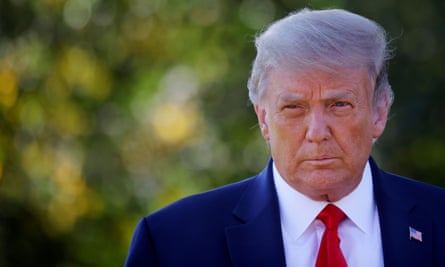
Trump departs on campaign travel to Minnesota from the South Lawn at the White House on Wednesday.
Donald Trump departs on campaign travel to Minnesota from the South Lawn at the White House on Wednesday.
in London and in New York

Last modified on Sat 3 Oct 2020 04.39 AEST

What happens if Trump is incapacitated?

Under the 25th amendment to the US constitution the president himself – or the vice-president with the agreement of eight cabinet officers, supported by Congress – can ask the vice-president, in this instance Republican Mike Pence, to take over as acting president.

Adopted by the US Congress in 1967 after John F Kennedy’s assassination, the 25th cleared up a vagueness in the constitution over succession in event of resignation, death or conviction in impeachment.

The least tricky part of the amendment is section 4, which stipulates what would happen should Donald Trump be indisputably physically debilitated either from an injury or ailment, so much so that he couldn’t communicate but remained alive.

Then the vice-president is in charge unless and until the president recovers.

If Pence is also unable to assume control, then under the constitution powers are delegated to the speaker of the House of Representatives, in this case, Nancy Pelosi, the Democratic California congresswoman. In the US Congress, the Democrats currently control the House, while the Republicans are in a majority in the Senate.

What are the implications for the election and its aftermath?

Here we get into murkier territory.Some Americans have already begun casting their ballots in early voting before official election day, which is 3 November, including overseas residents and those in states that permit early voting.

After the election, what happens if a president-elect dies during the lame duck period when the current presidential term is not over and the next president is officially inaugurated on 20 January? Under the constitution’s 20th amendment the vice-president would become president. The question of who would be declared the president-elect to be inaugurated to the position on 20 January would involve discussions and probably battles at state, party, electoral college and court level.

In a worst-case scenario involving death or permanent incapacitation before the election, the US would face an unprecedented electoral crisis.

Unlike in some other countries – such as the UK – Americans vote for an individual on the ballot for president, not for a party. For example there may be Republican and independent voters in this circumstance who would reject Trump but would be happy to vote for Pence, if he were the candidate.

Therefore in circumstances where Trump was taken off the ballot the vote would become deeply undemocratic, as Pence was never voted on as the presidential nominee via the process of primaries, which took place in the spring.

It is worth reiterating we are nowhere near that stage at the moment, this is about theoretical procedure in US politics, and that although Trump has tested positive, there is little information on his current condition and no prognosis.

What if Joe Biden also became ill?

In either case the party’s national committee, Republican or Democratic, would have to meet to formally nominate a new candidate. While that should be straightforward – seeing the vice-presidential candidate elevated – other candidates who were in the running in the primary stage could theoretically make a case for a hearing from their party.

It is also complicated by the fact that electors to the electoral college at state level a controversial layer of 538 representatives across the US who vote for the president based on the result of the popular vote in their statewould have to decide if votes already cast for a dead or incapacitated candidate would “bind” them to any replacement when the electoral college meets after the election, in December.

What about postponement?

The date of US elections is fixed in law – going back to 1845 – and elections have gone ahead through war and crisis. Trump has himself been dismissed by Republicans for even suggesting a postponement because of the coronavirus pandemic.

The law says US voters must go to the polls on the Tuesday after the first Monday of November every four years. This year that date is 3 November.

It would take an act of Congress – ie approved by by both the House and Senate – to change that.

What’s the worst-case scenario?

There are potentially many. Biden has also been close to Trump recently and would be in a high-risk group, but he, like Pence, has said he has tested negative.

Both are on the ballot and would cause issues if ill or incapacitated. Postponements, selection of new candidates and reissuing of ballots might involve not only new legislation and potentially the US supreme court but the parties themselves having to agree mechanisms as well.

Donald Trump showing 'mild' COVID-19 symptoms, Joe Biden, Mike Pence, Kamala Harris all test negative.

 Extract from ABC News

,
A composite image of Donald Trump and Joe Biden.
Mr Trump trails his rival in the polls and his campaign has been upended by his positive test.(AP: Morry Gash, Pool)

US President Donald Trump has been experiencing "mild symptoms" of coronavirus, leaving the White House and his presidential election campaign scrambling to adjust to the development.

Mr Trump and his wife Melania both tested positive for the deadly virus on Friday and have gone into quarantine.

Mr Trump is not incapacitated and is working in isolation to avoid infecting others, a White House official said.

Treasury Secretary Steven Mnuchin and White House Chief of Staff Mark Meadows said the President, 74, was exhibiting mild symptoms.

"We have a President that is not only on the job but will remain on the job and I'm optimistic that he will have a very quick and speedy recovery," Mr Meadows told reporters.

They gave no more details.

All campaign events involving the President and his family will either be turned into virtual events or postponed until further notice, Mr Trump's campaign manager said.

Bill Stepien added that Vice-President Mike Pence, who has tested negative for COVID-19, plans to continue to his campaign schedule.

After announcing his positive test on Friday morning Mr Trump tweeted: "We will begin our quarantine and recovery process immediately. We will get through this TOGETHER!"

On Thursday night, shortly after Mr Trump predicted the pandemic's end was in sight, news broke that Hope Hicks, a top adviser and trusted aide, tested positive for the virus.

Ms Hicks travelled with the President on Air Force One on Tuesday and Wednesday, leading to a slew of tests for those in the Trump's inner circle.

Many White House and senior administration officials were undergoing tests on Friday, but the full scale of the outbreak around the President may not be known for some time as it can take days for an infection to be detectable by a test.

Officials with the White House Medical Unit were tracing the president's contacts.

The Trump's youngest son Barron has tested negative, a White House official said, as have the President's daughter Ivanka and her husband Jared Kushner.

Wall Street tumbled at news of one of the biggest health scares involving an American president for decades, with the S&P 500 plunging more than 1.5 per cent at the opening of trade.

It remained down 0.5 per cent in afternoon trading, paring its earlier losses but the moves weren't close to as chaotic as earlier this year, when markets were first selling off on coronavirus fears.

Pence, Biden and Harris test negativeA man in a navy suit waves with his right hand while supporters in stadium seating look on.

Mr Trump's staff will be kept away from people working for Mr Pence.(AP: Evan Vucci)

The President's illness has upended his re-election campaign, with just 31 days left to go until the election.

Polls show Mr Trump has been trailing his Democratic opponent, former vice-president Joe Biden.

Mr Biden and his wife Jill used Twitter to wish Mr Trump and the first lady a speedy recovery.

"We will continue to pray for the health and safety of the president and his family," Mr Biden said.

Mr Biden, who spent 90 minutes on stage with Mr Trump during their first debate just days ago, has also been tested and was cleared of being infected on Friday (local time).

Vice-President Mike Pence and his wife have also tested negative.

Mr Pence is set to work from his residence, which is several kilometres from the White House, and his staff was being kept separated from Mr Trump's staff.

Mr Pence, 61, a former Indiana governor, would take over if Mr Trump were to become incapacitated.

Democratic vice-presidential nominee Kamala Harris also tested negative on Thursday, according to a person familiar with the matter.

Campaign plans scrapped

A man in a suit stretches his arms wide as he speaks to a large crowd of supporters who are holding signs.

President Donald Trump had four rallies planned but they will likely not go ahead.(AP: Jack Rendulich)

Mr Trump's advisers have acknowledged plans for the final weeks of the election campaign have been scrapped.

"Trump is a high-energy president with a giant personality. Without his persona, the campaign is missing its energy," Republican fundraiser Dan Eberhart said.

Mr Trump's positive test also means that others at the highest levels of the US Government have been exposed and may have to quarantine, too.

The President, who is tested regularly, has kept up a rigorous travel schedule across the country in recent weeks, holding rallies with thousands of people, despite warnings from public health professionals against having events with large crowds, in the run up to the November 3 election.

His national security adviser Robert O'Brien tested positive for the virus in July.

Mr Trump said he was not worried about the spread of COVID-19 in the White House when an aide of Vice-President Mike Pence tested positive to coronavirus in May.

One of the President's personal valets has also tested positive, along with Kimberly Guilfoyle, who is dating Mr Trump's oldest son, Donald Trump Jr.

Mr Trump had previously played down concerns about being personally vulnerable to contracting COVID-19, even after White House staff and allies were exposed and sickened.

"I felt no vulnerability whatsoever," he told reporters back in May.

Trump the latest world leader to catch the virusUk Prime Minister Boris Johnson leaves 10 Downing Street

UK Prime Minister Boris Johnson spent three nights in intensive care.(AP: Kirsty Wigglesworth)

British Prime Minister Boris Johnson kept working in isolation for around a week after testing positive in March but then fell gravely ill and was rushed into intensive care. He spent several weeks recovering before returning to work.

Canadian Prime Minister Justin Trudeau went into quarantine in March after his wife was diagnosed with the coronavirus.

Brazilian President Jair Bolsonaro called the virus a "little flu" after being infected in July.

Friday, 2 October 2020

When Trump defends armed rightwing gangs, his rhetoric has echoes of fascism.

Extract from The Guardian

OpinionThe far right


Signalling to his base, as he did referring to the Proud Boys on Tuesday, the president is following a playbook from 1930s Germany.

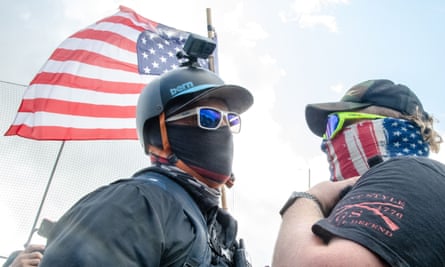
A Proud Boys rally in Portland, Oregon, on 26 September.

A protester and a Proud Boy face to face at a rally in Portland, Oregon, on 26 September.

Last modified on Thu 1 Oct 2020 18.24 AEST

You can imagine the men as they prepared for the showdown. For days, the papers had been predicting a “great sensation”. Press photographers besieged the entrance. No one could enter the building where the debate was due to take place without a special permit. In his dark blue suit, one question above all troubled the party leader, and with the help of his advisers, he puzzled how best to answer it. What if he was accused of links to fascist street gangs?

This wasn’t the United States in September 2020. It was Germany in May 1931.

For as the historian Benjamin Hett describes in his book, Crossing Hitler, the summer of 1931 saw Hitler being summonsed to court and accused of being complicit in the work of gangs who had beaten – and killed – their anti-fascist enemies.

Hitler’s response was to play a double game. First of all, he was worried about looking weak in front of his supporters, who had called him a coward and a conformist. So he needed to signal that the gangs still had his support. Second, he tried to pretend that any harm caused by his supporters was necessary since the country faced a much more threatening enemy: the far left.

“The SA men are the first men in the party,” he told his opponent, the private prosecutor Hans Litten. Then, in answer to Kurt Ohnesorge, the judge who moderated the hearing, Hitler said that the “red murderers” of the left were the real problem: “If an SA man really oversteps the boundary of self-defence, you can’t hold a man responsible for that.”

Compare this to Donald Trump signalling to his base. During Tuesday’s presidential debate, he was asked: “Are you willing tonight to condemn white supremacist and militia groups and to say that they need to stand down and not add to the violence?”

He answered, “I would say almost everything I see is from the left wing, not from the right wing.” He continued: “Proud Boys, stand back and stand by.” Then came the justification: “But I’ll tell you what, somebody’s got to do something about antifa and the left. Because this is not a rightwing problem, this is a leftwing problem.”

Trump is wrong to pretend that the left is responsible for the violence on America’s streets. Between 1 January 1994 and 8 May 2020, white supremacists and other rightwing extremists in the US carried out attacks that left 329 people dead. In the same period, a single attack staged by an anti-fascist resulted in a killing. And during that incident, the one person who lost their life was the anti-fascist perpetrator.

That survey ended in May. Since then, the number of killings carried out by anti-fascists has risen from zero to one. On 29 August this year a pro-Trump truck convoy made its way through Portland, firing paintballs and pepper sprays. A counter-protest saw an associate of the far-right group Patriot Prayer, Aaron J Danielson, shot dead. One anti-fascist, Michael Forest Reinoehl, admitted to the shooting in a media interview, but said he acted in self-defence. He was shot by US marshals on 3 September in Lacey, Washington.

Even after Danielson’s death, the grim headcount remains: the far right has been carrying out killings at the rate of 300 to the anti-fascist one.

The 1920s saw a similar disparity of casualties. The most detailed survey of deaths in Weimar Germany, carried out by the German mathematician Emil Julius Gumbel, found 314 murders carried out by the right in 1918-22 and 15 by the left. After 1923, deaths fell almost to zero before resuming again from 1928 with the rise of the Nazis.

In the US, since 2016 and Trump’s election, attacks on leftwing demonstrators have become more frequent. They have included the killing of anti-fascist protester Heather Heyer at Charlottesville. James Alex Fields Jr drove his car at protesters after being photographed earlier brandishing a shield with a fascist symbol right out of the 1920s (a bundle of rods and an executioner’s rod). He was sentenced to life in prison.

There were the 11 worshippers shot at the Tree of Life synagogue in Pittsburgh, allegedly by Robert Bowers. And there have been the more than 100 white supremacists who have attempted to disperse anti-racist protests since the spring by driving their cars at demonstrators – the same method of attack as that used by Fields at Charlottesville.

Hitler’s followers were responding to the electoral success of the left; they knew that in areas of Berlin the Communist vote was as high as 40%. And, in order to break the opposition to Hitler, they went into those districts and beat and killed antifascists. It was this violence that led to Hitler’s trial.

The main purpose of the Proud Boys, in summer 2020, is the same. That’s why the they were in Portland last weekend, carrying posters denouncing anti-fascists and supporters of Black Lives Matters, and promising to drive the left out of the city.

Trump is lying when he says that the left is responsible for the violence. In blaming the left he is encouraging his armed supporters and inviting further killings.

In many ways Trump is a weak authoritarian. After four years in power, Trump has not gone to war. His opponents are at large and not in jail. But when Trump defends armed gangs, he echoes the worst moments in modern history.

• David Renton is a barrister and author of Fascism: History and Theory

'It's degrading': Australians on the poverty line brace for pain after jobseeker cuts.

 Extract from The Guardian

As job opportunities vanish and the coronavirus supplement is slashed, single parents face an uncertain future

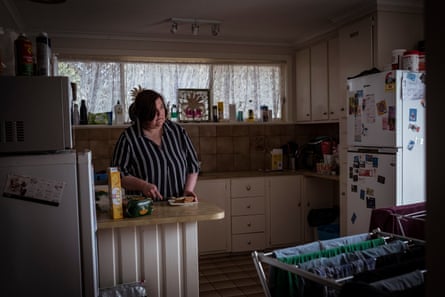
Mandy Weber
Mandy Weber says the cut to the coronavirus jobseeker supplement will make life harder at a time when there are many fewer jobs available.
Fri 2 Oct 2020 03.30 AEST

“My children will have to cut back on the medication that they need,” Mandy Weber says. The single mother of four had been relying on the government’s jobseeker payments to keep her children fed and healthy, as the coronavirus pandemic condemned her to unemployment.

“I could go to the supermarket, and instead of doing a $30 shop for the week, I could do a $200 shop for the fortnight,” she says.

The extra payment, introduced by the government in the wake of the pandemic, changed Weber’s life, affording her and her family the opportunity to live normal, dignified lives.

“It gave me the dignity to have fresh fruit, like apples and bananas, salads and fresh meat that we wouldn’t normally get,” she says.

But now that the supplement has been reduced, life in Bacchus Marsh, Victoria, has suddenly become very different for Weber and her children.

“It’s going to affect my household hugely; it’s going to affect whether we can pay our bills, maintain power and water, whether we can afford to pay rent, whether we can even afford to eat,” she says.

“There won’t be any birthday presents or Christmas presents, I no longer have enough to even buy them a cake.”

Weber is far from alone. Millions of Australians who have lost work during the pandemic and found themselves dependent on the supplement will find the cuts difficult to stomach.Mandy Weber

Mandy Weber says she will be unable to buy her children birthday presents as the rate of the jobseeker supplement is cut. Photograph: Christopher Hopkins/The Guardian

The jobseeker program, formerly known as Newstart, included a top-up to unemployment payments. But since 25 September that top-up has been cut by more than half – from $550 a fortnight to $250.

That reduces the fortnightly rate for singles from $1,115 to $815. Singles with children and over 60s will get $862 and couples will receive $760 each.

For many who have seen their livelihoods and opportunities vanish in the nation’s first recession in three decades, the cuts are disastrous.

“I just think it’s horrible and degrading. There are no words to describe it, it should not be cut,” Weber says.

“Now that it’s gone, it’s going to be a lot harder to survive really, and a lot harder to look for work.”

The government has also made it mandatory for recipients to apply for up to eight jobs each month.

Just before the pandemic hit, Weber had accepted a job at a local pub, and looked forward to ending her dependence on government payouts. But the pandemic ruined that plan – the pub was forced to shut its doors due to Covid-19 restrictions.

Since then, job opportunities have been few and far between.

“There’s over 100 people going for the same position, you’ve got a lot of qualified chefs working in childcare at the moment because there’s no work out there,” she says.

Kristin O’Connell of the Australian Unemployed Workers’ Union echoes Weber’s concern, saying people were already struggling as it was.

“People living on the jobseeker payments have been living on the poverty line for a few months, and they’re about to be $150 below it.

“And we know that’s going to cause people to skip meals, skip medical care and to be skipping real essentials that everyone should be able to access,” O’Connell says.

The flow-on effects from losing vital income support are telling – from cutting healthy food and medicine, to the added strain on mental health.

“It really affects your self-esteem. You can’t go into a job interview confident if you’re hungry and you can’t think. You may not even be able to afford toothpaste to brush your teeth,” O’Connell says.

The government’s caveat in cutting the rates to income support was that it extended both jobseeker and jobkeeper for six months.

The idea that people could just go out and get themselves out of poverty by finding a job is ridiculous, because there are no jobs

Both payments were introduced to support people who suddenly found themselves out of a job because of the pandemic, effectively acting as a safety net for millions.

But the pandemic has skewed the job market, making it hard for anyone to find work.

“There are just so few jobs available,” O’Connell says. “Last Tuesday, there were about 113,000 jobs advertised on Seek, and on the same day there were 1.62 million people living on unemployment payments.

“So the idea that people could just go out and get themselves out of poverty by finding a job, even if the system worked, is ridiculous at this time.”

Weber says she had been applying for jobs in the interim, but found it close to impossible to get a look.

“Before Covid-19, I would apply for around four jobs and guaranteed I would get one of them. Now I’ve applied for 100 jobs, and I’ve only managed to get one interview.”

A Deloitte report from earlier this month said reducing the supplements would cost the economy $31.3bn and as many as 145,000 full-time jobs over two years.

Weber says her only choice is to continue applying for jobs in the hope of keeping her children away from poverty.

“I will always apply for work. I am someone who wants to work. I’m not someone who wants to sit at home.”

Thursday, 1 October 2020

Narrabri gas project: do we need it and what's at stake for Australia's environment?


The NSW independent planning commission is due to hand down a decision on the proposed gas development at Narrabri. Here’s what is at play
Santos staff at a coal seam gas well rig in the Pilliga forest
The Narrabri gas field proposal by Santos has been in the works for more than a decade and is a sign of the government’s push to expand gas extraction and use.
Supported by
Limb Family Foundation
About this content
Environment editor

Last modified on Wed 30 Sep 2020 08.18 AEST

The New South Wales independent planning commission is due to make a decision on a proposed new gas development at Narrabri, in northern NSW, on Wednesday. Here is what is at play.

What is the project?

The proposal by Santos to develop a gas field at Narrabri has been in the works for more than a decade, but has become emblematic of something much larger – the Morrison government’s push to significantly expand gas extraction and use.

As proposed, the $3.6bn project would involve up to 850 coal seam gas wells being drilled down on 1,000 hectares across a 95,000 hectare site that includes Pilliga forest and nearby grazing land. The wells would descend more than a kilometre below the surface to draw up to 200 terajoules of gas a day for domestic use for 20 years – equivalent to 50% of NSW demand.

Who supports it?

Santos’ pitch is that it will deliver “more affordable, secure, cleaner energy” for the state, lead to jobs and investment in a regional area and can be developed “safely and sustainably” without harming water resources or the environment.

It is backed by both the federal and state governments, several business groups and gas-reliant manufacturers. It received formal backing from the Berejiklian government in June, when the state Department of Planning, Industry and Environment recommended it be approved with what it described as strict conditions, saying it was critical for energy security in the state and unlikely to result in significant impacts on the community or environment.

In a speech earlier this month, Scott Morrison placed the development at the centre of the government’s proposed “gas-fired recovery” from the coronavirus recession, saying “we need to accelerate development of new basins like the Beetaloo in the Northern Territory and Narrabri in NSW”. It prompted suggestions he was implicitly pressuring the independent commission.

Morrison has listed Narrabri as one of 15 projects of national significance, promising an accelerated assessment under federal environment laws. The energy and emissions reduction minister, Angus Taylor, has backed the suggestion it will reduce energy costs for consumers.

Who is opposed?

While political and business support for the project has been significant, the registered public response has been overwhelmingly against. The department received nearly 23,000 submissions during its deliberations. Nearly 98% were opposed on a range of grounds, including that it could damage groundwater relied on for agriculture, lead to a loss of pressure in the Great Artesian Basin, affect biodiversity in the Pilliga forest and release substantial greenhouse gas emissions.

Opponents include local farmers, scientists, conservationists and those who do not believe the economics stack up. A former national chief scientist Penny Sackett said it was at odds with the Paris agreement and cutting emissions to net zero by 2050 – a target backed by the NSW government and many in business, but not Morrison.

What do we know about what Narrabri would mean for gas prices?

The company changed its evidence in a late submission to the commission, handed in after public hearings were complete, to suggest the gas could be produced at Narrabri for $6.40 a gigajoule – significantly less than the previous estimates of between $7.28 and $9.36 a gigajoule. The new estimate roughly lines up with a federal government goal of the domestic gas price coming down to about $6 a gigajoule. It does not include the cost of transporting the gas.

The company said the lower estimate came from an Australian Energy Market Operator (Aemo) assessment of future gas opportunities published in March. But the Australia Institute pointed out the estimate Aemo used was provided by Santos itself. A separate analysis by Aemo a month earlier suggested Narrabri gas could be more expensive than that from the Cooper Basin in Queensland, which currently provides more than 50% of supply in NSW.

David Kitto, the director of the state department, had earlier told the commission the project was relatively small and bureaucrats had not claimed it would reduce gas prices. He rephrased this at a later appearance to say Narrabri was consistent with the state government’s policy to put downward pressure on prices by increasing supply.

Is the gas needed?

Aemo found southern Australia would need additional supply between mid-2024 and 2036 to meet forecast demand for residential, commercial and industrial customers, electricity generation and liquified natural gas (LNG) exports.

Under a $2bn energy agreement with the federal and NSW governments announced in January, the state agreed to increase supply by 70 petajoules a year. But the premier, Gladys Berejiklian, said Narrabri was one of “two or three options” that could do it. Others on the table included import terminals at Port Kembla and possibly Newcastle.

Aemo’s assessment, and the federal government’s plan, do not consider whether gas is the cheapest way to meet additional energy demand, or factor in the cost of the emissions associated with new gas developments.

In his energy speech this month, Morrison quoted a gas industry estimate that 225,000 manufacturing jobs were in industries that relied on gas and need a cheap, reliable supply. But an upcoming report by the Grattan Institute challenges this, finding there were only between 4,000 and 5,000 manufacturing jobs heavily reliant on gas on the east coast.

Several studies during the push for a green economic recovery from Covid-19 have argued that while Australia will rely on gas for some time to come, it does not need new gas fields – that an energy efficiency and electrification drive for households and business could reduce fossil fuel reliance while creating jobs, lowering costs and setting up the country for an inevitable low emissions future.

What are the environmental concerns?

Several have been raised, including the loss of parts of the Pilliga forest, the potential for contamination of aquifers connected to the coal seams in the area and concerns that Santos has not yet had to finalise a plan to dispose of the estimated 33,600 tonnes a year of salt waste the project will produce.

The company says it has signed a memorandum of understanding with Natural Soda to take salt. Scientists have argued this should not be seen as enough to assuage concerns that the salt could lead to dangerous contamination of ground and surface water.

The climate impact is likely to be significant. Gas is often described as having half the emissions of coal, but recent studies have suggested it could be more. A recent analysis suggested Australia’s emissions accounting underestimates national emissions by about 10%, largely due to a failure to properly recognise the impact of methane – a particularly potent greenhouse gas – released during gas production.

What does the commission need to consider when making its decision?

Criteria include the likely environmental, social and economic impact of the project, the suitability of the site, submissions received and the public interest.

Is the decision of the commission final?

Close to it. The substance of the decision cannot be appealed, but a judicial review can be requested by the proponent or opponents if they believe the commissioners have used their powers incorrectly.

If Santos is successful, the final regulatory hurdle will be federal environmental approval – a step the prime minister has said would be fast-tracked.

Attention would then turn to whether the company believes the project is a sound financial investment. Not everyone is convinced it would be.

America's year of fire and tempests means climate crisis just got very real.

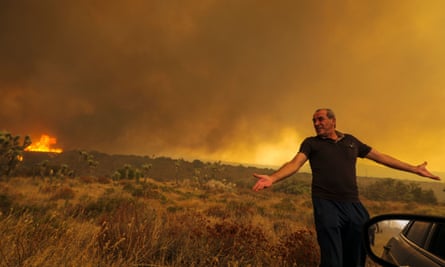
A frustrated Mike Gregoryan is asked to leave his home as Bobcat fire rages in Juniper Hills, Little Rock, California, earlier this month.

Record-breaking wildfires and hurricanes were just the most high-profile effects of global heating – and this is only the start

Last modified on Wed 30 Sep 2020 23.59 AEST

In a flurry of recent fires and storms, the climate crisis has left unmistakable wounds on America. Even in a tumultuous year not short of anguish elsewhere, scientists warn the climate-fueled disasters of 2020’s summer point to major shifts that will upend Americans’ lives like no other threat.

The American west has experienced its biggest year of fire on record, with blazes the collective size of Connecticut roaring across a tinderbox-dry landscape, consuming thousands of buildings, claiming several dozen lives and turning the Bay Area’s sky an eerie orange.

Meanwhile, the Atlantic has been so festooned with hurricanes – at one stage this month five storms were strung out across the ocean at once – that meteorologists exceeded their 21 English-language names for major storms and for only the second time had to turn to the Greek alphabet. Appropriately, the two phenomena met on 15 September, when wildfire smoke pouring across the country wafted into Paulette, yet another tropical storm, off the eastern seaboard.

Such events are consistent with a heating-up planet, according to scientists, with studies showing that hurricanes are becoming stronger as ocean waters warm up and the atmosphere holds more water vapor. In the west, prolonged, intense heat – perhaps the hottest atmospheric temperature ever recorded on Earth occurred in California in August – has dried out forests and soils, making them more susceptible to huge conflagrations.

Add in the floods that have soaked swaths of the midwest and the Arctic sea ice that just shrank to its second lowest extent on record and it’s clear climate impacts are now piling upon America in multiples.

“The changes from greenhouse gas emissions on the Earth’s climate system ain’t pretty and they do not come alone,” said Camilo Mora, an environmental scientist at the University of Hawaii and lead author of research that found climatic extremes are causing 400 different types of impacts upon humanity.

These threats are making people “unhealthy, thirsty, poor and homeless”, Mora said. “Climate change is like a horror movie with 400 endings to choose from.”

The different consequences of global heating, through the burning of fossil fuels, can overlap and trigger further damage. For instance, researchers have found that the combination of severe heatwaves and drought, once a rare amalgam, is becoming increasingly common in the US west, escalating the risk of wildfire and water shortages.

These connected threats will stress all aspects of US society, from transport to healthcare to community livability, researchers say. If emissions aren’t tamed, 13 million Americans face being displaced by sea level rise, US economy activity could plunge by half a trillion dollars a year and scorching heatwaves could make parts of the US south-west barely livable without day-long air conditioning.

“All of the systems that society depends on were designed to function in the climate of the past,” said Amy Snover, a climate scientist at the University of Washington who recently sealed herself inside her Seattle home for 11 days because the wildfire smoke outside was too toxic to breathe.

Snover added: “But we no longer live in the climate of the past. The climate disruption brought by warming, changes in precipitation, changes in storms and changes in sea level is destabilizing the foundation of all these systems at once.”

Millions of Americans are now being affected, to some degree, by climate breakdown but the consequences are landing most heavily upon people of color and those without the means to easily recover from losses.

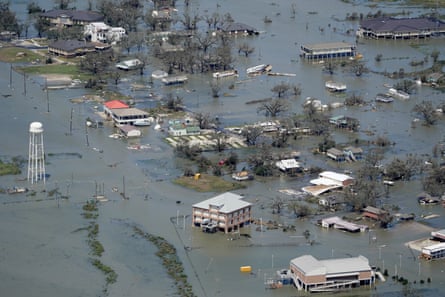
In August, when Hurricane Laura became the strongest storm to ever crunch into Louisiana, Rebekah Winstead quickly threw some mementoes and documents into a duffel bag and fled her trailer park home in Lake Charles with her three-year-old son.

Terrified, Winstead drove for 10 hours overnight to stay with her sister-in-law’s parents in Atlanta, where she “stayed up watching the storm camera, seeing the whole city of Lake Charles being destroyed”. A few days after the storm passed, Winstead and her husband surveyed their ruined trailer, wrenched from its foundations. Debris has since been washed down the street from floods caused by another storm, called Beta – the ninth storm to make landfall in the US this year.

“We lost most of our things, the windows were smashed, there was mold inside,” Winstead said. “It’s not livable, which is devastating. My son keeps asking to go home but we can’t. It’s heartbreaking to see your town completely demolished.”

Buildings and homes are flooded in the aftermath of Hurricane Laura near Lake Charles, Louisiana.

Buildings and homes are flooded in the aftermath of Hurricane Laura near Lake Charles, Louisiana. Photograph: David J Phillip/AP

Winstead’s home wasn’t insured but she hopes the family will be able to save enough for a new place further north, beyond the reach of hurricanes. “We’ve talked a lot about moving out of Louisiana completely because I don’t want to ever do this again,” she said. “I never thought at 27 I’d be married with a three-year-old and homeless. But there are a lot of people in our position, wanting to up and leave.”

The wildfires have also sent people reeling, leaving them unsure as to how they will piece their lives back together. In southern Oregon, fires burned down more than 2,500 housing units in the cities of Talent and Phoenix, many of them in trailer parks, causing concerns over a housing crisis for those displaced.

“The level of destruction in our small towns is devastating. People had to flee their homes with little to no notice,” said Sarah Westover, a Phoenix city councilor. “This is what climate disaster looks like and we are not prepared for the fallout.”

Americans will have to absorb heavier and heavier blows as the climate crisis intensifies. Rather than a new but stable normal, the disasters of 2020 are merely a rung on a climatic ladder that hasn’t been fully climbed yet. “Don’t think of it as the warmest month of August in California in the last century,” said Cristi Proistosescu, an atmospheric scientist at the University of Illinois. “Think of it as one of the coolest months of August in California in the next century.”

The dawdling response to the climate crisis means cascading changes are now baked into the system. The wildfire smoke that has blanketed the west is set to become a norm that may require mask-wearing outdoors long after the Covid-19 pandemic while, as researchers reported last week, 2.5 metres of global sea level rise from the melting of the Antarctic is now virtually guaranteed even if emissions are rapidly cut. “We will be renowned in future as the people who flooded New York City,” said Anders Levermann, co-author of the paper.

“What we see today is nothing by comparison to what is coming our way,” said Mora. “Basically, take what we see today and multiply it by two or three. I wish I could be more positive, but the evidence is overwhelming that nothing good can come from us producing more CO2.”

Australian government cites 'chilling effect' on cabinet in bid to block release of papers in Timor-Leste spy case.

Extract from The Guardian

Australian Capital Territory

Attorney general’s lawyers say they should not have to provide the documents, including briefing for prime minister, because it is not in public interest.

Bernard Collaery outside the ACT supreme court last year
Bernard Collaery outside the ACT supreme court last year. Protesters gathered outside the court on Wednesday in support of Collaery and Witness K in the Timor-Leste spying case.

Last modified on Wed 30 Sep 2020 16.57 AEST

Government lawyers have invoked cabinet confidence in an attempt to stop Bernard Collaery and his team from viewing a briefing to the prime minister relevant to the Timor-Leste spying case.

Collaery, a barrister and former ACT attorney general, has been charged over his role in exposing details of a 2004 Australian intelligence operation to bug the Timor-Leste government during commercial negotiations to carve up oil and gas resources in the Timor Sea.

It is alleged that Collaery, while representing intelligence whistleblower Witness K, illegally shared protected information about the operation.

Collaery faces jail time if found guilty. The case, still in its pre-trial stages, continues to wind its way through the ACT supreme court.

Protesters gathered outside the court on Wednesday in support of Collaery and Witness K. They were singing and brandishing placards praising the pair as whistleblowers and heroes.

Inside, an argument was heard over Collaery’s attempt to obtain five documents – all briefings to departmental secretaries and ministers – from the Australian government. Little detail was given in open court about the nature of the internal government briefings Collaery is seeking including when they were written.

One of the documents is a briefing to the prime minister ahead of a meeting of the powerful national security committee of cabinet.

Another was a briefing prepared for the head of the attorney general’s department ahead of a meeting of a group of other departmental secretaries involved in national security, known as the secretaries committee on national security

Lawyers acting for the attorney general, Christian Porter, argued they should be immune from providing the documents because it was not in the public interest for them to be produced. Producing the documents would breach cabinet confidence and compromise future deliberations, the government argued.

Anna Mitchelmore SC said handing over the documents would have a “particularly chilling effect” on cabinet deliberations, given the nature of the case and the fact that future cabinet deliberations may take place on related issues.

The government’s public interest immunity claim put Collaery and his team in a difficult position, the court heard. It requires them to demonstrate the documents are highly relevant to the case without having ever seen them.

But Collaery’s barrister, Christopher Ward SC, said the documents were clearly removed from cabinet deliberations and were needed for the proper administration of justice. “They are a very long way removed … from the deliberations of cabinet,” he said.

Some were merely background briefings for departmental secretaries ahead of meetings with other departmental secretaries, Ward argued.

The fact that similar issues were later discussed in cabinet meetings did not mean the briefings suddenly revealed cabinet deliberations.

“Nothing that is sought is a declaration that does directly reveal cabinet deliberations,” Collaery’s barrister said. “Not one of these documents are cabinet documents in the classic sense of the word.”

Ward said parts of the documents could be redacted, if necessary, and urged justice David Mossop to view the briefings himself.

Part of the proceedings were closed to the public to allow Ward to further argue his case. Mossop reserved his decision.