Thursday, 30 May 2019

Robert Mueller breaks silence to insist he did not exonerate Trump

Robert Mueller gives first public statement on Trump-Russia investigation – video
Robert Mueller, the special counsel, on Wednesday reignited demands for Donald Trump’s impeachment by breaking his two-year silence to deny that the US president is innocent of a crime.
In a sudden and dramatic turn, Mueller, whose report on Russian election interference and Trump campaign links to Moscow was published last month, delivered a sombre nine-minute statement that many construed as a signal to Congress to act on his finding that Trump sought to obstruct justice.
“If we had confidence that the president clearly did not commit a crime, we would have said that,” Mueller said from a podium at the justice department in his first public remarks since the investigation began. “We did not, however, make a determination as to whether the president did commit a crime.”
Mueller explained that his decision was based on longstanding justice department policy, rather than lack of evidence.
“A president cannot be charged with a federal crime while he is in office,” he said. “That is unconstitutional. Even if the charge is kept under seal and hidden from public view – that too is prohibited.”
The special counsel’s 448-page report did not establish a criminal conspiracy between the Trump election campaign and Russia. It did identify 10 incidents in which the president attempted to obstruct justice, for example by firing the director of the FBI, though it stopped short of charging the president with a crime.
His statement on Wednesday contradicted Trump’s claims that Mueller’s report awarded him “total exoneration” and also William Barr’s bald assertion last month that Mueller’s decision was not based on justice department policy.
Mueller explained: “The special counsel’s office is part of the Department of Justice and, by regulation, it was bound by that department policy. Charging the president with a crime was therefore not an option we could consider.”
Less than half an hour later, Trump tweeted in response: “Nothing changes from the Mueller report. There was insufficient evidence and therefore, in our country, a person is innocent. The case is closed! Thank you.”

"If we had confidence that the president clearly did not commit a crime, we would have said that"
But others interpreted Mueller’s intervention as a not-so-subtle message that, while his hands had been tied by department policy, Congress’s are not. Calls for Trump’s impeachment, circulating for weeks, rapidly turned into a clamour, with several Democratic candidates for president leading the way.
Senator Cory Booker of New Jersey said: “We have one remaining path to ensure justice is served. It is our legal and moral obligation to hold those who have committed crimes accountable. It’s clear that the House must begin impeachment proceedings. No one is above the law.”
Senator Kamala Harris of California tweeted: “What Robert Mueller basically did was return an impeachment referral. Now it is up to Congress to hold this president accountable. We need to start impeachment proceedings. It’s our constitutional obligation.”
Mueller’s statement was “an impeachment referral, and it’s up to Congress to act,” Senator Elizabeth Warren of Massachusetts tweeted.
And Beto O’Rourke, another Democratic presidential contender, added: “There must be consequences, accountability, and justice. The only way to ensure that is to begin impeachment proceedings.”
But first the burden lies with the House of Representatives, where the judiciary committee is leading oversight efforts. Its chairman, Democrat Jerry Nadler, stopped short of urging impeachment or calling for Mueller to testify.
He said: “Given that Mueller was unable to pursue criminal charges against the president, it falls to Congress to respond to the crimes, lies and other wrongdoing of President Trump – and we will do so. No one, not even the president of the United States, is above the law.”
The House speaker, Nancy Pelosi, has so far resisted calls for impeachment, a difficult strategic calculation. If passed by the Democratic majority in the House, it would almost certainly fail in the Republican-controlled Senate, leaving Trump in office and possibly strengthened going into next year’s presidential election.

Trump returns to the White House after his trip to Japan. He tweeted on Wednesday: ‘The case is closed! Thank you.’
Trump returns to the White House after his trip to Japan. He tweeted on Wednesday: ‘The case is closed! Thank you.’ Photograph: Mandel Ngan/AFP/Getty Images
Pelosi said on Wednesday: “The Congress will continue to investigate and legislate to protect our elections and secure our democracy. The American people must have the truth.”
For their part, Republicans were mostly silent, suggesting that Mueller’s intervention had changed nothing about their support for the president.
Lindsey Graham, the Republican chairman of the Senate judiciary committee, said: “Today’s statement by Mr Mueller reinforces the findings of his report. And as for me, the case is over. Mr Mueller has decided to move on and let the report speak for itself. Congress should follow his lead.”
But one House Republican has recently defied the party line to emerge as an outspoken critic of the president. Justin Amash, from Michigan, tweeted: “The ball is in our court, Congress.”
Democrats in the House, whose subpoenas are being resisted by the White House, are pushing for Mueller to testify in person. On Wednesday Mueller made clear he has little desire to appear and, if obliged, he will have nothing to add to what is already stated in his report.
“We chose those words carefully, and the work speaks for itself,” he said gravely. “The report is my testimony. I would not provide information beyond that which is already public in any appearance before Congress.”
Mueller, who is closing his special counsel office, also defended the FBI and the integrity of the investigation, which have been under constant assault from the president and his rightwing allies.
And he emphasised that the first volume of his report, which details Russia’s attack on American democracy, deserves urgent attention despite the Washington’s partisan firestorms and Trump’s repeated attempts to ignore it or play it down.

“There were multiple, systematic efforts to interfere in our election,” he said, “and that allegation deserves the attention of every American.”

Wednesday, 29 May 2019

Australia to achieve 50% renewables by 2030 without government intervention, analysis finds

Extract from The Guardian

RepuTex modelling suggests surge in state schemes and rooftop solar will reduce wholesale prices, making gas- and coal-fired power less competitive
Australia is on track to achieve 50% renewable electricity by 2030 even without new federal energy policies, according to modelling by the energy analysts RepuTex.
The analysis, to be released on Wednesday, suggests that a surge in renewable energy driven by state schemes and rooftop solar installations will reduce wholesale prices from $85 per MWh to $70 over the next three years.
Lower prices will make gas- and coal-fired power less competitive, even without a market mechanism to make fossil fuels reflect the cost of pollution or a direct constraint on emissions, although a lack of federal policy could lead to longer-term price rises, RepuTex found.
During the election campaign, the Coalition attacked Labor for its 50% renewable energy target – as well as its 45% emissions reduction target – claiming they would harm energy-intensive industries and cost jobs.
But after the Coalition won on 18 May, the Liberal senator Arthur Sinodinos urged the government to use the changing energy mix to bolster its environmental credentials, and treasurer Josh Frydenberg declared that the “inevitable” transition to low-emissions sources created an opportunity for the country.
With the federal renewable energy target set to expire in 2020, RepuTex noted that state policy was now the dominant signal for new investment in the national energy market.
RepuTex projected that current policies, including renewable energy targets in Queensland and Victoria, were likely to drive about 13GW of new renewable energy capacity by 2030, in addition to 6GW of renewable capacity currently committed for development.
The head of research at RepuTex, Bret Harper, said the 6GW of renewable capacity to be installed by the end of 2020 “should begin to reduce the role of marginal gas-fired generation in the market, leading to lower wholesale prices”.

"Without a plan to prepare for the exit of fossil fuel generation we forecast a return to a boom-bust investment cycle"
“The competitive pressure of new low-cost supply is modelled to significantly limit demand for coal-fired energy, even without a direct emission constraint,” he said.
“As a result, fossil fuel generation is modelled to be more broadly on the decline, displaced by a large volume of solar, wind and pumped hydro.”
RepuTex noted that the absence of a federal energy policy framework could force wholesale prices back up to $100 per MWh in the long term as ageing coal-fired generators are forced to close, reducing supply.
“The low price environment over the medium term is good for consumers, but not so good for inflexible generators, which will be at risk of being pushed out of the market by cheaper, more flexible technologies like wind and solar with pumped hydro,” Harper said.
“Without a plan to prepare for the exit of fossil fuel generation we forecast a return to a boom-bust investment cycle, with elevated wholesale prices and increased volatility, rather than a more orderly transition.”
The Coalition’s strong results in Queensland have emboldened conservatives who before the election demanded Scott Morrison examine whether a new coal-fired plant was needed in north Queensland and sign off on a shortlist for the electricity underwriting scheme that includes “one very small” coal project in New South Wales proposed by the coal baron and LNP donor Trevor St Baker.
The Coalition began 2019 by trying to bolster its climate credentials with a $2bn cash injection to the emissions reduction fund and government support for the “battery of the nation” project in Tasmania.

But a feasibility study for the Tasmanian interconnector proposal states the benefits are greater “when approximately 7,000MW of the national electricity market’s present coal-fired generation capacity retires”.

Tuesday, 28 May 2019

Australia isn't doing its part for the global climate. Sooner or later we’ll have to pay our share

But the cost of responding to climate change is trivial compared with the benefits
As the Australian election approached, the UK parliament declared a national climate emergency. Perhaps, with a different electoral outcome, Australia would have followed suit. Instead, at least for the next three years, we will ignore the emergency while chasing the mirage of coalmines promising to create thousands of jobs.
That mirage began to fade almost immediately with the announcement that the China Stone project, right next to Adani’s Carmichael mine project in the Galilee Basin, had suspended its bid for mining leases. Other projects in the basin have been on hold for years.
The prospects for the Carmichael mine are not much better, at least in the absence of a large injection of public money (which may now be on the cards). Adani announced in November that it would provide $2bn of its own money to fund the project. Gautam Adani could afford to spend this much if he chose to do so, but has so far shown no sign of willingness to pour such a large proportion of his personal wealth into an obvious dud. Such announcements have been made before and nothing has happened.
The coal boom of the last decade will fade away, whatever Australian governments do. By contrast, the climate emergency is not going away and will force itself on our attention sooner or later. When it does, we will face the need to reduce our emissions rapidly and to levels well below the very soft target the current government has set itself.
To match the commitments of comparable countries, Australia would need to cut emissions in 2030 by at least 40% relative to 2005. Moreover, a central point of the Paris agreement in 2015 was recognition that these initial commitments were inadequate and would need to be ratcheted up over subsequent rounds of negotiation. By the time we return our attention to the climate crisis, we will be facing a policy emergency.
Emergencies are costly. Problems that could have been addressed efficiently at low cost over a number of years turn into crises that must be addressed immediately with whatever measures are available. A few examples illustrate the point.
The first step in any serious program of emissions reduction is the transition away from coal-fired electricity generation. If we had implemented Kevin Rudd’s carbon pollution reduction scheme in 2012, or maintained the Gillard government’s carbon price, or even adopted the clean energy target proposed by the Finkel review in 2017 we would, like other developed countries, be on the road to coal-free electricity. The UK, which relied on coal for 50% of its electricity in the early 1990s, introduced emissions trading in 2002, and is now within a few years of eliminating coal-fired power altogether.
As things stand, however, Australia will be faced with the necessity of making the same transition over a period of perhaps five to 10 years. That will entail massive investment in solar PV, storage and wind, totalling perhaps $100bn. Given the uncertain environment created by decades of policy reversals, governments will need either to undertake this investment directly or provide long-term guarantees.
At the same time, the existing coal fleet will need to be closed down as rapidly as possible. Any investment in new or refurbished plants financed by the current government will be entirely wasted.
The story is similar with respect to transport. In 2014 the Climate Change Authority (of which I was then a member) proposed a light vehicle fuel-efficiency standards which would have saved motorists money over the life of a vehicle, while substantially reducing emissions. More recently, the emergence of electric vehicles has provided new opportunities for decarbonisation. The current government rejected the fuel-efficiency scheme and has derided electric vehicles – supposedly it might have an electric vehicles policy by mid-2020.
The result of this delay is that when we get serious about the climate emergency, we will have a large fleet of some of the world’s most fuel-inefficient cars, many of them nearly new. The efficient option of providing subsidies for electric vehicles, as Norway has done, will be too slow to achieve the necessary reduction in emissions.
So we will be forced to adopt some form of “cash for clunkers” scheme, in which people are paid to scrap old, inefficient vehicles. This was a terrible idea when it was proposed by Julia Gillard as an alternative to the carbon price she had promised would never be introduced and was promptly scrapped once the 2010 election produced such a price. But by the time we start taking action, it will be one of the few options capable of producing the rapid shift we will need.
Extending this analysis across the economy, it’s clear that emergency measures to reduce emissions will be very costly, compared with the efficient measures we could have adopted with a bipartisan commitment.
That’s the bad news. The good news is that the cost of an emergency response, while large compared with an efficient policy, will be very small in relation to an economy with an annual output, by 2030, of $2tn a year or more. To see this, we can turn to the estimates prepared for the government’s election campaign by Brian Fisher of BAEconomics.
These worst-case numbers, higher than the costs of the most radical emergency measures, amount to around $50bn a year, or 2.5% to 3% of national income. That’s a lot of money – like adding a new program on the scale of the NBN or the submarine contract every year for five to 10 years.
At the same time, it’s small enough that it would barely be noticed against the background of the general fluctuations in the economy. The average household has lost far more from the wage stagnation of the last decade. As far as the government budget is concerned, the likely impact is comparable to that of increasing health expenditures arising from our increased life expectancy and the development of new treatments.
More importantly, the cost of an emergency response to climate change is trivial compared with the benefits of stabilising the global climate at a level that is livable for humans and the natural environment. We are currently shirking our contribution to this global public good, and free riding on the efforts of others. But sooner or later we will have to pay our share.

John Quiggin is professor of economics at the University of Queensland. His latest book, Economics in Two Lessons, was recently released by Princeton University Press

Anthony Albanese to travel to Queensland on first day as Labor leader

Opposition leader pledges to reconnect with voters after Labor’s catastrophic election showing in seats across the state
Anthony Albanese will use his first day as opposition leader to travel to Queensland, pledging to reconnect with voters who turned away from the party and position Labor for victory in three years’ time.
The first-order visit to Queensland comes as the party’s likely new deputy, Richard Marles, admitted he was “tone deaf” to the concerns of coal workers in the state after he suggested the demise of the industry was positive for the country.
Albanese, who was confirmed as leader uncontested on Monday, will visit the seat of Longman, north of Brisbane, where Labor suffered a 4.1% swing against incumbent Susan Lamb.
It was one of a swathe of seats in the state that saw huge swings against Labor, leaving the party holding just six of Queensland’s 30 electorates.
Albanese, who was coy when asked about his position on the divisive Adani coalmine, said that he would travel to the state to hear directly from voters about their concerns.
“One of the things I will be doing … is visiting Queensland, to talk to people about some of the issues that might arise there,” he said. “I intend also to listen, not just talk.
“The old saying, and I quoted it the other day – ‘I think that we have two ears and one mouth for a reason’ – is a philosophy that I intend to put in place. We should listen more than we talk and it’s up to a leader to listen to all those people around them.”
But when asked if he supported the Adani coalmine – a key economic priority for people in central and northern Queensland that was seen as a crucial election issue – Albanese equivocated.
“We will go through, in terms of our processes, all of those issues,” he said. “But the truth is that the Adani coalmine has been approved at the federal level by the EPBC Act. It’s been approved not just once, it’s been approved twice. It is going through Queensland government approvals and then there is the other issue with regard to Adani, and indeed to the whole issue of the Galilee coal basin, the issue of the economics of it, the basic cost-benefit ratios.”
Marles, who in February welcomed the transition away from coal, said on Monday that he regretted the remarks.
“The comments I made earlier this year were tone deaf and I regret them and I was apologising for them within a couple of days of making them, and partly why they were tone deaf is because it failed to acknowledge the significance of every person’s job,” Marles said.
“Coal clearly is going to play a significant part of the future energy mix in Australia, and it’s clearly going to be a significant part of our economy and it’s really important that we acknowledge that people who work in the coal industry need to be valued by us and that we thank and celebrate their work.”
In February, when asked about the coal industry, Marles told Sky: “The global market for thermal coal has collapsed, and at one level that’s a good thing because what that implies is the world is acting in relation to climate change.”
Marles came under fire for the remarks, with state Labor MPs Julieanne Gilbert and Barry O’Rourke saying his views were “radically out-of-touch” with workers in the state.
Albanese’s decision to prioritise a visit to the state was welcomed by Queensland frontbencher Shayne Neumann who said the party could not form government if it ignored the concerns of regional areas.

“Labor cannot think you can give away 20 seats to the LNP every election and think we are going to win government,” Neumann said.

Malaysia's last Sumatran male rhino dies, dashing hopes to save the species in the country

    Updated about an hour ago


    Malaysia's last male Sumatran rhinoceros has died, dashing efforts to save the critically endangered species in the country.

    Key points:

    • Iman, a female captured in 2014, is now the only rhino of her kind left in Malaysia
    • Wildlife experts estimate that only about 30 to 80 Sumatran rhinos remain in the world
    • Genetic material has been preserved for future attempts to reproduce Sumatran rhinos

    The rhino, named Tam, was about 30 years old and lived at a wildlife reserve in Sabah state on Borneo island since his capture in 2008, Christina Liew, state minister for tourism, culture and environment, said in a statement.
    The Sumatran rhino, the smallest species of rhinoceros, was declared extinct in the wild in Malaysia in 2015.
    Iman, a female captured in 2014, is now the only surviving member of the subspecies left in the country.
    Another female rhino, Puntung, died in captivity in 2017.

    Wildlife experts estimate that only about 30 to 80 Sumatran rhinos remain in the world, mostly on the Indonesian island of Sumatra and on the Indonesian side of Borneo.
    Their isolation, caused by habitat loss and poaching, means they rarely breed and may go extinct in a matter of decades, according to conservation group International Rhino Foundation.
    Since 2011, Malaysia has tried to breed the species in captivity through in vitro fertilisation, but without success.
    Ms Liew said Tam's genetic material has been preserved for future attempts to reproduce Sumatran rhinos.
    A United Nations report released earlier this month warned that 1 million of the world's species are under threat of extinction.
    World Wildlife Fund (WWF) Malaysia paid tribute to the last male of its kind in the country on Facebook.
    "Our hearts are filled with sadness as we mourn not only the loss of wildlife, but the loss of a species," WWF wrote.
    "With Tam gone, we now only have Iman left, our last female rhino.
    "If we are not careful, the Sumatran rhino will not be the only species that will go extinct under our watch."
    In a Facebook post from 2015, WWF Malaysia said the Sumatran rhino used to inhabit forests across South and South East Asia, but its population "has drastically shrunk due to forest habitat loss and killing for its horn".
    "The demand for rhino horn stems from the common yet misguided belief that it harbours medicinal properties," they wrote.
    Reuters

    Monday, 27 May 2019

    It's a myth that Aussie battlers handed the Coalition its election victory

    Extract from The Guardian

    Data shows most high-income business owners vote for the Coalition and most lower-income workers vote for Labor
    Battlers. The working class. Ordinary voters. Since the Australian federal election, there have been claims these voters abandoned Labor for the Liberal-National Coalition. Similar to the idea of “Howard’s battlers”, commentators have asserted that Labor has become the party of wealthy inner-city elites, while the Coalition has become the party of “quiet Aussies”.
    Much of the commentary is starting to develop an argument along the lines that Scott Morrison’s daggy suburban dad charm beat out the parties of the left – which have been portrayed by some as representing inner-city elites – for the support of struggling workers employed in manufacturing and retail.
    However, the reality of this election was very different. The Coalition remains disproportionately the party of high-income business owners and the Labor party lower-income workers, the disabled and low-income parents.
    Many of these claims are based on confusion between aggregate movements in vote choice and the behaviour of individuals. They find that electorates with lower than average incomes, lower levels of education, and more renters, moved towards the Coalition. Besides linking (often small) swings with overall levels of support, they are also committing ecological fallacies.
    All this data tells us is that electorates with these characteristics swung towards the Coalition. You cannot make inferences about individuals from aggregate data.
    For instance, imagine a hypothetical electorate that is 60% working class and 40% middle class, and was won by the Coalition. Based on their recent performance, some commentators would claim this signifies that the Coalition was supported by the working class. This is not necessarily so. If it won 75% of the middle-class vote, the Coalition could win this seat with the support of less than 40% of the working class in the electorate.
    To properly understand how individual voters behave, we cannot rely on aggregate data alone. We need micro data, information on individuals. This is available. We can test whether elites or battlers supported the Coalition or Labor using data collected through the Cooperative Australian Election Survey, which asked 10,000 voters a series of questions over three weeks of the election campaign. Using this data, I look at two measures of elite and battlers status: whether a voter owns their own businesses or a private trust, and whether a voter is on a disability pension. I combine both of these measures with household income to get an idea of how advantaged a voter is. The results indicate that the commentary on the Coalition’s status as the party of the battler may be mistaken.
    A meaningful analysis of class has nothing to do with the colour of someone’s collar, their accent or education, but rather their access to resources and relationship with capital. The other things are usually more a symptom rather than cause of class.
    A high-income, self-employed plumber is not working class. They are a capitalist. This is not a pejorative. They own capital (their business) and profit off their own and (potentially) their employees’ labour. They do not necessarily have identical economic interests as a low-income plumber who is an employee, working for someone else and being paid a wage.
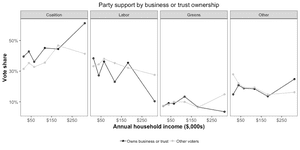
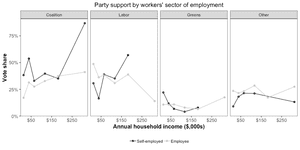
    While the Coalition received some of its highest support from those earning $208,000 or more who own a business or trust (approximately 60% of whom gave the Liberal-National parties their first preference in 2019), among those who could be better described as working class the picture was very different.
    Yes, some blue-collar workers voted for the Coalition, they always do. However, the working class – voters who work in blue-collar jobs, or sales and services, with lower to middle incomes, and who are employees – were not an especially Coalition-friendly group. About 25% of those with average to lower earnings (with household incomes below $78,000 per year) supported the Liberal and National parties with their first-preference votes. Conversely, about half of those with the lowest incomes (below $26,000 a year) voted Labor.
    It was only the self-employed in blue collar, and sales and service occupations, with incomes above $208,000 a year who overwhelmingly voted for the Coalition. These voters can hardly be called battlers, working class or even ordinary citizens.
    Party support by business or trust ownership
    Photograph: Cooperative Australian Election Survey, 2019.
    Party support by workers' sector of employment
    Photograph: Cooperative Australian Election Survey, 2019.

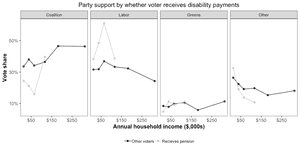
    Similarly, around half or more of voters who received both family tax benefits and a parenting payment and had household incomes below $26,000 voted Labor, while almost none voted Coalition (although the sample sizes for this analysis are a little small, so must be treated with caution).
    Party support by whether voter receives disability payments
    Photograph: Cooperative Australian Election Survey, 2019.

    What this means

    We need to be careful how we use data to understand election results.
    While electorates with certain characteristics (lower incomes, lower levels of education, more renters) swung towards the Coalition, we cannot make inferences about individuals from aggregate, electorate-level data. Claims that a particular group swung to or from Labor based on this data are wrong.
    Contrary to the narrative forming around this election – that the Coalition has become the party of workers, ordinary Australians or battlers – according to data collected on individual voters during the campaign, its strongest supporters remain high-income business owners. Workers, the disabled and parents on low incomes receiving federal government payments are all more likely to support Labor.
    • Shaun Ratcliff is a lecturer in political science at the United States Studies Centre at the University of Sydney

    • About this data: The Cooperative Australian Election Survey, 2019 was coordinated by Dr Shaun Ratcliff and Professor Simon Jackman. It comprises a sample stratified by age, gender and state collected through the YouGov online panel. Through this study, 10,316 respondents were surveyed between 18 April and 12 May 2019. This data was weighted by age, gender, education, language spoken at home, and state.

    New Labor leader Anthony Albanese calls for end to climate wars

    Albanese also urges more people to join ALP saying it needs to be ‘larger and more inclusive’ to win elections
    Anthony Albanese has called for an end to the climate wars, saying he wants to work with Scott Morrison on an emissions reduction plan that benefits both the environment and the economy.
    After being confirmed as the party’s new leader on Monday morning, the senior leftwinger has also urged more people to join the Labor party, saying the movement needs to be “larger and more inclusive” to win an election in three years’ time.
    Arguing the opposition had many lessons to learn following its shock election defeat under Bill Shorten, Albanese said he believed that “conflict fatigue” was among the reasons the party had failed to convince voters of the need for change.
    “People want solutions, not arguments. They have conflict fatigue,” Albanese said.
    “I am a values politician, but I also say this to Scott Morrison – I’m not Tony Abbott.”
    Flagging his desire to see bipartisanship on the vexed issues of constitutional recognition for indigenous Australians and climate policy, Albanese said he was prepared to work with the Coalition to develop a consensus position on a national emissions reduction plan.
    “Let me say this unequivocally – the science is in, climate change is real, we must act,” Albanese said.
    “Action will create jobs, it will benefit our economy and it will benefit our environment.
    “The time for the ongoing conflict over these issues surely is over.”
    But while indicating he was prepared to cooperate on some policy areas, Albanese also pledged to “strongly, forcefully” hold the Morrison government to account.
    Albanese’s call for climate policy certainty comes as Labor’s shadow environment minister Tony Burke indicated the party could move away from its support of a direct market mechanism to tackle emissions reduction, suggesting Labor shift to a regulation and spending model, such as that being advocated by the Democrats in the US.
    Albanese said he was neither a “neither a climate sceptic, nor … a market sceptic”, saying he had consulted with business about the need for policy certainty.
    “They are crying out for certainty, and it is time that the government worked with the opposition to deliver that certainty going into the future.”
    Treasurer Josh Frydenberg has indicated the Coalition will pursue the climate policy it took to the election which centres on a $3.5bn emissions reduction fund.
    Pledging to work hard over the next three years to convince people of the need to vote Labor, Albanese acknowledged the party needed to do more to “reach out” to those who didn’t support either major party at the May 18 election, while conceding Labor had a “big mountain to climb” to form government.
    “I want to see a larger, more inclusive party, and the first thing I want to say to all those millions of Australians who were disappointed with our performance…(is) join up, get involved, make us stronger for the next challenge,” Albanese said.
    “I am up for a hard job. I am up for hard work.
    “I intend to do my best to work with the Australian people to ensure that we elect a Labor government next time.”
    Flaunting his credentials as a “consultative” leader with experience across a range of portfolios, Albanese said he believed Labor should be the natural party of government that embraced both economic and social policy reform.
    “We can’t judge the economy separate from the people it’s meant to serve,” Albanese said.
    “It’s not in my view economic or social policy - it’s both, hand in hand.”
    But he said he would “hasten slowly” on policy development after the party regrouped following last Saturday’s election defeat that has been widely blamed on the party’s expansive policy agenda.
    Albanese assumes the leadership uncontested after none of his potential rivals nominated for the role.
    His deputy is expected to be Victorian MP from the right faction, Richard Marles.
    The Labor caucus will meet on Thursday to endorse the positions and confirm the carve up of Albanese’s frontbench, with 16 positions to be allocated to the party’s Right faction, and 14 for Left-aligned MPs.
    Albanese’s leadership rivals Chris Bowen and Jim Chalmers – both from the Right – withdrew from contention last week.
    On Sunday Marles said the party faced a challenge to reconnect with the community after the election, which he called a “devastating” moment in the party’s history.
    “I think it’s really important that Labor is speaking to and connecting with the broadest range of the Australian community that we possibly can,” Marles said.
    “It matters that working Australians around the nation identify us as their party because that is the basis of the Labor party and we need to be making sure that we rebuild that.
    “We need to come back from what has been a very devastating moment in our history and regroup as quickly as we can so that we are as competitive as possible three years from now when the Australian people go to an election again, because I can tell you there are millions of Australians who want to see Labor put its best foot forward and provide a choice for them at the next election.”
    Victorian MP Clare O’Neil, who had considered running for deputy, said she believed Marles would be “brilliant” in the role, and rejected suggestions that the party was going backwards in terms of its female representation.
    Former deputy Tanya Plibersek can no longer hold the deputy’s position because she comes from the same NSW Left faction as Albanese. After initially expressing an interest in the leadership, Plibersek withdrew from the contest to make way for Albanese, citing family obligations.
    “The stars haven’t aligned on this occasion to put a woman in one of those two positions,” O’Neil said.

    “Let’s wait for a few days because I am pretty sure that when we step back from this, we will see a Labor party where women have got their rightful place around the shadow cabinet table.”