Contemporary politics,local and international current affairs, science, music and extracts from the Queensland Newspaper "THE WORKER" documenting the proud history of the Labour Movement.
MAHATMA GANDHI ~ Truth never damages a cause that is just.
Religious leaders call on PM to take action to avoid climate catastrophe – video
More than 150 religious leaders have called on Scott Morrison to
acknowledge the world faces a climate emergency and block all new coal
and gas projects, including Adani’s Carmichael mine.
In an open letter
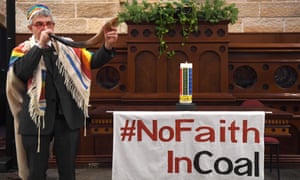
headed “no faith in coal”, the leaders say the climate crisis is a
profoundly moral problem and Australia’s response will be crucial in
addressing it.
“Simply put, opening up new coal reserves for mining is not
compatible with any global response to avoid catastrophe. We call on you
to show true moral leadership,” the letter says.
Signatories to the letter include bishops, rabbis, theologians, the
grand mufti of Australia and the heads of the Uniting Church, the
Federation of Australian Buddhist Councils, Muslims Australia and the
National Council of Churches.
It asks the prime minister to make the climate emergency his number
one priority and endorses the three demands of protesting school
students: stopping the Adani mine in central Queensland, not allowing
new coal or gas developments and moving Australia to run entirely on
renewable energy by 2030.
“Despite the differences in our faith, we all regard addressing the
climate emergency as our shared moral challenge. We stand together for
our common home, the Earth,” the letter says.
“Will you and your government have the courage to agree to this simple threefold agenda? We pray that you will.”
Rabbi Jonathan Keren-Black uses a rabbinical horn (shofar) to sound the end of the era of coal. Photograph: Dean Lewins/AAP
The
letter was organised by advocacy group the Australian Religious
Response to Climate Change. It concedes the shift will be challenging,
not least for people in communities reliant on fossil fuel industries,
but says a courageous leader would come up with a jobs plan based on
clean energy.
Loreto Sister Libby Rogerson said burning fossil fuels was worsening
extreme weather, crop failures and sea level rise. By continuing the
practice, Australia was moving further away from “loving God and God’s
creation and loving our neighbour”, she said.
“We have a sacred responsibility to care for the Earth and all living
beings, especially the vulnerable people on the frontlines,” she said.
The letter was published shortly after City of Sydney
became the latest jurisdiction to declare a climate emergency.
Councillors unanimously backed a motion by the lord mayor, Clover Moore,
on Monday warning the climate crisis poses a serious risk to
Sydneysiders.
Noting Australia’s greenhouse gas emissions have increased four years straight,
Moore called on the Morrison government to respond urgently by
reintroducing a price on carbon and establishing a body to help workers
in fossil fuel industries to transition to other jobs.
“Successive federal governments have shamefully presided over a
climate disaster, and now we are at a critical juncture,” she said.
Other cities to have declared a climate emergency include London,
Auckland and Vancouver. At a meeting in March, Australia’s capital city
mayors called for national action to adapt to the changing climate, including increasing storm severity, extreme heat, drought, floods and bushfire.
The government has rejected calls for additional policies to reduce
emissions, which began to rise after the Coalition repealed a carbon
price scheme in 2014.
In a speech to business leaders in Perth on Monday, which focused on reducing regulation, Morrison said: “We all agree you need to take action on climate change and we’re taking responsible and effective action.”
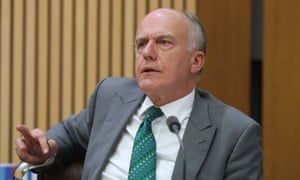
Senator Eric Abetz has not always felt the need to defend the ‘fundamental’ principle of free speech.
Photograph: Mike Bowers/The Guardian
The
modern conservatives often seem afraid of new technology. They act as
though renewable energy, battery storage and electric cars will take us
down the path to blackouts, economic ruin and, of course, the end of weekends as we know them.
But if recent history has taught us anything it’s that there is nothing
consistent about the modern conservatives, most of whom live in fear of
the unintended consequences of renewable power but warmly welcome the unexpected possibilities of nuclear power.
The same contradictions are obvious in agriculture. While spruiking
the virtues of genetic modification (GM) and the safety of glyphosate is
standard fare for the modern conservatives, not all agricultural
innovations are so warmly welcomed. While organic crops offer farmers
significantly higher returns, such farming practices are often dismissed
as “virtue signalling” rather than real farming. And when chickenless
chicken meat was launched on to the market recently (apparently it
tastes a bit like chicken), the National’s deputy leader, Bridget
McKenzie, responded by tweeting:
“Not happy with latest fake food push. Chicken-free chicken is not
chicken, it’s reconstituted peas. We need to protect our farmers.”
It is not clear whether McKenzie realises that, on the most recent UN data, Australia is the world’s largest exporter of chickpeas, or if she simply doesn’t care.
While the modern conservatives’ love of all things coal seems to
revolve around support for traditional coalmining jobs and fears around
renewable energy’s reliability, if you scratch the surface another rich
vein of hypocrisy can be found.
Despite the many column inches they dedicate to the obvious statement
that “the wind doesn’t always blow, and the sun doesn’t always shine”,
modern conservatives remain strategically silent about the fact that
so-called baseload coal-fired power stations are notoriously unreliable, especially on the hottest days when we need power most.
Similarly,
while their technophobia is on full display when talking about the
dangers of batteries for renewable energy storage or driverless electric
cars, perplexingly, the modern conservative seems relaxed and
comfortable when it comes to the fact that robot trucks and robot trains
are proliferating in the mining industry.
If conservatives were really concerned about creating jobs in regional
Australia, they would insist that none of the new coalmines they are so
keen to subsidise use any robot trucks or trains. But they aren’t, so
they won’t.
Of course, it’s not just technological change that the modern
conservatives seem confused about; the desirability of cultural change
really twists them in a knot too. Take “traditional family values” for
example. On the one hand, modern conservatives rage against the
“selfishness” of some parents for denying their children access to a
traditional mother and father. But at the same time they’ve created an
industrial relations system in which parents – traditional or otherwise –
struggle to spend time with their kids because they need to work split
shifts, weekends and other unsociable hours. Parents working in the gig
economy don’t get paid holiday leave to spend time with their children.
Indeed, our Pentecostal prime minister doesn’t even think work on
Sundays should be discouraged with penalty rates. While parliament never
sits on a Sunday, it seems our religious representatives still expect a
cheap coffee on the Sabbath.
And then there is freedom. Modern conservatives in Australia
are up in arms about Israel Folau’s freedom to say whatever it is he
wants to say about homosexuals. Eric Abetz – perhaps the loudest
conservative in the Liberal party since the voters of Warringah showed
Tony Abbot the door – declared:
“The fundamental point of the need to protect freedom of speech and
freedom of religion is in the DNA of every true Liberal and that is why I
am seeking to pursue it.”
But Senator Abetz has not always felt the need to defend this
“fundamental” principle of free speech. Back in 2014 when he was “public
service minister Eric Abetz”, a public servant working at the
Australian Taxation Office resigned after being disciplined for making derogatory comments
about conservative commentator Melinda Tankard Reist. Commenting on the
case, Abetz said this employee’s departure should act as a lesson for
the nation’s 165,000 federal public servants and their use of Twitter
and other social media. He then went on to state:
“APS employees need to ensure that they understand the APS values and
code of conduct and how they apply to the official and unofficial
communications.”
Abetz’s inconsistent indifference to the obligations of employees to
follow their employer’s codes of conduct makes clear that the
fundamental principle motivating him has more to do with protecting
fellow Christians than support for freedom of expression.
Of course, it’s not just conservatives who get caught up in the
contradictions of modern politics. There are plenty of environmentalists
who rely heavily on the CSIRO’s climate science but publicly question
the reliability of its GM science. Likewise, there will be more than a
few people cheering on GoFundMe’s decision to end Folau’s campaign who were outraged at the thought that a baker might refuse to sell a wedding cake to a gay couple.
So, what’s going on? Do modern conservatives like new technology or
fear it? Do they like freedom of speech or don’t they? And if both
conservatives and progressives are capable of inconsistency when it
comes to their principles, is there any point (or hope) in having
rational debate anymore? I think there is.
While the word “ideology” gets thrown around more than it used to,
the fact is, ideology is less important than it has ever been. These
days, so-called free market ideologues in the Liberal party
love to subsidise coalmines while tying unions and charities up in the
red tape that they claim to hate. So-called socialists in the Greens
want to use market-based mechanisms to reduce greenhouse gas emissions.
The problem isn’t the policy positions of the “free-marketeers” or the
“socialists” – it’s the increasingly meaningless labels that are being
used.
Modern conservatives don’t fear technology, they oppose new
technologies that harm their friends. Put simply: renewable energy is a
threat to the mining industry, but robot trucks and trains will boost
the profits of the mining industry.
Modern conservatives don’t fear social change. They oppose social
change that undermines the power of institutions that they like, such as
the church, and they embrace social change like the gig economy because
it undermines the power of institutions they fear, like the unions.
It’s no longer ideologies that defines and divides Australian politics,
but interests. While the philosophical positions adopted by political
parties might be all over the shop, the interests they support remain
remarkably stable. The right tend to line up behind wealth, power and
the establishment, and the left fire up to support new industries that
solve new problems, and to protect marginalised groups from established
institutions. There’s nothing wrong with such demarcations, but they
have less and less to do with ideology. • Richard Denniss is chief economist at the Australia Institute
Three of the nation's media bosses are demanding
greater protections for whistleblowers and journalists, in a rare show
of public unity prompted by recent police raids.
Key points:
Executives from the ABC, Nine and News Corp will demand greater protections for the media and whistleblowers
The calls are prompted by the AFP raids on journalists over two separate stories based on leaked information
The ABC and News Corp are launching court challenges against the search warrants
Last month, the Australian Federal Police (AFP) searched the home of News Corp political journalist Annika Smethurst and the ABC's Sydney headquarters, over two separate stories based on the leaks of highly classified information.
In the days after the raids, Prime Minister Scott Morrison said he understood the concerns from the media and the public
about the way the situation had been handled, and suggested there could
be a discussion on how to protect the work of the press and those who
provide information that is in the public interest to be published.
Few
incidents have brought the media together in such a way, and the
National Press Club (NPC) in Canberra will today play host to executives
from the ABC, Nine and News Corp in a debate about the freedom of the
fourth estate.
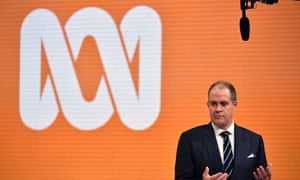
ABC managing director David Anderson will tell the
NPC he is heartened to hear members of the Government suggest a free
media is a "foundation stone of democracy", but argues the law does not
adequately reflect those ideals.
"Decriminalising journalism is a mandatory first step," he will say.
"The Criminal Code and the Defence Act both make it an offence for reporters to receive certain types of information.
"No-one deserves to be punished for doing their job and pursuing information that is clearly in the public interest."
The ABC is taking the AFP to the Federal Court, challenging the search warrant relating to the Afghan Files investigation published in 2017.
News Corp is taking its legal fight straight to the High Court, arguing the raids on its reporter's home over her story on plans to expand the powers of the nation's intelligence agencies breach the constitution's implied right of political communication.
The company's executive chairman, Michael Miller, argues there is a strong need to "protect the public's right to know".
"We
demand the right to contest any kind of search warrant on journalists
or news organisations before the warrant is issued," Mr Miller is
expected to tell the NPC.
"Public sector whistleblowers must be adequately protected and the current laws need to change.
"We need a new regime that limits which documents can be stamped 'Secret'."
Miller
is demanding a review of freedom of information laws, and says
journalists should be exempted from the last seven years' worth of
national security laws "that put can put them in jail for just doing
their jobs".
Bad legislation and overzealous officials hampering media: Marks
"As a society, we shouldn't fear truth. We shouldn't fear debate. We shouldn't fear opinions," he is expected to say.
"We
are operating at a time when a combination of factors — including
technological change, bad legislation across several fronts and
overzealous officials in the judiciary, bureaucracy and security
services — have steadily eroded the freedom within which we the press
can operate.
"Doing what journos do best is never
easy. Breaking big stories and conducting major investigations that
serve the greater good is tough, relentless work. But work rendered
increasingly difficult by the myriad of hurdles I've mentioned."
However,
Marks will tell the NPC that there is a balancing act when it comes to
national security, and warn that journalists may have to put such
interests "before their desire to publish or broadcast". The National Press Club will be live on the ABC News Channel from 12:30pm AEST on Wednesday.
ABC managing director David Anderson wants to stop paying Foxtel
retransmission fees as he seeks savings of $14.6m in the next financial
year.
Photograph: Joel Carrett/AAP
The ABC’s tight budget may lead to Foxtel losing $4m a year as the national broadcaster pushes to sever a costly retransmission deal with the News Corp pay TV platform.
The managing director of the ABC, David Anderson, told staff he
wanted to stop paying the retransmission fees as he looks for ways to
meet the funding shortfall imposed by the Coalition’s $83.7m “indexation pause”, as first reported by Nine newspapers. Anderson has to find $14.6m in the next financial year, hopefully without cutting programming and jobs.
A spokeswoman for the ABC confirmed the negotiation with Foxtel was under way.
“The ABC is considering various savings measures to meet funding cuts
with minimal impact to our content, services and staff, in accordance
with our ongoing obligation to find efficiencies,” she said.
“We are currently in discussions with Foxtel regarding the costs associated with the retransmission of ABC services.”
A 2014 efficiency review of the ABC and SBS, ordered by the former communications minister Mitch Fifield, recommended the public broadcasters stop paying the $6m for retransmission of their channels on Foxtel.
Anderson has long indicated that more jobs were likely to go to “free up” as much money as possible for content.
“Despite extensive requests from the ABC, the budget papers locked in
the $83.7m pause in indexation funding flagged in last year’s budget,”
Anderson told staff in an email after the election.
“The cut comes into effect at the start of the next financial year,
with a first-year impact of $14.6m. This is on top of the $254m the ABC
has had to absorb in efficiency cuts over the past five years.”
The ABC has a “Foxtel Retransmission Deed” under which it is bound to pay for satellite costs and Foxtel agrees to retransmit the ABC on its pay television service.
A former ABC managing director, Mark Scott, said in 2014 that if
Foxtel didn’t carry the ABC channels it would impact content. However,
the landscape has changed considerably since then. Foxtel has been
challenged by streaming service Netflix and other players which have
comparatively low monthly subscription charges.
Recent News Corp results show that “churn”, which is the number of
users giving up their subscriptions, has risen from 14.5% to 15.6% while
the average spend per customer has fallen by 3% to $78.
The ABC is struggling to provide all its services with a diminishing budget. Funding to make content has declined by 28%, or $336m, in real terms since the mid-1980s.
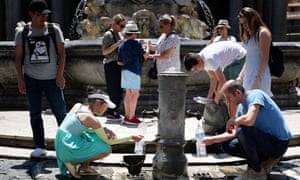
Tourists in Rome drink from a public fountain during the unusually early summer heatwave.
Photograph: Alberto Pizzoli/AFP/Getty Images
Authorities have urged children and older people to stay indoors and
issued severe warnings against dehydration and heatstroke as an unprecedented week-long heatwave begins its advance across continental Europe.
Meteorologists said temperatures would reach or even exceed 40C from Spain to Switzerland
as hot air was sucked up from the Sahara by the combination of a storm
stalling over the Atlantic and high pressure over central Europe.
High humidity meant it would feel like 47C, experts warned. “El infierno [hell] is coming,” tweeted the TV meteorologist Silvia Laplana
in Spain, where the AEMET weather service forecast temperatures of 42C
by Thursday in the Ebro, Tagus, Guadiana and Guadalquivir valleys and
warned of an “extreme risk” of forest fires.
In France, officials in Paris set up “cool rooms” in
municipal buildings, opened pools for late-night swimming and installed
extra drinking fountains as temperatures in the capital reached 34C on
Monday and were forecast to climb further later in the week.
“I’m worried about people who are downplaying this, who are
continuing to exercise as usual or stay out in the sun,” the health
minister, Agnès Buzyn, said. “This affects all of us, nobody is a
superman when it comes to dealing with the extreme heat we’re going to
see on Thursday and Friday,” she told a press conference.
Ice-creams ready to be served at a retirement home in
Souffelweyersheim, eastern France. Photograph: Patrick Hertzog/AFP/Getty
Images
Emmanuel Demaël of Météo-France said the heatwave was unprecedented
“because it’s hitting so early in June – we haven’t seen this since
1947.” Record monthly and all-time highs were likely to be set in
several parts of the country, Demaël predicted, and night-time
temperatures were unlikely to fall below 20C.
School
exams were postponed until next week, charities distributed water to
homeless people and sales of fans quadrupled. France’s deadliest recent
heatwave was in August 2003, when almost 15,000 mainly elderly people died as hospitals were overwhelmed.
In Italy,
“the most intense heatwave in a decade” was under way, with hospitals
preparing to deal with a wave of heat-related illnesses and the health
ministry suggesting army doctors may be needed to counter a shortage of
medics.
Highs of 37C to 40C were forecast across the north and centre,
including in Rome, Florence, Bologna, Milan and Turin, with several
Italian cities expected to set new records for the highest ever June
temperatures.
Authorities in Rome warned of the health risk from uncollected
rubbish piled up on the capital’s streets, and eight tourists –
including a Briton – were fined €450 (£403) each on Sunday for cooling
off in the city’s fountains.
Sabine Krüger of the German state meteorological service, DWD, said
the June record of 38.2C, set in Frankfurt in 1947, was likely to be
beaten by the middle or end of this week, with 100 hours of sunshine
forecast before Friday, temperatures in Frankfurt set to reach 39C or
even 40C by Wednesday and Berlin predicted to swelter in 37C. DWD on Monday warned citizens to take extra precaution in view of the
extreme heat and high UV radiation over the coming days: “Avoid staying
outdoors for long periods between 11am and 3pm,” it said, adding that
sunblock, sunglasses and a sun hat were advisable even in the shade.
Animal protection groups also warned pet owners to avoid leaving dogs or
cats in cars unattended.
The heatwave comes after storms and record rainfall caused major
problems in parts of Bavaria this weekend, with the Munich fire brigade
called out 50 times and flights into and out of Munich airport suspended
on Saturday evening.
In Switzerland, MeteoSwiss issued a “severe danger” level four heat
alert for several parts of the country, warning of temperatures in
excess of 33C and reaching 37C or even 39C in some places from Tuesday
until Thursday. A number of all-time highs were likely to be recorded,
it said.
Even Scandinavia looks unlikely to be spared, with parts of southern Denmark
and Sweden predicted to reach 30C by Tuesday – and to feel more like a
thoroughly un-Scandinavian 35C, the Danish broadcaster TV2 said.
Longer range weather forecasts show summer temperatures throughout
July and August are expected to be higher than normal this year,
rivalling those of 2018, which according to the European Environment
Agency was one of the three warmest years on record on the continent.
Scientists have said last year’s heatwave, which led to increased
mortality rates, a dramatic decline in crop yields, the shutdown of
nuclear power plants and wildfires inside the Arctic Circle, was linked to the climate emergency.
Meteorologists warn that such heatwaves are likely to become more
frequent even if countries succeed in their commitments to limit global
temperature increases to 1.5C as part of the 2015 Paris climate accord.
The EU has pledged to cut carbon emissions to 40% below 1990 levels by
2030.
Additional reporting by Sam Jones, Angela Giuffrida and Philip Oltermann
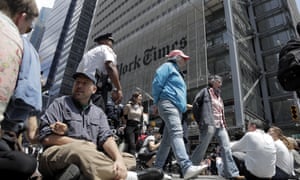
Activists sit on an intersection as others are taken into custody by police officers outside the New York Times building.
Photograph: Julio Cortez/AP
A climate change protest orchestrated by the Extinction Rebellion
activist group briefly blocked Eighth Avenue in New York on Saturday
afternoon, between the Port Authority transit hub and the home of the
New York Times.
The New York police department (NYPD) said 70 people were arrested as
they called for more effective media coverage of the dangers of climate
change, in a dramatic demonstration that saw people stage a die-in in
front of the newspaper building and disrupt traffic in midtown
Manhattan.
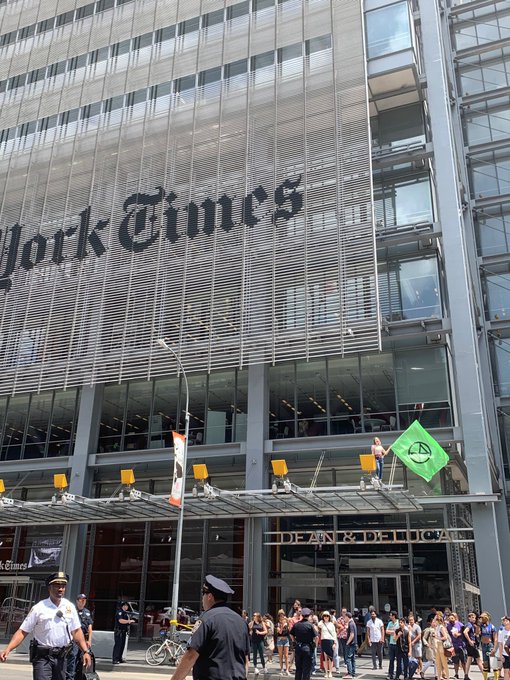
Two demonstrators scaled the front of the Port Authority building, which houses a major bus terminal and subway interchange, to hang a protest banner. Protesters also climbed on to the canopy outside the Times headquarters and unfurled a banner that encouraged the use of the phrase “climate emergency” instead of “climate change”.
One protester, Donna Nicolino, told the Guardian she was ready to be arrested, because “we want the New York Times as well as all the other media to treat climate change as the crisis it is”.
She joined a line of people with arms linked on West 40th Street and
Eighth Avenue, blocking the road. The group remained until they were
arrested by New York City police officers.
“The lack of coverage of the climate crisis is completely
unacceptable,” said Becca Trabin, a member of Extinction Rebellion’s
press and fundraising teams. “It’s a public safety crisis on a global
scale.”
Trabin said that though it might not be convenient to report on, read
about and discuss climate change every day, it should nonetheless be a
media priority.
“No one wants to hear about the climate crisis every day but
if we don’t read about it every day we endanger ourselves,” she said.
A spokeswoman for the New York Times, Danielle Rhoades Ha,
said that in 2018 the newspaper published 795 articles about the
climate, including investigative stories and dispatches from across the
globe about the impact of climate change.
“There is no national news organization that devotes more time, staff
or resources to producing deeply reported coverage to help readers
understand climate change than The New York Times,” Rhoades Ha said.
“We fully support this group’s right to express their point of view,
even when we disagree with it as it relates to our coverage.”
For nearly an hour, the block outside the Times building was crowded
with demonstrators, onlookers and NYPD officers. A police recording
repeated a warning that anyone who did not clear the street would be
arrested. A helicopter flew overhead.
“Seas are rising and so are we,” chanted one group of demonstrators
on the sidewalk, where surprised tourists, workers and bystanders asked
for more information.
The block remained closed after the demonstration ended as police
officers processed the arrest of several demonstrators, including two
who had rappelled down the face of Port Authority to hang a sign.
Passersby stopped police to ask if a movie was being shot or if there had been a terrorist attack.