Monday, 28 September 2020

Amid talk of civil war, America is already split – Trump Nation has seceded.

Extract from The Guardian 

OpinionUS elections 2020

The president thrives on division, speaks of ‘we’ and ‘them’ and encourages violence. No wonder we fear he won’t accept defeat.
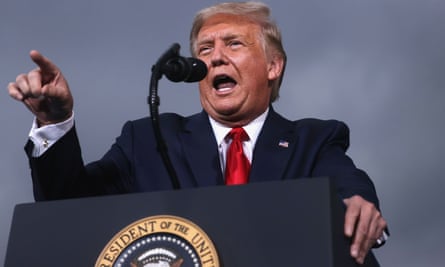
Donald Trump holds a campaign event in Winston-Salem, North Carolina.

Donald Trump holds a campaign event in Winston-Salem, North Carolina.

Last modified on Sun 27 Sep 2020 15.02 AEST

What is America really fighting over in the upcoming election? Not any particular issue. Not even Democrats versus Republicans. The central fight is over Donald J Trump.

Before Trump, most Americans weren’t especially passionate about politics. But Trump’s MO has been to force people to become passionate about him – to take fierce sides for or against. And he considers himself president only of the former, whom he calls “my people”.

Trump came to office with no agenda except to feed his monstrous ego. He has never fueled his base. His base has fueled him. Its adoration sustains him.

So does the antipathy of his detractors. Presidents usually try to appease their critics. Trump has gone out of his way to offend them. “I do bring rage out,” he unapologetically told Bob Woodward in 2016.

In this way, he has turned America into a gargantuan projection of his own pathological narcissism.

"To Trump and his core enablers and supporters, the laws of Trump Nation authorize him to do whatever he wants."

His entire re-election platform is found in his use of the pronouns “we” and “them”. “We” are people who love him, Trump Nation. “They” hate him.

In late August, near the end of a somnolent address on the South Lawn of the White House, accepting the Republican nomination, Trump extemporized: “The fact is, we’re here – and they’re not.” It drew a standing ovation.

At a recent White House news conference, a CNN correspondent asked if Trump condemned the behavior of his supporters in Portland, Oregon. In response, he charged: “Your supporters, and they are your supporters indeed, shot a young gentleman.”

In Trump’s eyes, CNN exists in a different country: Anti-Trump Nation.

So do the putative rioters and looters of “Biden’s America”. So do the inhabitants of blue states whose state and local tax deductions Trump eliminated. So do those who live in the “Democrat cities”, as he calls them, whose funding he’s trying to cut.

California is a big part of Anti-Trump Nation. He wanted to reject its request for aid to battle wildfires “because he was so rageful that people in the state of California didn’t support him”, said former Department of Homeland Security chief of staff Miles Taylor.

New York is the capital of Anti-Trump Nation, which probably contributed to Trump “playing down” the threat of Covid-19 last March, when its virulence seemed largely confined to that metropolis. Even now, Trump claims the US rate of Covid-19 deaths would be low “if you take the blue states out”. That’s untrue, but it’s not the point. For Trump, blue states don’t count because they’re Anti-Trump Nation.

To Trump and his core enablers and supporters, the laws of Trump Nation authorize him to do whatever he wants. Anti-Trump Nation’s laws constrain him, but they’re illegitimate because they are made and enforced by the people who reject him.

"If he loses the election, Trump will not accept the result because it would be the product of Anti-Trump Nation."

So Trump’s call to the president of Ukraine seeking help with the election was “perfect”. It was fine for Russia to side with him in 2016, and it’s fine for it to do so again. And of course the justice department, postal service and Centers for Disease Control and Prevention should help him win re-election. They’re all aiding Trump Nation.

By a similar twisted logic, Anti-Trump Nation is dangerous. Hence, says Trump, the armed teenager who killed two in Kenosha, Wisconsin, acted in “self-defense”, yet the suspected killer of a rightwinger in Portland deserved the “retribution” he got when federal marshals killed him.

It follows that if he loses the election, Trump will not accept the result because it would be the product of Anti-Trump Nation, and Trump isn’t the president of people who would vote against him. As he recently claimed, “The only way we’re going to lose this election is if the election is rigged.”

In the warped minds of Trump and his acolytes, this could lead to civil war. Just this week he refused to commit to a peaceful transition of power. His consigliere Roger Stone urges him to declare “martial law” if he loses. Michael Caputo, assistant secretary of public affairs at the Department of Health and Human Services, warns “the shooting will begin” when Trump refuses to go.

Civil war is unlikely, but the weeks and perhaps months after election day will surely be fraught. Even if Trump is ultimately forced to relinquish power, his core adherents will continue to view him as their leader. If he retains power, many if not most Americans will consider his presidency illegitimate.

So whatever happens, Trump’s megalomaniacal ego will prevail. America will have come apart over him, and Trump Nation will have seceded from Anti-Trump Nation.

What could Amy Coney Barrett, Donald Trump's Supreme Court pick, mean for US abortion rights?

Extract from ABC News

Analysis

By Prudence Flowers

A close up of Judge Amy Coney Barrett she has blue eyes and brown hair.
Amy Coney Barrett could soon join the US Supreme Court, and her selection could be a boost for Republicans.(AP: Rachel Malehorn)

Last week, US Supreme Court Justice Ruth Bader Ginsburg died of metastatic pancreatic cancer. Ginsburg's "most fervent wish", revealed by her granddaughter, was that she "not be replaced until a new president is installed".

Just eight days later, President Donald Trump has announced Amy Coney Barrett to fill Ginsburg's newly vacant seat.

Barrett is 48, a devout Catholic and a professor at Notre Dame Law School in Indiana.

She was appointed by Trump to the US Court of Appeals for the Seventh Circuit in 2017 and was shortlisted for the Supreme Court vacancy ultimately filled by Brett Kavanaugh in 2018.

The future of Roe v Wade

Ginsburg, known to her fans as the Notorious RBG, dedicated her life to the fight for equality and was the de facto leader of the liberal Supreme Court justices.

If Barrett is confirmed, and Republicans have indicated they have the votes to fill the vacancy, this will be Trump's third Supreme Court appointment.Candles are lit next to pictures of Associate Justice Ruth Bader Ginsburg as people mourn her death at the Supreme Court

Mourners light candles to honour Ruth Bader Ginsburg in Washington.(Reuters: Joshua Roberts)

Conservatives on the court would then have a 6-3 majority, which would likely have sweeping implications for an array of issues, including the future of Roe v Wade — the 1973 Supreme Court ruling that guarantees a woman's right to an abortion.

Since the late 1970s, Republicans have made opposition to Roe v Wade a central element of their social, political and legal identity.

The Supreme Court has been at the heart of this strategy. Every Republican presidential candidate since Ronald Reagan has campaigned on a pledge to appoint justices who respect "the sanctity of innocent human life".

How conservative justices differ today

However, once a justice is confirmed to a lifetime appointment on the nation's highest court, his or her voting behaviour is impossible to guarantee.

In the early 1990s, there were ostensibly seven conservative justices on the court, five of whom had been nominated by Republican presidents Reagan and George H W Bush.

Yet in the case Planned Parenthood v Casey (1992), a challenge over abortion laws in the state of Pennsylvania, a triumvirate of Reagan-Bush appointees sided with the two liberal justices, arguing "liberty finds no refuge in a jurisprudence of doubt" and the weight of precedent meant Roe v Wade must be upheld.

Judge Amy Coney Barrett and President Donald Trump

Amy Coney Barrett and US President Donald Trump at a White House announcement ceremony.(AP: Alex Brandon)

But the current crop of conservative justices share a more uniform judicial philosophy than the Reagan-Bush appointments.

Like Barrett and her mentor, the late Justice Antonin Scalia, they champion the legal theory of "originalism", which views Roe v Wade and the broader right to privacy as a "fanciful reading" of the US Constitution.

Anti-abortion lawyers argue if the court finds the right to privacy does not exist, "the state would be free to regulate and prohibit abortion".

Roberts no longer the swing vote

When Kavanaugh was confirmed in 2018, conservatives had a 5-4 majority on the court. Court watchers predicted Chief Justice John Roberts would emerge as a swing vote on a range of issues.

Roberts had cast votes with the liberal justices, most significantly in upholding the constitutionality of Obamacare (otherwise known as the Affordable Care Act) in 2012. He also has a well-established interest in the reputation of the Supreme Court and the importance of precedent.

In his 15 years on the bench, Roberts has made it clear he does not support abortion rights, but he was expected to avoid an outright assault on Roe v Wade.A man in a suit puts his arm on a man in judge's robes

Justice John Roberts has long been a key figure in Supreme Court abortion debates.(Reuters: Jonathan Ernst)

In June this year, Roberts sided with the liberal justices to rule a Louisiana anti-abortion law unconstitutional on the grounds precedent was established in a nearly identical case the court had struck down in 2016.

Yet in his separate concurrence, Roberts was clear he still agreed with his dissenting position in 2016.

If Barrett is confirmed, Roberts' power as a swing voter will be dramatically diminished. This would affect the final judgements of the court, but just as significantly, it would shape what kind of cases the court hears.

Less dependent on Roberts, the conservative justices are likely to take up a broader range of controversial matters, confident they have a majority.

Which abortion cases could be decided next?

In her academic writing, Barrett has indicated significant opposition to Roe v Wade, and in her brief time as a circuit judge, has ruled twice against abortion rights.

Currently, there are two abortion cases the justices could decide to hear. One is a challenge to a 2018 Mississippi law that banned abortion from 15 weeks, and the other relates to the provision of early medication abortions during the COVID-19 pandemic.Amy Coney Barrett looks down with her eyes closed in front of a United States flag

Amy Coney Barrett still needs her selection confirmed by the Supreme Court.(Reuters: Carlos Barria)

In the past decade, an unprecedented number of anti-abortion laws have been passed in US states, many based on model legislation developed by anti-abortion groups.

Many of these could be heard by the court in the next year or two. These include targeted regulation of abortion provision (TRAP) laws, which place prohibitive and medically unnecessary restrictions on doctors and clinics that provide abortion care.

There are also gestational bans (outlawing abortion after 20 weeks), method bans (targeting dilation and evacuation, the most common second-trimester abortion procedure) and reason bans (outlawing abortion for reasons of race, sex or disability).

There are also more restrictive bans that prohibit abortion in the first trimester, either at conception or up to six to eight weeks' gestation.

Although Roe v Wade is politically contentious, its popularity with the general public has remained stable since the late 1980s.

A close up of Judge Amy Coney Barrett she has blue eyes and brown hair.

Amy Coney Barrett could soon join the US Supreme Court, and her selection could be a boost for Republicans.(AP: Rachel Malehorn)

Most Americans support the ruling — surveys last year found between 60 per cent and 77 per cent want to see the decision upheld.

Yet the future of safe, legal abortion in the US will ultimately depend on how emboldened the conservative justices now feel.

Will they choose cases that incrementally erode abortion rights and access? Or will they, for the first time since the 1990s, push for reconsideration of the constitutional issues and rights at the very heart of Roe v Wade?

Prudence Flowers is a lecturer in US History at Flinders University. She has also received funding from the South Australian Department of Human Services, and is a member of the South Australian Abortion Action Coalition. This article originally appeared at The Conversation.

Sunday, 27 September 2020

Religious nationalism in the East and the West.

Podcast from ABC Radio National

What is religious nationalism, and what does it look like in our current global context? On God Forbid, James and the panel turn their attention to the East and the West — from Christian nationalism in the U.S. to Hindu nationalism in India.

In this episode:

When we think about the Christian right in America, Evangelicals come to mind. But that’s just one part of a complex picture. Christian nationalism is another form of religious expression with quite different aims and ambitions. 

Mahatma Gandhi’s vision of Indian secularism had all religions treated equally in the constitution: Muslim, Christian, Sikh or Buddhist. So why then, have we been seeing a rising tide of Hindu nationalism in recent decades? 

In February, India’s Supreme Court ruled women could hold permanent command positions in the army – a long campaigned for outcome. But are women still restricted or discouraged in other areas of Indian society? And what role does religion have in this?

Duration: 54min 8sec
More Information

Hear U.S. journalist Katherine Stewart talk to RN’s Philip Adams about Christian nationalism here. 

Listen to social activist Shabnam Hashmi, Professor Neera Chandhoke and Professor Sumit Ganguly on this episode of RN’s Rear Vision with Annabelle Quince. 

Hear lawyer Aishwarya Bhati speak to presenter Patricia Karvelas on RN Drive. 

Guests: 

Suvarna Variyar is a PhD candidate at The University of Sydney. She’s an expert in fundamentalist Hinduism, Hindu nationalism and gender in India. She’s also written about French nationalism, and the musical Les Misérables.

Andrew West is the presenter of RN's Religion and Ethics Report. A journalist and broadcaster, Andrew has decades of experience reporting about religion in the U.S. and Australia.

Presenter: 

James Carleton 

Producer: 

Hong Jiang  

Saturday, 26 September 2020

'His abuses have escalated': Barr's kinship with Trump fuels election fears.


Extract from The Guardian

Barr appears to see himself locked in a historic struggle against literal evil, and he appears to regard the upcoming election as the climactic battle.

The attorney general has been giving misleading statements on election integrity, and, critics say, has a deep sense of mission about re-electing the president

Last modified on Sat 26 Sep 2020 04.25 AEST

Donald Trump’s astonishing suggestion at a campaign rally last weekend that the US president will deploy government lawyers to try to hit the brakes on the counting of ballots on election night relies on the complicity of one federal official more than any other.

That official is the attorney general, William Barr, who, as the leader of the justice department, directs the army of government lawyers who would sue to halt the counting of votes.

Conveniently for Trump’s stated plan, Barr appears not only ready to acquiesce, he seems eager to bring the lawsuits, having laid groundwork for challenging the election with weeks of misleading statements about the integrity of mail-in voting.

To some observers, the attorney general appears to have also laid the groundwork for a further alarming step, one that would answer the question of what action the Trump administration is prepared to take if a contested election in November gives rise to large new protests.

In order for Trump to steal the election and then quell mass demonstrations – for that is the nature of the nightmare scenario now up for open discussion among current and former officials, academics, thinktankers and a lot of other people – Trump must be able to manipulate both the levers of the law and its physical enforcement.

In Barr, Trump not only gets all of that, critics say, but he also enjoys the partnership of a man whose sense of biblical stakes around the election imbues him with a deep sense of mission about re-electing Trump.

In a break with the relative reticence of his first 18 month in office, Barr has laid out his own thinking with a series of recent speeches, interviews and internal discussions. Even routine critics of Barr have been struck by the Barr that has now revealed himself.

The erstwhile mild-mannered Washington lawyer has been spouting attacks on election integrity and hostility toward street protests while describing, in explicitly religious terms, an epochal showdown between the forces of “moral discipline and virtue” – which he believes he represents – and “individual rapacity” manifesting as social chaos, embodied by leftwing protesters among others.

“His abuses have only escalated as we have gotten closer and closer to the election, and as the president has felt more and more politically vulnerable,” said Donald K Sherman, the deputy director of the Citizens for Responsibility and Ethics in Washington watchdog group, which has called for Barr’s impeachment.

“I can’t put it more plainly than this: the attorney general is a threat to American citizens having free and fair access to the vote, and is a threat to American having their votes counted.”

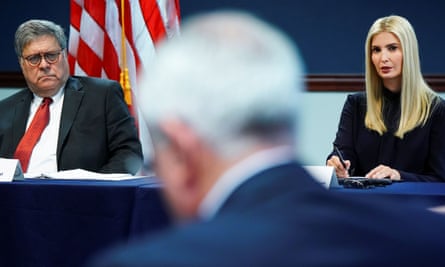
In recent weeks, Barr has reportedly asked prosecutors to weigh charging protesters under sedition laws, meant to punish conspiracies to overthrow the government, and to weigh criminal charges against the Seattle mayor for allowing residents to establish a small “police-free” protest zone. He has designated New York City, Portland and Seattle as “anarchy” zones that he says “have refused to undertake reasonable measures to counteract criminal activities”, threatening federal funding.Barr with Ivanka Trump on Monday at a meeting in Atlanta on human trafficking.

Barr with Ivanka Trump on Monday at a meeting in Atlanta on human trafficking. Photograph: Elijah Nouvelage/Reuters

Such designations cleanly feed Trump’s re-election narrative of public safety under threat. They also reflect a constitutionally questionable, and normally non-conservative, eagerness on Barr’s part to reach the arm of federal government into local law enforcement.

Barr has demonstrated this tendency before. In June, he took the highly unusual step, as attorney general, of personally directing federal officers to use crowd suppression tactics to eject peaceful protesters from Lafayette Square near the White House.

Barr later denied giving any direct orders, but the White House stated flatly: “It was AG Barr who made the decision.”

Meanwhile Barr has competed with Trump to erode faith in the upcoming election, peddling baseless conspiracy theories about foreign nations printing counterfeit ballots, spreading tales about mass mail-in ballot fraud – in a lie that was later retracted by the justice department – and expressing frustration that the United States uses mail-in voting and multi-day voting, which are common measures to accommodate voters going back decades.

“We’re losing the whole idea of what an election is,” Barr complained in an appearance earlier this month at Hillsdale College in Michigan.

Neil Kinkopf, a Georgia State law professor who worked in the Office of Legal Counsel under Bill Clinton, said that Barr’s solicitousness for Trump’s political wellbeing was historic.

“I think this attorney general is demonstrably more committed to the political success of the president, and the president’s political agenda than any attorney general in history I can think of,” Kinkopf said.

What drives Barr? For political observers familiar with Barr’s long Washington career, which included an earlier stint as the attorney general under George HW Bush, the notion that he could help lead American democracy off a cliff might provoke some cognitive dissonance. Like other powerful Republicans and everyday voters who have enabled Trump, Barr does not appear to be motivated by personal loyalty to Trump per se, but by a sense of Trump’s role in a greater plan.

Before his appointment by Trump, many insiders saw Barr as a committed institutionalist who would protect the independence of the justice department from Trump’s most damaging tendencies, though Barr clearly was a strong believer in a muscular presidency.

But others saw Barr coming. They include Kinkopf, who testified against Barr before the Senate at Barr’s January 2019 confirmation hearing. In his testimony, Kinkopf warned about Barr’s subscription to so-called unitary executive theory, which lays out an “alarming” and “dangerously mistaken” view of “an executive power of breathtaking scope, subject to negligible limits”, Kinkopf said.

The attorney general sees himself clearly as fighting culture wars that are to him moral and religious

“It appears that, if confirmed, William Barr will establish precedents that adopt an enduring vision of presidential power; one that in future administrations can be deployed to justify the exercise of power for very different ends,” Kinkopf warned at the time.

But today even Kinkopf says he is “deeply surprised” by the extent to which Barr has surpassed that warning.

“When I testified against him, I recognized how dangerous the unitary executive theory is,” Kinkopf said. “But what I didn’t appreciate, and I don’t think anybody appreciated, was just how fully he would deploy that theory in advance not of rule-of law values, but in order to advance both the president’s political agenda, and I think more deeply for Barr, his own social and religious commitments.”

Those commitments, in turn, are a matter of public record, including in a speech Barr delivered at Notre Dame University about one year ago. In the speech, Barr described a political philosophy driven by the need to counter an “individual rapacity” in humans that quickly produces “licentiousness” and the destruction of “healthy community life” if not restrained. The only possible restraint, in Barr’s view, are “moral values [that] must rest on authority independent of men’s will – they must flow from a transcendent Supreme Being.”

In short, Barr argued, as he has elsewhere, that the inevitable result of secularism is moral decay and social chaos.

It appears that it is just such chaos that Barr sees in the current street protests driven by the ant-racism Black Lives Matter movement. He has denounced the protesters in his Michigan speech as “these so-called Black Lives Matter people” and claiming they were “not interested in black lives. They’re interested in [using] props – a small number of blacks who are killed by police… to achieve a much broader political agenda.”

If Barr gives shockingly short shrift to the motivations of protesters haunted by the recurring specter of police killings of people of color, he holds his own motivations in high esteem.

Barr appears to see himself locked in a historic struggle against literal evil, and he appears to regard the upcoming election as the climactic battle. A Trump loss, Barr recently told a Chicago Tribune columnist, would mean the United States was “irrevocably committed to the socialist path”. He called the election “a clear fork in the road”.

“The attorney general sees himself clearly as fighting culture wars that are to him moral and religious,” Kinkopf said. “And those are deeper I think commitments for him than the commitment to federalism. And so to the extent that the balance of federal and state power gets in the way of achieving what he wants to achieve in the culture wars, he’s willing to cast that aside.

“So if there weren’t a culture war angle on it, I think he would take the position that states and local governments should be left to police their own communities, and the federal government should keep its nose out. But because he sees something at stake in the current protests that jeopardizes what he feels as being the proper order of society, he’s not troubled about using federal power to pursue what he views as being the right results.”

'Sliding towards extinction': koala may be given endangered listing as numbers plummet

 Extract from The Guardian

The species is among 28 animals being assessed for potential upgrade of their threat status, federal government says

A koala in a tree
Severe declines in Australia’s koala populations were exacerbated by last summer’s bushfires, environmental groups say.

Last modified on Fri 25 Sep 2020 23.57 AEST

The koala is being considered for official listing as endangered after the summer’s bushfire disaster and ongoing habitat destruction on the east coast forced the government to reconsider its threat status.

The iconic species, which is currently listed as vulnerable under national environment laws, is among 28 animals that could have their threat status upgraded, the federal environment minister, Sussan Ley, said on Friday.

The greater glider, which had 30% of its habitat range affected by the bushfire crisis, is also being assessed to determine whether it should move from vulnerable to endangered, while several frog and fish species, including the Pugh’s frog and the Blue Mountains perch, are being considered for critically endangered listings.

Several Kangaroo Island species, including the Kangaroo Island crimson rosella and Kangaroo Island white-eared honeyeater, are among birds being assessed for an endangered listing.

Ley has asked the threatened species scientific committee to complete its assessments by October next year.

The koala assessment will apply to the combined populations of New South Wales, Queensland and the ACT, where more than 10% of the population was affected by bushfire. Koalas on the east coast are also under multiple other pressures due to continued habitat destruction, drought and disease.

Environmental groups, which nominated the species for an endangered listing, said already severe populations declines had been made worse by the 2019-20 bushfire disaster.

“We welcome prioritisation for the koala but also hope the process can be sped up and the koala listed as endangered before October 2021,” said Nicola Beynon of Humane Society International.

Josey Sharrad, of the International Fund for Animal Welfare, said koalas on Australia’s east coast were “sliding towards extinction” and immediate action was needed to bring the species back from the brink.

A recent NSW parliamentary inquiry found koalas would be extinct in the state by 2050 without urgent intervention to protect habitat and help the species recover.

Ley said on Friday that because of the ongoing effects of the bushfires, the government would introduce additional nomination processes for the listing of threatened species over the next two years on top of the annual nomination process.

The 28 species included on the finalised priority assessment list for formal assessment in the 2020 period include two reptiles, four frogs, seven fish, six mammals and 12 birds, bringing the total number of species currently being assessed to 108.

After a species makes the priority list, it is assessed by the scientific committee, which then makes a recommendation to the minister regarding its threat status.

“This process is critical in ensuring threatened species are given strategic protection, are eligible for targeted funding and that awareness is raised about the issues impacting them,” Ley said.

A recent interim report from a review of Australia’s conservation laws found governments had failed to protect Australia’s unique wildlife and the environment was in unsustainable decline.

The government currently has a bill before the parliament to devolve decision-making powers under national environmental laws to the states.

Donald Trump's plot against democracy could break America apart.

Extract from The Guardian

Opinion Donald Trump


Even some conservatives fear a power grab might trigger the disintegration of the US. It’s happened to superpowers before.

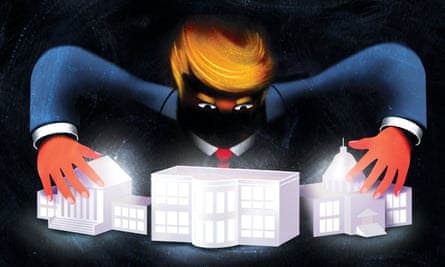
Illustration by Thomas Pullin

Illustration by Thomas Pullin

Last modified on Sat 26 Sep 2020 04.52 AEST

We know that US democracy is on the line this November, but what about the United States itself? Is it possible that not only America’s democratic health hangs in the balance, but the very integrity of the country?

Such talk sounds hyperbolic, but start with the danger to the US democratic system that becomes more clear and present each day. This week Donald Trump was asked if he would commit to a peaceful transfer of power in the event of his defeat. His reply: “Well, we’re going to have to see what happens.”

Later the White House clarified that of course the president would accept the results of a “free and fair election”. But that formulation contained an implied caveat: what if he decides that the election was not “free and fair”? After all, Trump has said repeatedly that if Joe Biden wins, that can only mean that the election was “rigged”.

How this might unfold was laid out this week in a chilling essay by Barton Gellman in the Atlantic headlined The Election That Could Break America. Many of the dangers are by now familiar. Aware that polls show them unable to win a straight contest, Republicans are already working hard to un-level the playing field. They have purged electoral rolls of likely Democratic voters. They have hobbled the Post Office, to prevent mail-in ballots – which are likely to favour Democrats – arriving in time.

Once the polls close, Team Trump will claim only the in-person votes, tallied on election night – and likely to skew towards Republicans – should qualify. They will try to stop the votes being counted, whether by lawsuit or by physical disruption (a tactic deployed successfully in the infamous Florida recount of 2000). As Gellman argues, it’s not just that Trump will refuse to concede defeat: he’ll use all the power at his disposal to “obstruct the emergence of a legally unambiguous victory for Biden”, even to “prevent the formation of a consensus about whether there is any outcome at all”.

There is one trick up Republican sleeves so outrageous that no one had even contemplated it until now. It’s technical, but bear with me. The president is chosen by an electoral college, made up of electors from all 50 states. For more than a century, those electors have been chosen to reflect the winner of the popular vote in that state. But Republican officials have noted that there’s nothing in the constitution that says it has to be that way. The legislatures – the mini-parliaments of each state – have the power to choose the electors themselves. And guess what: Republicans control the legislatures in the six most hotly fought battleground states. If they declare that the official vote tally showing Biden the winner is unreliable – on the grounds that, as Trump says, all postal votes are suspect – there is nothing to stop them choosing a slate of pro-Trump electors instead, claiming this reflects the true will of the people of their state.

It sounds like a Lukashenko manoeuvre, a coup against democracy – and that’s exactly what it would be. And yet there are Republican party officials talking on the record of how they are contemplating that very move.

Ah, but surely the supreme court would never allow such a thing. And yet, as of last week, there is a vacancy on that court. Trump plans to replace Ruth Bader Ginsburg at speed, aiming to seat his own handpicked judge in time to settle any election-related cases in his favour. That too he says out loud. Again, the Belarusian reek is unmistakable.

The trouble is, Democrats are all but powerless to stop a president and a party that has no shame in smashing through every democratic guardrail regardless of the hypocrisy: recall that, in March 2016, Senate Republicans refused to give Barack Obama’s supreme court pick so much as a hearing, insisting it was unconscionable to make such an appointment in an election year. Yet here they are, ramming their choice through a matter of weeks before polling day.

The result is that soon there will be a 6-3 rightwing majority on the US’s highest court, ready to overturn landmark decisions on healthcare or reproductive rights, and to thwart action on the climate crisis. What’s more, a seat on the supreme court is for life, and several of these rightwing judges are relatively young. That 6-3 majority could be in place for decades.

So now a dark question arises. What will the US’s increasingly progressive majority do if Republican state officials reinstall Trump in the White House, in defiance of the voters? What will they do if that 6-3 court overturns Roe v Wade and bans abortion across the entire country?

Think for a second how that latter situation will have arisen: it is because the Senate picks the judges, and the Senate enshrines minority rule. With two senators per state, tiny Wyoming (population: 600,000) has the same representation as gargantuan California (40 million). On current trends, 70% of Americans will soon have just 30 senators representing them, while the 30% minority will have 70. When it comes to their right to medical treatment or to rid their streets of military-grade assault weapons, the urban, diverse majority are subject to the veto of the rural, white, conservative minority.

How long is that sustainable? How long will a woman in, say, California accept the presence of guns and the absence of abortion rights because that’s what a minority of voters in small, over-represented states wants? Serious people are beginning to ask that question. Gary Gerstle, professor of American history at Cambridge University, says he’s found himself reading about countries that once had democracy but lost it – and that he’s doing that “to understand the future of America”.

He wonders if progressive, “blue” states might increasingly go their own way – flexing their right to deviate from the federal government, as branches of it move ever further out of democratic reach. As we spoke, New York governor Andrew Cuomo announced that he will not accept any federally approved Covid vaccine for his state until New York experts have tested it first. That, says Gerstle, could be a harbinger of things to come, including perhaps a revival of the pre-civil-war concept of “nullification”, whereby dissenting states declare decisions made in Washington null and void. It would be a historic turnaround for the American left: “states’ rights” was the rallying cry of the segregationist south, asserting their right to be racist. Now it could become the weapon of liberal America.

In a new book, Divided We Fall, the conservative writer David French raises the once-taboo question of “America’s secession threat” – imagining, for example, a “Calexit” as California leads a breakaway of liberal western states after a rightwing supreme court has struck down a California law to curb guns. Since Ginsburg’s death, that reads less like dystopian fiction than a forecast.

Such talk might seem fanciful. Yet there was probably a similar reaction to Andrei Amalrik’s 1970 essay Will the Soviet Union Survive Until 1984?. At the time, it must have sounded absurd: of course the USSR was here to stay. But Amalrik was not far off. Twenty-one years after he had asked the question, a once mighty superpower lay in pieces. Oceans rise, empires fall – and even America is not immune.

• Jonathan Freedland is a Guardian columnist

• Who’ll win the race for the White House? Join Guardian journalists Jonathan Freedland, Daniel Strauss, Lauren Gambino and Richard Wolffe for an online Guardian Live event, on Tuesday 20 October, 7pm. Book tickets here

The case for an Australian federal anti-corruption watchdog is more compelling after a troubling week.

 Extract from The Guardian

Politicians are getting bolder with every passing year and it is becoming harder to hold them to account

Australian prime minister Scott Morrison with acting immigration minister Alan Tudge
‘Before we succumb to the temptation of thinking Australian officialdom is more competent than elsewhere, it pays to broaden our field of vision. Then the picture becomes more troubling.’

Sat 26 Sep 2020 06.00 AEST

In the opening stages of the pandemic, before the second wave, when it looked like we’d flattened the curve of infections and the worst could be avoided, Australians seemed to harbour a quiet pride about our exceptionalism.

While the coronavirus response wasn’t perfect, by working to save lives and cushion people from the economic shock triggered by the pandemic, governments reminded citizens that politicians could do something other than plot mercilessly against one another, and fit up their opponents for everything that wasn’t right about the country. The officials and experts sitting behind governments also became more visible during the crisis, reinforcing the sense of an apparatus working for the common good.

This tableau of institutional competence is looking a bit more battered as the punishing months of 2020 grind on, and as politics-as-usual reasserts itself. As I write on Friday afternoon, Daniel Andrews is giving evidence to an inquiry examining what went wrong in hotel quarantine in Victoria, a managerial failure that seems to have sparked the second wave.

But despite the challenges, and missteps, Australia is still faring better at managing the calamities of the year than many other places, and polls suggest citizens retain a solid degree of confidence in the performance of our governments.

But before we dare to hope, before we succumb to the temptation of thinking Australian officialdom is more competent and public spirited than elsewhere, it pays to broaden our field of vision, because if we do that, the picture becomes more troubling.

Let’s start our Saturday stocktake with a land sale for an airport. The Australian National Audit Office this week trained a spotlight on a decision in 2018 by federal officials to purchase a 12.26 hectare triangle of land for just under $30m. The area known as the “Leppington triangle” is adjacent to the site for the western Sydney airport.

The ANAO decided to prod and poke this particular transaction because a year after buying the land, the department of infrastructure valued the land purchase at just $3m. Strange, right, that precipitous plunge in value? Enough to make an auditor curious.

The poking around resulted in the ANAO reconstructing a deliberative process where meetings were held in coffee shops without proper records, where conflict of interest procedures weren’t properly followed, where decision-makers weren’t appropriately advised, and where unorthodox valuation processes were adopted.

Unsurprisingly, the ANAO let rip. The whole case study “fell short of ethical standards”.

An unnamed official in the department, in fact, predicted this excoriation would happen. Making a record of approval to proceed with a valuation for the Leppington site in March 2017, the official noted in Sir Humphrey Appleby tones if the valuation activities, including the instructions provided and the land value advised, were ever disclosed publicly, this may “invite scrutiny over the department’s activities”. The commonwealth “may be criticised for its approach”.

The sorry story can be summarised this way. The government wanted to buy land owned by the Leppington Pastoral Company for the second Sydney airport. LPC was a reluctant seller. The parcel of land wasn’t needed, according to the ANAO, for another 32 years. But officials pushed through anyway. In the process they “overstated the identified benefits” (and, astonishingly) “did not quantify costs, and did not address risks” – which was a departure from the approved strategy.

For the record, the Leppington Pastoral Company is operated by billionaire brothers Tony and Ron Perich and the company has donated a total of $176,600 to the Liberals since 2002, including $58,800 in 2018-19.

The officials knew they were trying to buy land from “a sophisticated and well-resourced entity” with “access to substantial resources including legal and property advisors”. But in one of the more sharp asides in the ANAO report, the auditor notes there shouldn’t be special procedures for the powerful. It is not appropriate, the ANAO says, for the Australian government to offer “sophisticated and well-resourced” entities greater inducements to sell than it offers those without “access to substantial resources”.

The audit raises many intriguing questions. Why did officials behave this way? Were they just cowboys, extemporising in coffee shops at taxpayer expense? Were they under pressure to deliver a result for a government that wanted to present progress on a signature infrastructure project in western Sydney? In any case, one of the portfolio ministers at the time, Paul Fletcher, has made it clear this week he doesn’t accept responsibility, because he didn’t know what was going on.

A bit like Bridget McKenzie, the former sports minister, who gave out $100m in sports grants even though it wasn’t ever clear that the minister had the legal authority to be the decision-maker. Her officials at Sport Australia clearly knew that because in early June 2018, they recorded that their own legislation required the agency to approve the grants, not the minister.

The health department also had concerns about the legalities. In June 2018, a health department official warned a superior that McKenzie might need to formally order Sport Australia to designate her the decision-maker for grants programs. But the necessary legal guidance doesn’t seem to have been sought to clarify what needed to happen, and McKenzie said later officials should have raised any questions around legalities with her.

A bit like the robodebt debacle. The government has maintained that it believed its controversial welfare debt recovery scheme was legal until it received advice to the contrary in late 2019 after a challenge from Victoria Legal Aid. But new court documents suggest the government was, in essence, warned 76 times by a tribunal that Centrelink robodebts were not legally enforceable. A statement of claim associated with the class action contends that Alan Tudge, the human services minister, knew there were errors in the program in January 2017.

Speaking of Tudge, did he know that he had “engaged in conduct which can only be described as criminal” (to quote federal court justice Geoffrey Flick) when he failed to explain unlawfully depriving a 34-year-old Afghan asylum seeker of his liberty, leaving the man in detention for five days because he thought the tribunal that ordered his release got the law wrong? What an extraordinary judgment that was. The attorney general has defended Tudge and the commonwealth is mulling an appeal.

The point of raising these examples is not to make us all depressed, or to embark on a gratuitous Saturday morning walk of shame. If you are an optimist, you’d be tempted to conclude that there are problems in Australian governance, but our institutions are robust enough to ensure that failure, incompetence or malfeasance doesn’t remain hidden.

Andrews was before an inquiry on Friday afternoon because the evidence suggested the government had a case to answer, and the premier is prepared to have his decisions subjected to scrutiny – even if we remain none the wiser about who took the decision to use private security.

The ANAO exposed shoddy process with Leppington and questionable process with sports grants. Tribunals and lawyers and community advocates persisted with whistleblowing on robodebt until the problems could not be ignored by the government any longer. The federal court called out a minister of the crown, reminding him that he “cannot place himself above the law”.

While there is reassurance in all of those things, we’d be mugs to think that our systems don’t need buttressing.

I said this back in March – which honestly feels like a century ago. I used to think we didn’t need a federal anti-corruption body because I was confident the institution I work in, the media, had the resources to keep powerful people in check. That’s no longer the case. We do our best, we work harder than we have ever worked, but we don’t have the resources we had during the golden age of journalism.

What needs fixing in our institutions is more complicated than having an anti-corruption watchdog active on the beat. I’m worried, for example, that public servants are too timid to be truthful with political masters making unreasonable demands, because the appetite isn’t there for frank and fearless advice. I’m worried that politicians are getting bolder with every passing year, and it is becoming harder to subject them to gravitational forces.

I’m worried about all kinds of complex problems, and how they might get fixed. But we can keep this much simple: the case for an anti-corruption watchdog is now more than obvious.