Extract from The Guardian
Exclusive: The Australian Industry Group’s Innes Willox says the case for strong climate action has strengthened rapidly and the cost has turned out to be lower than expected
- Katharine Murphy: So Morrison’s going to Glasgow. Should we laugh, weep or rage for the lost decade?
- Innes Willox: ‘Both bad climate policy and no policy will see Australia lose jobs and investment overseas’
- Australian Politics podcast: Australia’s climate indecision continues as Scott Morrison heads to Glasgow
- Get our free news app; get our morning email briefing

Last modified on Sat 16 Oct 2021 11.27 AEDT
Australia’s biggest industry association has called on the Morrison government to set a target of cutting the country’s greenhouse gas emissions in half by 2030 to join the global “mainstream” on the climate crisis.
Innes Willox, the chief executive of the Australian Industry Group, said the case for strong climate action had strengthened rapidly while the cost of cutting emissions had turned out to be lower than expected. The risks of climate change were becoming increasingly clear and serious, he said.
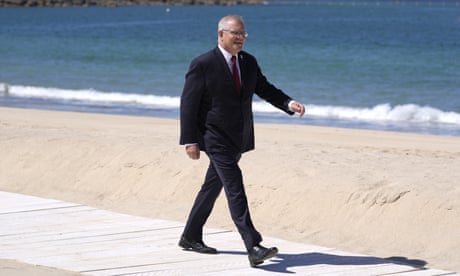
Willox’s call, in a comment piece for Guardian Australia, came as Scott Morrison ended weeks of equivocating and confirmed he would attend the Cop26 climate summit in Glasgow in two weeks.
The prime minister’s announcement, which followed pressure from international governments and Prince Charles, said the conference was “important” but he was yet to reach an agreement within the Coalition government on new climate targets and a long-term strategy to reach them. Nationals MPs will meet on Sunday to discuss a possible climate deal that Morrison could take to Glasgow.
“That’s what the Nats are fighting for, and that’s what the Coalition has always fought for and it’s why we won those seats at the last election,” he told Channel Nine. “We’ll get the balance right. I think we can arrive at an agreement and this will happen over the next few days, but I think it’s incredibly important that the Nats are allowed to have their party room to discuss it.”
Willox urged the Morrison government to include three commitments in any forthcoming climate package: a “firm commitment” to join the more than 120 countries aiming to reach net zero emissions by 2050, a pledge to make a much deeper cut in emissions by 2030 than currently planned, and policy directions to reach the goals. He said all sectors of the economy should be involved in the country reaching climate neutrality, but there was a case that methane from livestock should be “cut deeply and stabilised”, rather than necessarily reduced to zero.
On the 2030 target, he said Australia’s “advanced economy peers” – South Korea, Canada, Japan, the US, the EU and the UK – had set goals to cut emissions by between 40% and 68% below their national peaks, and Australia should do similar. The Morrison government’s existing 2030 target, set six years ago by the then prime minister Tony Abbott, is a 26-28% cut below 2005 levels.
“There is no magic number, but roughly halving Australia’s emissions from our own peak would put us in the mainstream on 2030 goals,” he said.
Willox said developing policies to meet the new goals would take time and public consultation but the next frontier should be economic incentives for mass deployment of clean technologies. That should include incentives to boost energy efficiency and the use of clean alternatives to gas, and strengthening the much-criticised safeguard mechanism, an Abbott-era policy that was meant to limit emissions from big industry but hasn’t.
“Trade competitiveness needs to be front of mind in designing these policies,” he said. “But it is becoming ever clearer that our competitiveness hinges on successfully making the transition to net zero emissions, not on holding it back.”
‘It would be easy’: call to halve emissions by 2030
The package of information to be released by the Morrison government before Glasgow will include new emissions projections for 2030 – where Australia’s CO2 levels are expected to reach based on current national, state and private action.
A report by researchers at Climate Analytics said it was likely the projections would forecast that emissions would fall by between 30% and 38% by 2030 – well beyond the federal government’s target.
It said virtually none of the credit should go to the Morrison government as the improved projections – up from just a 22% cut below 2030 last year – would be largely due to action by state governments and a shift in international markets by countries that were adhering to the Paris agreement.
Bill Hare, Climate Analytics’ chief executive, said state policies to drive renewable energy and electric vehicle sales and a projected decline in the market for Australia’s coal and liquefied natural gas exports had made the difference.
The report, commissioned by the Australian Conservation Foundation, outlined scenarios under which the government could increase its 2030 target to between 50% and 60%.
“It would be easy for Australia to more than halve emissions by 2030 simply by accelerating renewable energy, providing greater national incentives for electric vehicles and reducing land clearance rates,” Hare said.
“Yet the federal government’s present encouragement of new fossil fuel projects, like coalmines and massive gas developments, would make this impossible.”
With some Nationals openly hostile to signing up to a mid-century net zero commitment and others on the fence, it is unclear whether Morrison will have the political capital to be able to take the extra step and increase the 2030 target.
Sources say Australia has raised with both the UK and US governments the idea of publicly declaring it would “overachieve” on its 2030 target without formally increasing the goal, but both allies have pressed Morrison to deliver a formal increase rather than just window dressing.
The roadmap outlining Australia’s transition to net zero was discussed by cabinet for the first time on Wednesday afternoon.
It was followed by a warning from the Reserve Bank deputy governor, Guy Debelle, that investors could shun Australia – lose interest in its appetite for Australian bonds and equity – if it did not adopt a 2050 net zero target.
Morrison had been hopeful Australia’s new policy commitments for Glasgow would be unveiled early next week after government MPs returned to Canberra for a new parliamentary sitting fortnight. But the prime minister pushed that timetable out on Friday.
“The government will be finalising its position for me to take to the summit prior to my departure over the next fortnight,” Morrison told reporters in Sydney. “We’re working through those issues with our cabinet and with our colleagues and I look forward to those discussions concluding over the next couple of weeks.”

No comments:
Post a Comment