Extract from The Guardian
Up to 100,000, including Kahnawake Mohawk delegates, brave Glasgow rain as 21 arrested after scientists blockade bridge.
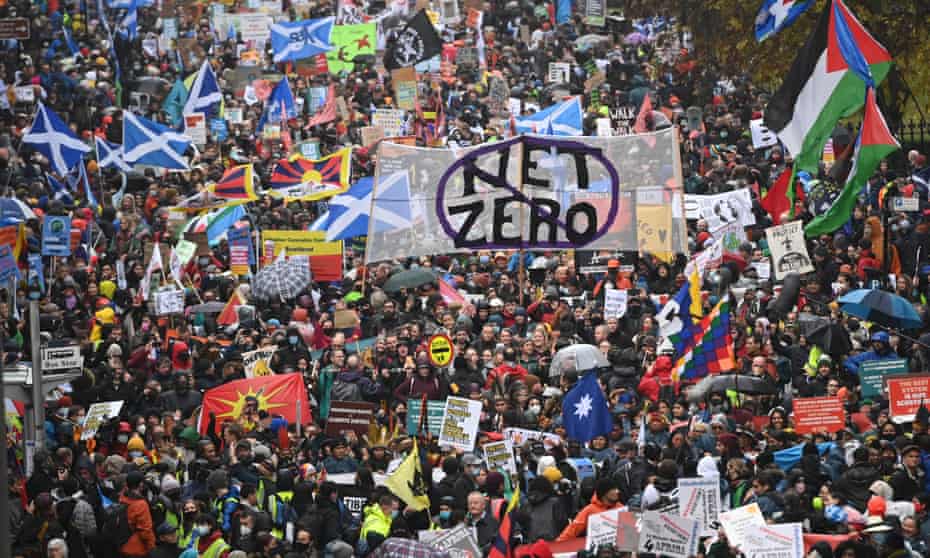
Climate protestors gather for the Global Day of Action for Climate Justice march in Glasgow, Scotland.
Last modified on Sun 7 Nov 2021 05.36 AEDT
People on almost every continent were gathering for marches and rallies on Saturday to mark a Global Day for Climate Justice, halfway through the Glasgow climate change summit.
Activists in the Philippines, eight hours ahead of the UK, had already finished their rally as protesters gathered in Scotland. There were also rallies in South Korea, Indonesia, the Netherlands and France. The Belgian arm of Extinction Rebellion occupied a street in Brussels.
The Scottish morning saw heavy rain, but the early mood was one of cheerful acceptance. “What do you expect protesting in Glasgow?” asked Lucy Bell, who works for the Vegan Kind, an online vegan supermarket based in Rutherglen. “There are so many people here from different backgrounds. It’s easy to get discouraged by the negotiations going on behind closed doors but I’m feeling optimistic this morning despite the rain.”
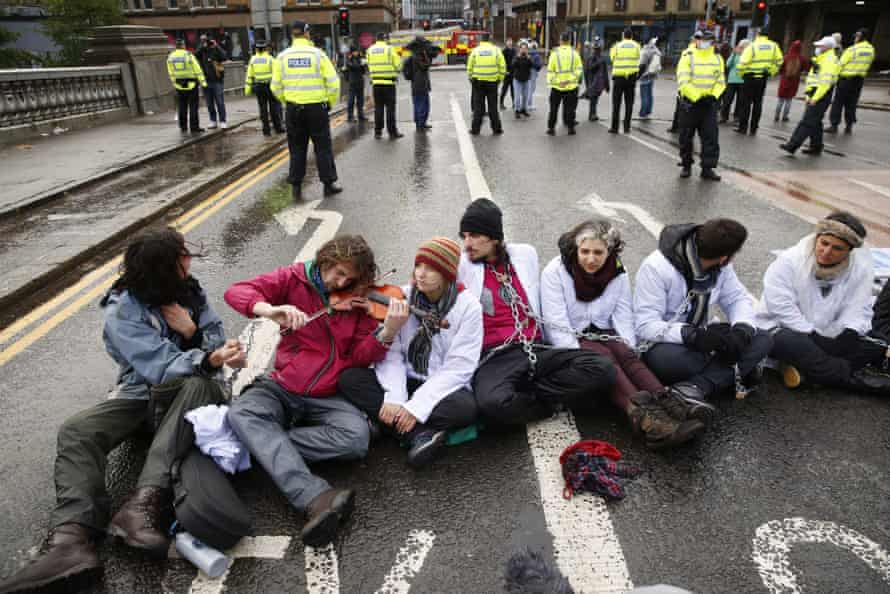
Direct action group Scientist Rebellion block the King George V bridge. Photograph: Murdo MacLeod/The Guardian
In Glasgow city centre, direct action group Scientist Rebellion blocked the King George V bridge, one of the main routes to the south side, at about 11.30am. More than 20 scientists, from students to a retired professor, all wearing lab coats stood chained together by the neck. The coalition of activist academics believes non-violent civil disobedience is the only remaining option to draw attention to the extremity of the climate crisis.
The march got under way at about midday, and was headed by a small group of First Nation people from Kahnawake Mohawk territory located in Quebec, Canada.
“It’s so evident that indigenous people hold the answers – they have to start listening and start thinking seven generations ahead, not just the immediate need,” said Karahkwintha, 23.
Ohontsakahte, 26, added: “Inside the Cop venue, unfortunately, it’s corporate interests at the front of the line, so here today indigenous people are leading the movement – and that’s how it should be inside the Cop venue too. We’re here to put indigenous voices at the forefront of the climate crisis.”
Cop delegates were also scattered among the huge crowds. Tracy Sonny, 37, a Cop negotiator from Botswana focused on climate adaptation and capacity building, was at the march to show solidarity and call for more unity. “We need to see more political will and a change in mindset … we’re already feeling the impact of climate change; we need to respond now, people are drowning.”
Despite the dreich weather, the atmosphere was electric as each bloc made itself heard with live music and chants such as “system change not climate change” and “world leaders at Cop26 … your inaction makes us sick.”
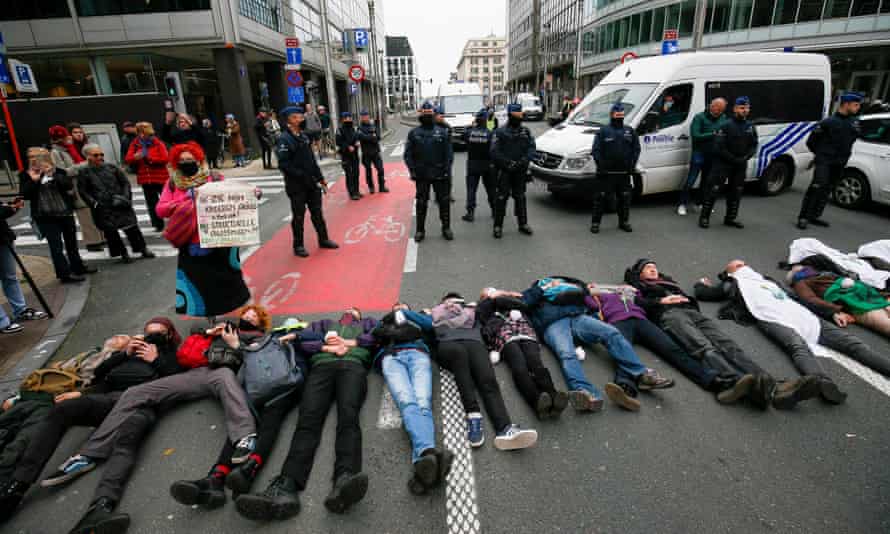
Members of the climate action group Extinction Rebellion during a protest at Rue de la Loi in Brussels. Photograph: Julien Warnand/EPA
Vegan activists fought strong gales to make their point with four giant inflatable animals tethered on ropes above their heads or strapped to the ground. Each symbolised a different problem with the livestock industry: a cow for methane, a chicken for Covid and health, a fish for microplastics, and a pig for obesity. “The cow in the room is being ignored at this Cop,” said Carl Le Blanc of Climate Healers. “Animal agriculture has been taken off the agenda and put on the menu.”
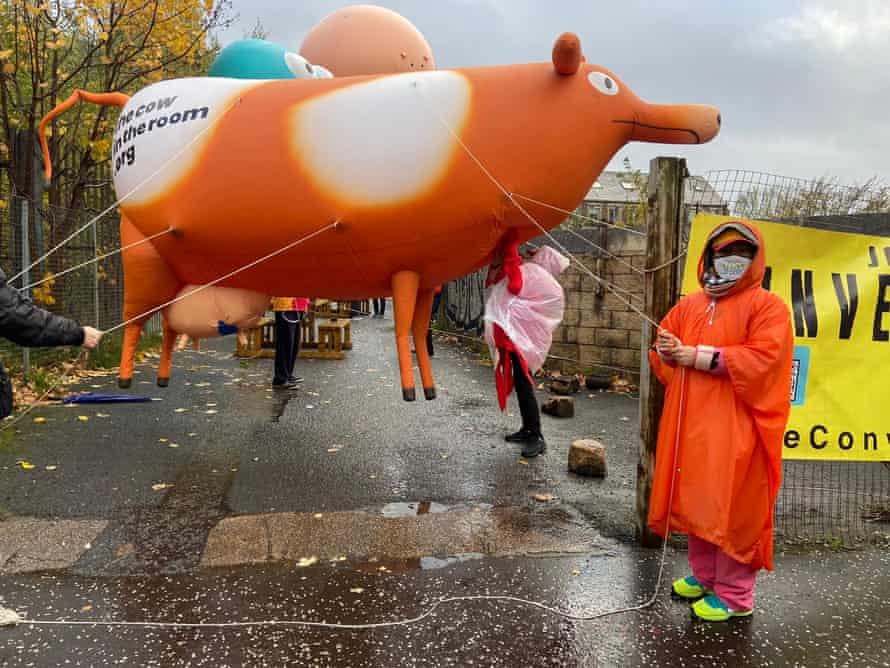
‘The cow in the room is being ignored at this Cop,’ said Carl Le Blanc of Climate Healers, heading off to join the Glasgow march during Cop26. Photograph: Jon Watts
Roisin Greaney, 28, a postgrad student from Dublin said: “I’m here today because, I would say a small group of people but in this case it’s a very large group of people, wants to put a sustained pressure on the people inside the blue zone.
There was also despair; Chris Cornroy, 37, who works for Oxfam, said: “The world is probably going to end within our lifetime, so any difference you can make counts. But I don’t think anything will be achieved from this if I’m being honest. I don’t think anything will make a positive difference today.”
By the afternoon the rain clouds had parted and the sky had begun to brighten as crowds of marchers spilled across the expanse of Glasgow Green, still singing, chanting and playing music.
The mood was “celebratory, positive and punchy” said Mary Martin from Coatbridge, who had marched from Kelvingrove. “Walking the walk,” she laughed as she shivered against a strong gust of wind. As for the progress of the climate talks, “I’m holding my breath.” The lack of inclusivity at the negotiations concerns her, the opposite of her experience on this march where she notes the rapport between different groups.
In London thousands of protesters, including trade unionists, refugee rights groups, students and environmentalists, marched from the Bank of England to Trafalgar Square.
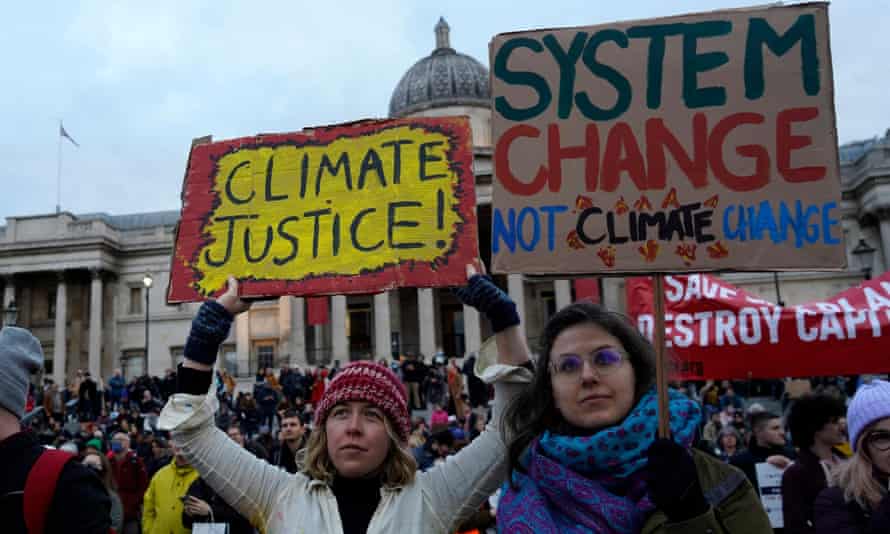
Protesters gather in Trafalgar Square having marched from the City of London. Photograph: Niklas Halle’n/AFP/Getty Images
Dawn Fuller, 56, said: “We have had enough of hearing them talk – now we absolutely have to see some real action.” She said her two grown-up children were increasingly anxious about the escalating climate emergency. “We have seen so much greenwashing at Cop26 … But it has to stop – it is our children’s future at stake.”
Many protesters called for urgent reform of the economic system and linked the climate crisis to global inequality and structural racism.
Rebecca Hotchkin, 23, who is studying medicine in London, said global health inequalities were being exacerbated by the climate crisis. “Health justice and climate justice are linked. Governments must start addressing the underlying causes to the various crises we face.”
In Glasgow organisers estimated that more than 100,000 people were in attendance, but police were reluctant to put a figure on the crowd. In London they said about 10,000 were marchers, although organisers put the figure closer to 20,000. Worldwide there were more than 300 protests, with more than 100 in the UK alone.
Nicola Sturgeon told reporters on Friday that she had confidence that the Glasgow climate march would be policed “appropriately”, adding that Iain Livingstone, Police Scotland’s chief constable, had spoken to the force’s independent advisory group after the concerns were raised in an open letter.
Assistant chief constable Gary Ritchie appealed to marchers to act responsibly and warned people travelling to Glasgow to prepare for delays.
He added: “There will be an increased police presence in Glasgow, and roads, public transport and the streets will be significantly busier than would normally be expected in the city on a Saturday.
“If you’re going to a march, please act responsibly, be respectful in your actions and follow the route and instructions given to you by event organisers or police officers.”

No comments:
Post a Comment