Extract from The Guardian
Australia has watched and waited for the past 24 hours, wondering if the world would dodge the Trump bullet.
Australia and the world has not dodged the Trump bullet.
Donald Trump will be the next president of the United States.
Given the primacy of the US relationship, given Canberra’s alliance with Washington has been the bedrock of Australia’s strategic fortunes, and the fortunes of the Pacific, since the Anzus treaty was signed in 1951 – Australia is in shock.
Worse than shock, Australia is in completely uncharted territory.
America has battled for its soul for 18 months, in full view of the world, and the culmination of the argument has been the elevation of a post-truth nihilist, a demagogue, to the White House.
Trump has spent months telling the world precisely who and what he is: a nationalist, an isolationist and a protectionist who believes the US should not be the world’s policeman.
As he rises to claim his prize, Australia has no other option than to take the 45th president of the US at his word.
As Thomas Wright, a fellow at the Brookings Institute, wrote in an extensive analysis published by the Lowy Institute, Trump has adhered to his America-first philosophy for the best part of three decades, and has stuck with this world view even when there was a high political cost.
So let’s consider the implications for Australia.
America has elected a president who has sent contradictory signals about whether or not he will commit to our region, a president who thinks Japan and South Korea should pay for their own defence, a president who has flirted liberally with the notion that countries acquire nuclear weapons, a president who wants to retreat from international agreements to combat the threat of global warming.
Trump has been contemptuous of the Trans-Pacific Partnership (TPP), which is the economic expression of the Obama administration’s pivot to the region – a trade pact considered a strategic bulwark against China’s rise.
Trump has vowed to junk the TPP – should it pass by some miracle during the lame duck session – and impose tariffs on goods and services imported from China, provoking the biggest player in Australia’s neighbourhood, and potentially stoking a trade war between the two largest economies in the world.
Trump’s vision for regional engagement, articulated this week by two of his campaign policy advisers, is heavy on military assertiveness, light on diplomacy and economic integration.
Alexander Gray and Peter Navarro wrote this week the US navy was “perhaps the greatest source of regional stability in Asia. The mere initiation of the Trump naval program will reassure our allies that the United States remains committed in the long term to its traditional role as guarantor of the liberal order in Asia”.
If that pre-campaign positioning comes to pass, Australia will come under pressure on a range of fronts, most acutely over military activity in the South China Sea, and also over whether American military assets could be positioned on Australian soil, a development China would consider a diplomatic affront.
Nothing at all is certain, but Australian politics has elected to reassure rather than startle.
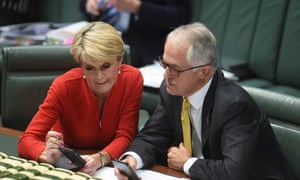
The financial markets took a sharp nosedive as the probability of a Trump presidency increased steadily throughout Wednesday afternoon, and the prime minister and the foreign affairs minister spent a portion of question time hunched over their smartphones, watching the results.
Australia and the world has not dodged the Trump bullet.
Donald Trump will be the next president of the United States.
Given the primacy of the US relationship, given Canberra’s alliance with Washington has been the bedrock of Australia’s strategic fortunes, and the fortunes of the Pacific, since the Anzus treaty was signed in 1951 – Australia is in shock.
Worse than shock, Australia is in completely uncharted territory.
America has battled for its soul for 18 months, in full view of the world, and the culmination of the argument has been the elevation of a post-truth nihilist, a demagogue, to the White House.
Trump has spent months telling the world precisely who and what he is: a nationalist, an isolationist and a protectionist who believes the US should not be the world’s policeman.
As he rises to claim his prize, Australia has no other option than to take the 45th president of the US at his word.
As Thomas Wright, a fellow at the Brookings Institute, wrote in an extensive analysis published by the Lowy Institute, Trump has adhered to his America-first philosophy for the best part of three decades, and has stuck with this world view even when there was a high political cost.
So let’s consider the implications for Australia.
America has elected a president who has sent contradictory signals about whether or not he will commit to our region, a president who thinks Japan and South Korea should pay for their own defence, a president who has flirted liberally with the notion that countries acquire nuclear weapons, a president who wants to retreat from international agreements to combat the threat of global warming.
Trump has been contemptuous of the Trans-Pacific Partnership (TPP), which is the economic expression of the Obama administration’s pivot to the region – a trade pact considered a strategic bulwark against China’s rise.
Trump has vowed to junk the TPP – should it pass by some miracle during the lame duck session – and impose tariffs on goods and services imported from China, provoking the biggest player in Australia’s neighbourhood, and potentially stoking a trade war between the two largest economies in the world.
Trump’s vision for regional engagement, articulated this week by two of his campaign policy advisers, is heavy on military assertiveness, light on diplomacy and economic integration.
Alexander Gray and Peter Navarro wrote this week the US navy was “perhaps the greatest source of regional stability in Asia. The mere initiation of the Trump naval program will reassure our allies that the United States remains committed in the long term to its traditional role as guarantor of the liberal order in Asia”.
If that pre-campaign positioning comes to pass, Australia will come under pressure on a range of fronts, most acutely over military activity in the South China Sea, and also over whether American military assets could be positioned on Australian soil, a development China would consider a diplomatic affront.
Nothing at all is certain, but Australian politics has elected to reassure rather than startle.
The financial markets took a sharp nosedive as the probability of a Trump presidency increased steadily throughout Wednesday afternoon, and the prime minister and the foreign affairs minister spent a portion of question time hunched over their smartphones, watching the results.
Julie Bishop was deployed immediately after question time to soothe and settle. Bishop said Australia had already engaged with the Trump team, and would use the transition period to press Australia’s interests and the interests of the region.
Penny Wong said the US alliance remained one of the essential pillars of Australia’s foreign policy regardless of who was in the White House.
Australia’s former ambassador to Washington Kim Beazley ranged between glass half full and glass half empty.
Beazley noted if Trump were to pursue his objectives internationally “it will effectively suspend American leadership in global free trade and in the global order”.
But there was one reason Australia could look on the bright side.
“We do have one advantage going for us with a Trump presidency, and that’s this. We are a member of the only American alliance that the Trump people unreservedly approve of. So at least we’ve got a basis of a discussion with them.”
Right now, given the chasm that has opened up before us, Australia will take any bright side it can get.

No comments:
Post a Comment