Extract from The Guardian
The
president’s reported remarks on the Obama-era New Start Treaty
between the US and Russia have provoked alarm among security
specialists
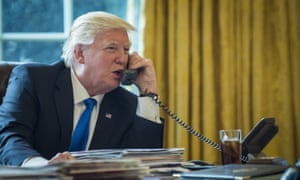
Don
Trump speaks with Vladimir Putin
in the Oval Office on 28 January. Photograph: UPI / Barcroft Images
Julian
Borger and Ben
Jacobs in Washington
Friday
10 February 2017 11.22 AEDT
Donald
Trump has told Vladimir
Putin he does not want to renew a 2010 arms control treaty
that limits the number of strategic nuclear weapons the US and Russia
can deploy.
Trump
angrily denounced the New Start Treaty in a 28 January phone call to
the Russian leader, according to sources briefed on the call.
Reuters, which first
reported Trump’s remarks, said the new US president also
had to pause the hour long call to ask what the New Start Treaty was.
The
White House spokesman, Sean Spicer, confirmed that the call was
paused but said it was because the president wanted to solicit the
views of his aides.
“It
wasn’t like he didn’t know what was being said,” Spicer said.
“He wanted an opinion on something,”
He
did not give any further details, describing the hour-long
conversation as a “private call”. The Kremlin had previously
characterised it as a friendly discussion in which “both sides
demonstrated a mood for active, joint work on stabilizing and
developing Russian-American cooperation,”
According
to accounts of the conversation given to the Guardian, the phone call
began with a friendly exchange, with both leaders stressing their own
popularity and complimenting each other on their domestic support.
Then when Putin brought up two issues on which their countries had
cooperated on, New Start and the 2015 nuclear deal with Iran, Trump
lost his temper, dismissing both as strategic losses for the US given
away by Barack Obama, and he began hectoring Putin.
The
New Start treaty, agreed between Obama and the then Russian president
Dmitry Medvedev, obliges
both countries to reduce their strategic arsenals, including
land-based intercontinental ballistic missiles, submarine launched
missiles and long-range bombers to 1550 warheads each by 2018. There
are also limits on the number of missile launchers each side can
have.
A
clause in the treaty allows the agreement to be extended by up to
five years by mutual agreement. According to the Reuters report, it
was when Putin raised the possibility of extension, that Trump paused
the call to ask about the treaty, and then returned to the
conversation with a tirade against the agreement.
Thomas
Countryman, former assistant secretary of state for international
security and nonproliferation, said he had raised the possibility of
New Start’s extension last month with his Russian counterpart,
deputy foreign minister, Sergei Ryabkov.
“Both
capitals have known that the extension of the treaty ... would be an
easy win-win that could set a new tone for relations between the two
countries,” said Countryman. ”I’m deeply disturbed that the
president was not just neutral on the question, not just negative -
saying not right now - but actually seemed to take a step backward in
calling into question an agreement that is beneficial to both sides
and has been implemented faithfully by both sides.”
Countryman
was suddenly
removed from his position at the end of last month while on
his way to a nuclear weapons conference in Rome, as part of a purge
of senior state department officials who have yet to be replaced,
leaving the department’s senior ranks seriously depleted.
Countryman
said he had no first-hand knowledge of the tone or content of the
Putin call, but said it was “ominous” if the president had not
been fully briefed on New Start before talking to the Russian leader.
“If
it is all going to be seat-of-the-pants – ‘last time I looked on
Twitter’ –rather than pursuing a carefully prepared agenda,
that’s disturbing,” Countryman said.
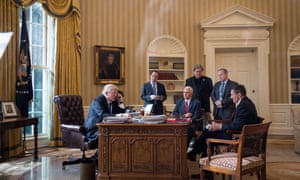
According
to accounts of the conversation given to the Guardian, Trump lost his
temper when Putin brought up the nuclear arms agreement. Photograph:
Drew Angerer/Getty Images
Both
before and after his election victory, Trump has made dramatically
contradictory statements on the US nuclear arsenal. He denounced the
agreement, which he referred to as ‘Start Up’ in a presidential
debate in October, wrongly claiming that it meant Russia could
“create warheads and we can’t”.
In
December, he tweeted that the US should “expand
its nuclear capability” and told a reporter: “Let it be an
arms race.”
In an
interview shortly before inauguration, however, he appeared to offer
deep bilateral cuts in nuclear arsenals accompanied by sanctions
relief for Moscow, saying: “I think nuclear weapons should be way
down and reduced very substantially.”
Joseph
Cirincione, the head of the disarmament advocacy group, the
Ploughshares Fund, said Trump was “tripping up over his own
narcissism. He is letting his personal prejudices get in the way of
his strategic goal. He is picking a fight with Putin who he wants
better relations with.”
New
Start was approved by the Senate and has the overwhelming support of
the US military establishment, including seven
past commanders of US nuclear forces. But it has critics on
the right wing of the Republican party and some US conservatives.
“There
are a lot of critics that say that New Start really got the US
nothing and it allowed the Russians free space to grow their
strategic nuclear deterrent,” James Jay Carafano, a national
security and foreign policy analyst at the Heritage Foundation.
Steven
Pifer, a former senior state department official, argued that if the
US walked out of New Start now, it would give Russia a strategic
advantage as it already has functioning production lines producing
new nuclear weapons to replace the old.
Pifer,
now at the Brookings institution, said the report suggested Trump
“really doesn’t have a good understanding of nuclear balance
between Russia and the United States.”
Countryman
said he feared that if arms control broke down between Washington and
Moscow, it could pave the way to an accelerated arms race.
“The
Obama administration was frustrated we were not able to move forward
with the Russian Federation on logical next steps in arms control,”
he said. “But we didn’t move backwards, and I am very concerned
that now we are.”

No comments:
Post a Comment