Extract from The Guardian
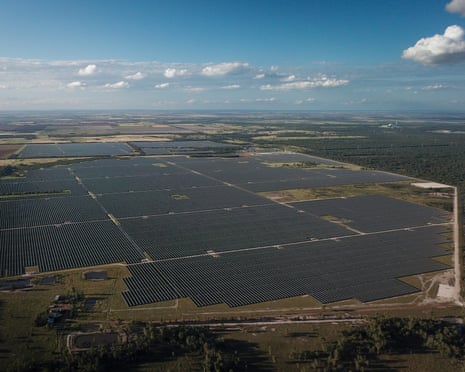
In 2024 seven solar and windfarms and seven storage projects – totalling 3,202 megawatts – had been approved. Then came the LNP government
It was 2024, and the rubber was hitting the road hard on the Labor government’s plans to get the power grid almost entirely off coal by 2035.
Seven solar and windfarms, and seven energy storage projects – totalling 3,202 megawatts, roughly four medium-sized coal power stations’ worth of electricity capacity – had been committed to, according to the national Clean Energy Council’s data. It was a record year.
But that October the Liberal National party led by David Crisafulli won government, bringing a sharply different approach to energy in Australia’s highest-emitting state.
“There’s been a bit of whiplash,” the chief executive of the Queensland Renewable Energy Council, Katie-Anne Mulder, says with only a hint of understatement.
But key to the slowdown, Trad says, was the LNP’s coal-friendly energy plan.
“That sent a signal to developers that their investments might not be secure in Queensland,” she says.
Roadblocks and red tape
The director of analysis at Green Energy Markets, Tristan Edis, says Queensland had several advantages that are “now evaporating”.
It had comparatively more space to connect new projects on its electricity distribution network. The previous government had been driving investments beyond signals from the market by instructing state-owned power companies “to pretty much make renewables investment happen”.
Now, he says, planning approval “looks like it’s becoming a lottery”. Steps to keep coal plants running – which include a $1.6bn maintenance fund – meant anyone building new solar and windfarms was “facing a kamikaze battle with the government”.
The fall away in investments in Queensland from 2024 to 2025 is mirrored nationally but to a much lesser degree, Clean Energy Council data suggests.
Nationwide, 8,290 megawatts of projects reached financial close in 2024, compared with 6,529 megawatts in 2025.

While Queensland saw capital investment drop off a cliff, it surged in South Australia from 210 megawatts in 2024 to 2,118 megawatts in 2025.
“Many states have a bipartisan policy but in Queensland that’s not the case,” Trad says.
“That chaos means billions of dollars of investment – and the skills and the training that go with it – go elsewhere for other communities to enjoy. Queensland will be left behind.”
Mulder says Queensland also faces another roadblock: there’s a backlog of more than 100 projects awaiting assessment under federal environment laws.
“For Queensland, we have 75% of renewable energy projects that have gone into the [federal environment] system since 2021 [that] are still under assessment,” she says. “And the backlog is getting greater.”
An Albanese government spokesperson says 43 of the 138 renewables projects it had approved were in Queensland and that only one of 12 projects referred in 2021 remained under assessment. Reforms to national environment laws passed last year would also help to reduce the number of approvals needed.
Priority projects have also identified and offered tailored support and $43.8m had been invested to better assess the likely impacts of projects that would help cut timeframes.
“In the last 12 months, 100% of EPBC Act decisions for Queensland projects have been made within statutory timeframes,’” the spokesperson adds.
Australia’s biggest climate emitter
Queensland is Australia’s biggest emitting state, accounting for just under a third of the country’s footprint.
Officially, its emissions dropped by 34% between 2005 and 2023. But if emissions from changes in land use and forest cover are excluded, emissions actually increased over the same period, with those from transport, energy and mining all rising.
The Crisafulli government has said it remains committed to a net zero emissions target by 2050. Officially, the 2035 target of the previous government to cut emissions by 75% from 2005 levels is still policy.
But analysis by the Queensland Conservation Council has estimated if the new energy roadmap is put in place, the state will be lucky to achieve to a 50% cut by 2035.
We forget we’re in a global race for investment
“It just isn’t in Queensland’s interest to step away from climate targets,” says Ariane Wilkinson, a Brisbane-based climate and energy policy expert at WWF-Australia.
“Queensland needs a credible transition plan that ensures our energy security and isn’t tied to unreliable coal and expensive gas.”
But she says the state’s approach to climate and energy could have other risks. The state’s climate commitments were “a core reason” why the World Heritage committee had decided not to add the Great Barrier Reef – a multibillion-dollar tourism drawcard and major employer – to Unesco’s in danger list.
Francesca Muskovic is the executive director of policy at the Investor Group on Climate Change that represents investors managing more than $4tn in Australia and New Zealand.
“Queensland has a really bright outlook with abundant resources and access to important critical minerals,” she says.
“The ‘Future Made in Australia’ could be a future made in Queensland. The state should be at the forefront but the risk is that this isn’t realised. The simple truth is that capital will go where it’s welcome.”
But she said Queensland was not only likely losing out to other states but also to global investors – some of which had raised Queensland’s situation specifically in meetings – could take their money away from Australia entirely.
“We forget we’re in a global race for investment.”
The Guardian sent questions to the state’s treasurer, David Janetzki, who is also the energy minister, but did not get a response.

No comments:
Post a Comment