Extract from The Guardian
Australia currently spends just 1.8% of GDP on research and development, lagging OECD average.
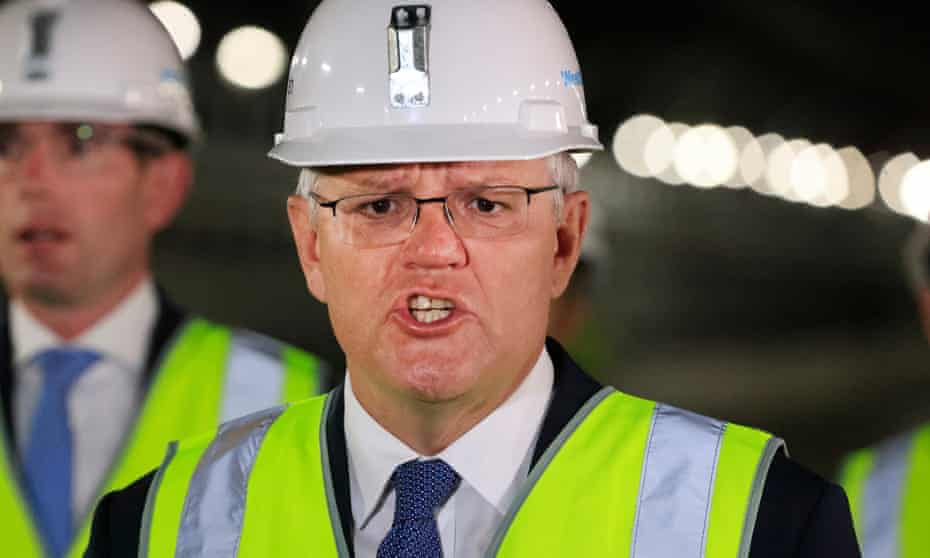
Prime minister Scott Morrison’s reliance on ‘technology not taxes’ to reach net zero needs to be backed with funding, Australian scientists say.
Last modified on Mon 8 Nov 2021 00.04 AEDT
Australia risks losing jobs to other countries if it fails to lift its below-average spending on research and development, a peak science body has warned, amid Scott Morrison’s vow to promote “technology not taxes” on climate policy.
Morrison told the climate summit in Glasgow last week: “It will be our scientists, our technologists, our engineers, our entrepreneurs, our industrialists and our financiers that will actually chart the path to net zero, and it is up to us as leaders of governments to back them in.”
“We need to back them in at scale, with deeper investment across the board,” Schubert said.
Australia is currently ranked 21st in the OECD for research and development, with Israel, South Korea, Japan and Taiwan at the top of those rankings.
With an election due in Australia by May, the group is urging all political parties to pledge to make Australia a global superpower in science, technology, engineering and mathematics (Stem) by lifting Australia into the top-10 in the OECD.
Schubert said Australia should be “taking notes” from the UK, whose research and development investment is similar to Australia’s as a share of GDP but with the prime minister, Boris Johnson, pledging to ramp it up to 2.4% of GDP.
She said the group’s 10-point pre-election wishlist, released on Monday, was not about “investment for the sake of investment, but rather a clear-eyed economic strategy that is about seizing jobs, wealth and income for Australia’s next generations”.
In the coming decade, Schubert said, a range of frontier technologies would develop at scale, including artificial intelligence and machine learning, quantum computing, clean energy technologies, biotech and agricultural technologies.

The election proposals also include $2.4bn fund to “drive income-generating commercialisation of Australian research and create thousands of new jobs”.
They also include a call for “a comprehensive plan to transition to a net zero emissions economy and safeguard Australia’s unique biodiversity”.
In a separate statement released on Monday, an alliance of business representatives, unions, investors, and farming, welfare and environment groups have described the Morrison government’s commitment to net zero by 2050 as “a first step”.
The Australian Climate Roundtable said it was also necessary to raise Australia’s medium-term emissions reduction goals – despite the government’s decision not to increase its formal 2030 target of a 26% cut to 28% on 2005 levels.
The roundtable said stronger medium-term action would “provide a clear and credible basis for action and investment” and “maintain our competitiveness amidst a growing global transition”.
“Innovation remains critical to identify low, zero and negative emissions options, improve their capability and reduce their costs,” said the roundtable, whose members include the Business Council of Australia, the Australian Industry Group and the Nationals Farmers’ Federation.
“Support for basic and applied research, demonstration and commercialisation is important.”
The roundtable said government policy should seek to prevent the unnecessary loss of competitiveness by Australia’s trade exposed industries – but delaying changes “will not resolve these fears and may worsen trade risks, given the impacts of other nations’ climate transition choices on Australia’s export industries”.
Labor has said it will release more details about its climate policy at some point after the Cop26 conference in Glasgow wraps up.
Labor’s climate spokesperson, Chris Bowen, hinted on Sunday the opposition was looking at changes to the existing safeguards mechanism, which the Coalition legislated as a tool to stop industrial emissions going up.
Bowen told the ABC’s Insiders program the Business Council had “made a useful contribution” by suggesting changes to the safeguards mechanism.
“You don’t release a budget reply until you see the budget. We’ve now seen the government’s alleged plan [but] we’re still waiting on more detail about the modelling,” Bowen said.
The leader of the Greens, Adam Bandt, accused the Morrison government of “holding back the rest of the world’s efforts to keep people safe” from the climate crisis.
In a speech to the Green Institute on Monday, Bandt will say that if Australia had kept the carbon price legislated during the Gillard minority government, “we would have met the Coalition’s weak 2030 targets in 2020”.
“We would not face, as a country, the humiliation and shame on the international stage Scott Morrison inflicted on us these past weeks,” Bandt will say, according to his speech notes.
“We would be able to stand with our allies, the USA and the UK, to increase our 2030 commitments.”

No comments:
Post a Comment