Contemporary politics,local and international current affairs, science, music and extracts from the Queensland Newspaper "THE WORKER" documenting the proud history of the Labour Movement.
MAHATMA GANDHI ~ Truth never damages a cause that is just.
Tuesday, 16 May 2017
38 million pieces of plastic waste found on uninhabited South Pacific island
Henderson Island, part of the Pitcairn group, is covered by 18 tonnes
of plastic – the highest density of anthropogenic debris recorded
anywhere in the world
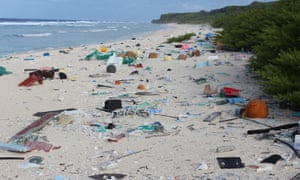
Plastic debris on East Beach, Henderson Island.
Photograph: Jennifer Lavers
One of the world’s most remote places, an uninhabited coral atoll, is also one of its most polluted.
Henderson Island, a tiny landmass in the eastern South Pacific, has
been found by marine scientists to have the highest density of
anthropogenic debris recorded anywhere in the world, with 99.8% of the
pollution plastic.
The nearly 18 tonnes of plastic piling up on an island that is
otherwise mostly untouched by humans have been pointed to as evidence of
the catastrophic, “grotesque” extent of marine plastic pollution.
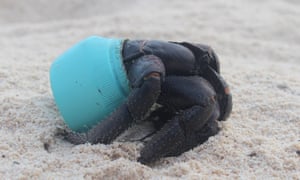
One of many hundreds of crabs that now make their homes
out of plastic debris washed up on Henderson Island in the Pitcairn
island group. This particular item is an Avon cosmetics jar. Photograph:
Jennifer Lavers
Nearly 38m pieces of plastic were estimated to be on Henderson by
researchers from the University of Tasmania and the UK’s Royal Society
for the Protection of Birds, weighing a combined 17.6 tonnes.
The majority of the debris – approximately 68% – was not even
visible, with as many as 4,500 items per square metre buried to a depth
of 10cm. About 13,000 new items were washing up daily.
Jennifer Lavers, of the University of Tasmania’s institute for marine
and antarctic studies, told the Guardian the sheer volume of plastic
pollution on Henderson had defied her expectations.
“I’ve travelled to some of the most far-flung islands in the world
and regardless of where I’ve gone, in what year, and in what area of the
ocean, the story is generally the same: the beaches are littered with
evidence of human activity ...
“However, my thought was the remarkable remoteness of Henderson
Island would have afforded it some protection. I was totally wrong.
“The quantity left me speechless and that’s why I went to such pains to document it in such detail.”
Lavers
found hundreds of crabs living in rubbish such as bottle caps and
cosmetics jars, and has been told of one living inside a doll’s head.
“From the looks on people’s faces, it was quite grotesque,” she said.
“That was how I felt about all these crabs – we are not providing them a
home, this is not a benefit to them.
“This plastic is old, it’s brittle, it’s sharp, it’s toxic. It was
really quite tragic seeing these gorgeous crabs scuttling about, living
in our waste.”
The largest of the four islands of the Pitcairn Island group, Henderson Island is a Unesco World Heritage Listed site and one of the few atolls in the world whose ecology has been practically untouched by humans.
The island exhibits remarkable biological diversity given it covers
only 3,700 hectares, with 10 endemic species of plant and four land bird
species. Its isolation had, until recently, afforded it protection from
most human activities.
Lavers said her findings had proved to her nowhere was safe
from plastic pollution. “All corners of the globe are already being
impacted.”
Like seabirds and turtles, remote islands serve as sentinels for the
health of the wider marine ecosystem, “acting like a sieve or a trap,
filtering out the ocean”, she said.
The state of Henderson – “the most polluted, most remote island in
the whole world” – was indicative of the extent of the problem, and the
“absolutely mind-boggling” rate at which plastic was being produced
globally.
The 17.6 tonnes of plastic on Henderson accounted for only 1.98
seconds’ worth of annual production, found the paper – co-written by
Lavers with Alexander Bond – published in Proceedings of the National
Academy of Sciences on Monday.
“Across the board, no country got a free pass on this – we found
bottles from Germany, containers from Canada, I think it was a fishing
crate from New Zealand. What that says is we all have a responsibility
in this, and we have to sit up and pay attention to that.”
The threat to biodiversity posed by plastic debris has come under
increased scrutiny as findings reveal the extent of the problem, with
millions of tonnes ending up in the ocean every year.
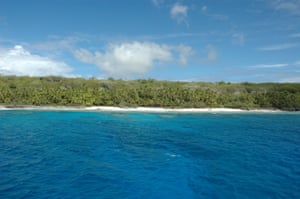
North West beach on Henderson Island looking pristine in a
Unesco image, but the remote atoll’s beaches are littered with tonnes
of plastic. Photograph: Ron Van Oers/Unesco
In February, scientists reported “extraordinary”
levels of toxic pollution in the Mariana trench, with plastic waste
facilitating the spread of industrial chemicals to one of the most
remote and inaccessible places on the planet.
At the world oceans summit in early March, Indonesia pledged to
put up to $1bn a year towards reducing plastic and other waste products
polluting its waters, setting a goal of a 70% reduction in marine waste
within eight years.
Laver said individuals and governments had a part to play in reducing
the amount of plastic polluting the world’s oceans, but the key was
urgency.
“For me, marine plastic pollution is the new climate change, but I
would like for us to not make the same mistakes. We’ve been arguing
about climate change, and whether it exists and what is changing, for
the better part of 40 years ...
“Let’s not wait for more science. Let’s not debate it. The rate of
plastic in our oceans is absolutely phenomenal, and we need to do
something now.”

No comments:
Post a Comment