Contemporary politics,local and international current affairs, science, music and extracts from the Queensland Newspaper "THE WORKER" documenting the proud history of the Labour Movement.
MAHATMA GANDHI ~ Truth never damages a cause that is just.
Thursday, 16 January 2020
Climate emergency: 2019 was second hottest year on record
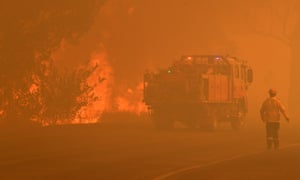
‘The drumbeat of the Anthropocene’: alarming heat records revealed.
Photograph: Dean Lewins/AAP
The year 2019 was the second hottest on record for the planet’s
surface, according to latest research. The analyses reveal the scale of
the climate crisis: both the past five years and the past decade are the
hottest in 150 years.
The succession of records being broken year after year is “the
drumbeat of the Anthropocene”, said one scientist, and is bringing
increasingly severe storms, floods, droughts and wildfires.
The previous hottest year was in 2016, the year that a natural El Niño event
boosted temperatures. The new data is for the average global surface
air temperature. More than 90% of the heat trapped by human greenhouse
gas emissions is absorbed by the oceans, but on Monday scientists
revealed 2019 as the warmest yet recorded in the seas, calling it “dire news”.
The average temperature in 2019 was about 1.1C above the average from
1850-1900, before large-scale fossil fuel burning began. The world’s
scientists have warned that global heating beyond 1.5C will significantly worsen extreme weather and suffering for hundreds of millions of people.
The World Economic Forum’s global risk assessment
for the next decade, also published on Wednesday, found the top five
dangers were all environmental, including extreme weather, failure to
prepare for climate change and the destruction of the natural world.
“The last decade was easily the warmest decade in the record and is
the first decade more than 1C above late 19th-century temperatures,”
said Gavin Schmidt, of Nasa’s Goddard Institute for Space Studies, which
produced one of the temperature records.
“What is important is the totality of evidence from multiple
independent data sets that the Earth is warming, that human activity is
driving it and the impacts are clearly being felt,” he said. “These
announcements might sound like a broken record, but what is being heard
is the drumbeat of the Anthropocene.”
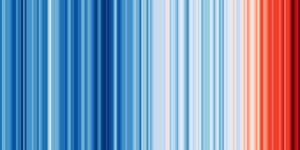
‘Warming stripes’ represent annual temperatures from 1850
to 2019, with darker reds representing the warmest years. Photograph:
Ed Hawkins
“It’s now official that we have just completed the warmest decade on
record, a reminder that the planet continues to warm as we continue to
burn fossil fuels,” said Prof Michael Mann at Penn State University in
the US.
While
instrumental temperature records stretch back to 1850, data from ice
cores indicate that today’s temperatures were last seen at least 100,000
years ago. Furthermore, the level of carbon dioxide is the highest it
has been for several million years, when the sea level was 15-20 metres
higher.
The four temperature datasets are compiled from many millions of
surface temperature measurements taken across the globe, from all
continents and all oceans. They are produced by the UK Met Office with
the University of East Anglia (UEA), both Nasa and Noaa in the US, and
Europe’s Copernicus Climate Change Service.
Small differences between the analyses arise from how data-sparse polar
regions are treated, but all agree that the past five years are the
warmest five years since each global record began.
The Met Office’s forecast for global average temperature for 2020
suggests this year could well set another record and is very likely to
be among the top three hottest. The UK government will host a critical
UN climate summit in Glasgow in November. The UN secretary general,
António Guterres, and many others are urging nations to increase
dramatically their pledges to cut carbon emissions, which would lead to global temperatures rising by a disastrous 3-4C.
“It is obvious we are not succeeding in preventing dangerous
anthropogenic interference with the climate system, which was the main
goal of the original 1992 UN climate change convention,” said Bob Ward,
of the Grantham Research Institute on Climate Change at the London
School of Economics.
“Even if we succeed in limiting warming to 1.5C, this would not be a
‘safe’ level of warming for the world,” he said. “Therefore we must
focus on cutting global emissions to net zero as soon as possible. We
know the transition to a net zero economy is the growth story of the
21st century.”
Rosie Rogers, of Greenpeace UK, said: “We’re breaking more records
than Usain Bolt, but there are no gold medals for dangerous temperature
rises, or the floods and fires that come with it. We cannot run away
from the climate emergency.”

No comments:
Post a Comment