Contemporary politics,local and international current affairs, science, music and extracts from the Queensland Newspaper "THE WORKER" documenting the proud history of the Labour Movement.
MAHATMA GANDHI ~ Truth never damages a cause that is just.
Saturday, 11 January 2020
Terror, hope, anger, kindness: the complexity of life as we face the new normal
Main image: A community facing catastrophe: New Year’s Eve in Mallacoota, East Gippsland,
In the faces of the bushfire victims we saw ourselves and our shared future. We can no longer shy away from reality
by James Bradley
Victoria.
Photograph: Rachel Mounsey/The Guardian
When
we come to write the history of climate politics in Australia, it’s
possible New Year’s Eve 2019 will be seen as the moment everything
changed. That was the day the nation – and indeed the world – watched in
horror and despair as the people of Mallacoota fled to the beach to escape the wall of flame bearing down on their town.
They weren’t the only ones fleeing the fire that day. In towns from
the Blue Mountains to the outskirts of Melbourne, communities were
facing catastrophe. But there was something about the images from
Mallacoota, the crowds of people and animals huddled on the sand in the
eerie red light that somehow brought not just the scale but the
uncanniness of the crisis home. “When Brueghel meets the Anthropocene,” a
friend of mine tweeted. More like Bosch, others replied.
It’s possible the reasons these images seem so resonant is the fact
they are on a beach, a place that occupies a curious duality in
Australian culture, serving as both the most potent symbol of our
national myth of egalitarianism and a theatre for our deepest anxieties
about both our nation’s origins and the possibility of invasion, whether
by aggressors or by refugees.
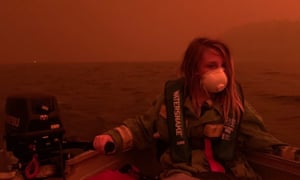
As if to underline that ambivalence, another image appeared not long
afterwards. Taken by Mallacoota resident Allison Marion, it showed her
11-year-old son, Finn, seated in the stern of a dinghy, one hand on the
tiller of an outboard engine, his eyes above the mask that obscures his
face wary and exhausted. Behind him the sky is deep orange, the sea
barely visible through the murk. A decade-and-a-half ago the writer
Robert Macfarlane wondered why the climate crisis lacked an iconography. It has one now.
But it’s difficult not to suspect New Year’s Eve was also the moment
many Australians realised we were in uncharted territory, that the
future so many of us had feared for so long had finally washed over us,
and we were completely unprepared.
The catastrophe that is still playing out on the eastern seaboard,
South Australia and Tasmania has been a long time coming yet still the
sheer scale of it is difficult to comprehend. At the time of writing 27
people have been killed, and an estimated 8.4 million hectares have burned
or are currently burning, an area larger than the whole of Ireland or
Austria. More than 1,800 homes have been destroyed, along with many
agricultural sheds and structures, and with them, lives and livelihoods.
Thousands of people have been evacuated, and many more stranded for
days or even longer with limited food, fuel or electricity.
The photo taken by Mallacoota resident Allison Marion showing her 11-year-old son, Finn, seated in the stern of a dinghy.
The
impact on livestock has also been horrifying. The National Farmers’
Federation estimates in excess of 100,000 sheep and cattle have been
killed, and hundreds of thousands more will have to be euthanised in
coming days. The Australian defence force has been mobilised to deal
with their carcasses – “to dig the pits”, as the federal agriculture minister, Bridget McKenzie, put it earlier this week.
Dead sheep are tipped into a mass grave on a property in
Cobargo on the New South Wales south coast, which was destroyed by fire
on New Year’s Day. Photograph: Andrew Quilty/The Guardian
In
many cases burned areas will never recover. Endangered plant species
confined to small areas are likely to have been wiped out; likewise the
sheer intensity of the fires will have destroyed not just the complex
and highly diverse communities of organisms that populate the forest
floor, but also the old-growth trees that shelter species such as
gliding possums and provide nesting sites for many birds. As biologist Prof John Woinarski of Charles Darwin University put it: “There are no winners … These fires are homogenising the landscape. They benefit no species.”
Rolling disasters
Away from the fires the impact has also been considerable. In Sydney, the city has been shrouded in smoke since early November, the stink of burning constantly in the air. Breathing masks have become a common sight on the streets. My younger daughter’s school began keeping the children in at lunchtime. On one of the worst days
a friend of mine who is an anaesthetist at one of Sydney’s major
hospitals texted me to say they had been forced to cancel his surgeries
because the air conditioners were pulling too much smoke into the
operating room. In the city, fire crews were run ragged responding to
fire alarms set off by the smoke, sending office workers spilling on to
the streets. In Canberra, where the smoke has intensified in recent weeks, things
are even worse: flights have been cancelled due to poor visibility,
government departments have told workers to remain at home, and the
National Library and Gallery were forced to close due to fears about the
smoke’s effect on their collections.
Bushfires leave thick, smoky haze across Australia's east coat – video
"If we are to find a way forward we will
need kindness as well as anger, empathy as well as rage, humility as
well as righteousness"
Overseas the story is the same. In the middle of last year, fires spread through the Arctic, igniting not just grassland but boreal peatlands dried out by unusually high temperatures in the region. In Brazil fires destroyed nearly 10,000 sq km of rainforest,
prompting warnings from scientists that the Amazon is now close to a
tipping point, beyond which its collapse will be unstoppable. In March Cyclone Idai
left more than 1,300 people dead in Madagascar, Mozambique, Zimbabwe
and Malawi. Indeed one report by British charity Christian Aid suggests
the changing climate amplified the effects of no less than 15 major disasters in 2019, while in July last year the UN warned climate change is now causing an average of one disaster a week.
There has been a lot of talk about adapting to the new normal
in recent weeks. But this is not the new normal. This is just the
beginning. The rolling disasters we are now experiencing are the result
of 1C of warming above pre-industrial averages. Even if the commitments
enshrined in the Paris agreement are met – something that looks extremely unlikely – we are on track for well over 2C of warming by the end of the century, while on current trends we are headed for 3C or 4C.
A world that is 3C or 4C hotter will be almost unrecognisable. Large
areas in equatorial and subequatorial regions will be effectively
uninhabitable. Sea levels will rise by many metres. Ecosystems around
the world will collapse, causing mass extinctions on land and in the
oceans. Hundreds of millions of people will die, while hundreds of
millions more will be displaced.
Sharnie Moran and her 18-month-old daughter, Charlotte,
as thick smoke rises from bushfires near Nana Glen, near Coffs Harbour
in November. Photograph: Dan Peled/AAP
Even at 2C our world will be irrevocably altered. According to the IPCC’s special report, Global Warming of 1.5C,
released in October 2018, 2C of warming will lead to significant
increases in both the incidence and severity of heatwaves and extreme
weather events, dramatically affect food production, especially in
south-east Asia, south and central America and sub-Saharan Africa,
leading to a “rapid evacuation” of people from tropical countries.
Tropical diseases will spread into formerly temperate areas. Sea levels
will rise by up to a metre by 2100, and continue rising for centuries
afterwards. The impacts on the natural world will be similarly
devastating: extinction rates will soar, ocean acidification and warming
waters will devastate marine life and coral reefs will disappear almost
entirely within a decade or two.
In fact, the IPCC’s advice is that to have any hope of avoiding dangerous climate change, we must hold warming to only 1.5C above pre-industrial averages.
At 1.5C, the world will be a much harder, less hospitable place than
the one we once knew. Heatwaves, droughts and disasters like those of
recent weeks will be more commonplace. Shortages of food and water will
affect only half as many people as they will at 2C, and the number of
people displaced might be held to only 50 million. Natural systems and
biodiversity will be irreparably damaged, but we might save 10% of coral
reefs, and sea level rise might be held to only half a metre by 2100.
As best-case scenarios go, this is pretty bleak. But it gets worse.
Because in order to have any chance of holding warming to 1.5C, net
global emissions need to reach zero by 2050, with close to half that
reduction taking place over the next 10 years. This isn’t going to be
achieved by installing solar panels or making meat-free Monday part of
our lives. It demands the transformation of every aspect of our
economies and societies in the space of a few years. In a world where
emissions are still rising year on year, where rightwing populism is on
the march and the international order looks shakier by the day, the odds
of this happening look vanishingly unlikely.
The brutal truth, in other words, is that things are going to get worse whatever we do. A lot worse. And probably quickly.
None of this is a secret, yet individually and collectively we have
grown skilled at not thinking about it. After all, how could we?
Acknowledging the truth would demand we recognise not just the scale of
the problem and its intractability, but also our part in it. The writer
Amitav Ghosh has described this elision of reality as “the great
derangement”. Yet with each new freak weather event or shattered record
or unprecedented disaster, it has become harder to keep pretending
things are OK, harder to keep the sense of rising panic at bay.
Protesters marched on PM Scott Morrison’s official
residence in Sydney to demand curbs on greenhouse gas emissions and
highlight his absence on an overseas holiday as bushfires burned across
NSW. Photograph: Wendell Teodoro/AFP via Getty Images
As the old joke goes, denial is a mighty river. Yet even it has its
limits. Fifty years ago the American psychiatrist Elisabeth Kübler-Ross
identified what she believed to be the five stages of grieving. First
comes denial, then anger, bargaining, depression and finally acceptance.
These stages are not necessarily clear-cut – witness the growing anger
of the millions of people who joined climate marches around the world
in recent months – but I suspect that for many people New Year’s Day
was the point where denial finally stopped being an option, and their
grief and terror finally coalesced into fury.
We
should be angry, of course. Incandescently angry. Because where we are
is not an accident. It is the result of decades of inaction by our
political leaders, of campaigns of lies and disinformation by fossil fuel companies
and their enablers in politics and the media, of pandering to special
interests and privileging greed over the futures of our children. In any
other field, people who knowingly ignored expert scientific advice
would be held liable for the death and destruction that flowed from
their actions. Yet our prime minister, the leader of a party that has done more to prevent action on climate change in this country than any other, a party that systematically ignored warnings from fire chiefs and scientific agencies in the lead-up to the disaster and was, even as the country burned, working to reduce emission reduction targets at the Madrid climate summit, refuses to countenance changes to his government’s climate policies.
How do we live when reality sinks in?
But the real question is what do we do when the anger subsides? How
do we live once our disbelief at the scale of the disaster fades and we
are left to grapple with the knowledge the world we knew has gone?
Climate scientist Joëlle Gergis has written about her increasing tendency to burst into tears,
as “the reality of what the science is saying manages to thaw the
emotionally frozen part of myself I need to maintain to do my job. In
those moments, what surfaces is pure grief”.
Orchardist Stephenie Bailey as she describes the impact
bushfires have had on her farm in Batlow, NSW. Photograph: Saeed
Khan/AFP via Getty Images
Kübler-Ross’ model grew out of her experiences with the terminally
ill, but our predicament is not entirely dissimilar. There is no magic
bullet or miracle cure that will save us. We cannot make this better.
Instead we face a future in which the only certainty is uncertainty and
loss, a future in which the choices we have made will shape the lives of
generations to come for centuries, and mostly for the worst.
Faced
with this reality we can sink into depression and despair. Or we can go
further, admit the old world has gone, and begin to fight to make
things better. This will not be easy. As the intransigence of Scott
Morrison and his government and the organised campaigns of disinformation about the causes of the fires already circulating on social media demonstrate, the forces opposing change are powerful, and will fight to the end.
But there are other forces at work as well. As if to underline the
historic failure of the federal government, it was ordinary people who
stepped into the breach in the aftermath of the fires, offering money, food, places to stay. I can’t have been the only one moved to tears by the sight of truckies and tradies gathering in Bairnsdale to help residents and holidaymakers stranded in the Gippsland,
or the images of members of the Muslim community in New South Wales and
Victoria who travelled hundreds of kilometres to cook food for exhausted firefighters and shattered communities. “We can’t fight fires but we can put a barbecue on,” one of the men told the ABC.
Their actions are a reminder that if we are to find a way forward we
will need kindness as well as anger, empathy as well as rage, humility
as well as righteousness. Yet we also need to recognise that just as
acceptance frees the terminally ill, it can liberate us to imagine a way
forward. The philosopher Donna Haraway speaks of the imperative of
“staying with the trouble”, of not shying away from reality but instead
inhabiting the present in all its complexity, terror, hope and joy and
recognising our kinship with those around us. Perhaps it is time we all
learned to do that, time we learned to recognise our own hopes and fears
in other people.
Because that is what many of us glimpsed in the faces of the people
on the beach in Mallacoota on New Year’s Eve. We saw ourselves, our
shared future, the terror and pain of what is coming. And we could no
longer look away.




No comments:
Post a Comment