The fairy penguins under my shack are gone, and soon the
forty-spotted pardalotes and swift parrots will join them. Our children
knew these birds; their children will not
I
am not a twitcher’s binocular strap, but I adore birds. I watch birds
for hours. Their freedom and joy move me. Something in their play and
way suggest minds far different than ours. A man I once met who kept
cockatoos told me that you have to be careful because they fuck with
your head.
And they do.
Birds
are an education to watch, and a liberation that never ends. I love
seeing the golden whistler sing so beautifully in its honeyed whistle to
its reflection in our shack kitchen window, like a lost troubadour. It
is a cliche but in this case nevertheless true to say that I feel my
soul soar in the heat thermals above when a sea eagle that nests in a
stag two kilometres down the coast arrives and circles and circles,
because it can, because it will, waiting, gyring freedom, while the
little songbirds nesting far below shriek a cacophony of terror,
absolute freedom’s corollary.And they do.
Few things induce volts of happiness in me like the common cranky fan (grey fantail) when it meets me near the water tank and bursts into its elaborate dance, up and down like a demented Mata Hari, if Mata Hari were a bird, only a metre or two away from my face.
Sometimes I even dance with it.
Cranky fans make perfectly shaped pipe nests – cobweb and moss delicately woven with threads of sheep’s wool and sheoak needles that trail off into twisting bark streamers as raffish as a Parisian’s scarf – as if with an eye for some aesthetic perfection that always delights me, and the sight of their tiny nestlings jigging their stuttering beaks and blind eyes up and down above such beauty, as if operated by some heaving hidden crankshaft, is, for me, one of the great joys of spring.
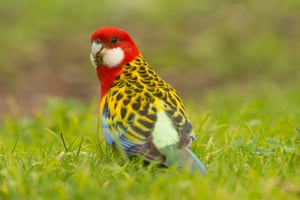
The sporting-strip plumage and loud yabber of the eastern rosellas strutting the table outside our kitchen like tradies having knock-off drinks, the soulful dirge of the boobook owl in the early hours, the bush cracking open when a Joe Witty (the grey shrike-thrush) sounds its wild whiplash call on a misty morning – all these things still strike me after so many years – or perhaps more so after so many years – as immeasurable gifts.
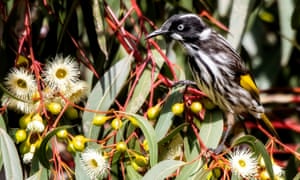
It may be that birds’ beauty is truth, but that truth is always complex. New Holland honeyeaters, like all tyrannical mobs, are at their heart fearful, swarming the banksia and adjacent birdbath not 10 metres from where I am writing this by first posting advance scouts ever closer to the target as surreptitiously as a special forces unit, before storming it and bullying all other birds out with a sudden large, raucous swarm. And that’s the thing: the lightness of birds is tempered by the Hobbesian world in which they live, where they can never admit pain or illness without risking attack from other birds.
Now though the attacks are of another order of threat.
This February I was on Maatsyker Island, south of Tasmania, and witnessed the spectacle of a vast sky darken in early evening as hundreds of thousands of muttonbirds came in from the sea to feed their young. Now “not insignificant numbers” of them are reported to be washing up dead on Alaskan beaches.
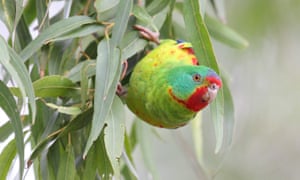
I like walking in Hobart’s great central bush park, the Queens Domain, where the last of the swift parrots, of which there are fewer than 2,000 left, nest in spring, little green missiles blurring above, searching for the last habitat not logged or cleared. They could be saved and, though some people gamely try, no government cares. When they are gone they will, no doubt, be used; perhaps as a number plate icon or a marketing logo for Tasmanian tourism. Their wonder and mystery though will be irrecoverable, and along with them there will have vanished a larger sense of what the world is and who we are in it.
Our shack’s bush block on Bruny Island is part of the remnant habitat for the last of the forty-spotted pardalotes, of which there are about 500 left, tiny clumpy wonders scarcely bigger than a large moth, smaller than a matchbox, with a very short tail that means they drop and bumble in the upper reaches of the white gum (Eucalyptus viminalis), the manna of whose leaves is their main food source. They gather in the blocked gutter above my writing room in late afternoon, their short soft chirrup announcing bathing time. They shimmer as they shake in the water, as if already only half here.
Yet we do.
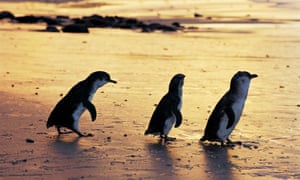
Enjoying the company of birds is also then to know an inconsolable sadness. The fairy penguins that once nested under the shack, chicks squawking all night for parents to return with food, are gone from our part of the coast. No one knows where or why. Soon the forty spots and the swifties will join them. Our children knew these things; their children will not.
We live in the twilight of things, granted one last glorious vision. Unequal to even bearing adequate witness to the wonder that is vanishing and unable to halt it, glimpsing in the destiny of these birds perhaps only our postponed future, I sometimes have a sense of the greatest foreboding when those birds of traditional omen, the yellow-tailed black cockatoos, pass overhead.
In the interminable space between each slow, forceful cut of air made by that bird’s great wingbeat – a whoomp strong enough that you can, if close, feel it as a draught – a deep silence opens out into the end of time itself.
And when that happens I go to the water tank, hoping that a cranky fan may yet dance with me.

No comments:
Post a Comment