Contemporary politics,local and international current affairs, science, music and extracts from the Queensland Newspaper "THE WORKER" documenting the proud history of the Labour Movement.
MAHATMA GANDHI ~ Truth never damages a cause that is just.
Friday, 10 March 2017
WA Nationals leader digs in on mining tax as BHP Billiton steps up attack
Brendon Grylls is going to the state election with a mining tax
proposal he says will recoup the government an extra $2.3bn a year – and
the industry is escalating its campaign to oust him
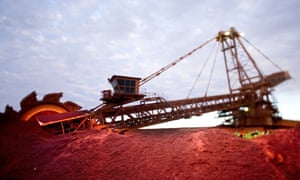
BHP Billiton’s iron ore is loaded in Port Hedland. A proposal for a
mining tax by local MP Brendon Grylls has been countered by a $5m
advertising campaign by the mining lobby.
Photograph: BHP Billiton
Five months ago, pictures of macaws started popping up on the
screensavers of employees at BHP Billiton’s iron ore operations in Port
Hedland, 1,500km north of Perth.
The colourful image came with a warning.
“Increasing WA iron ore royalties by $5 would make them seven times higher than our biggest competitor Brazil,” it read. “What’s at risk if WA mining is made uncompetitive?”
The target of the message was the local MP, Brendon Grylls. As leader of the Western Australian National party,
Grylls had suggested increasing a minor charge attached to some of the
state’s oldest and most established iron ore mines from $0.25 a tonne to
$5 a tonne, in line with inflation.
It’s a policy that could cost the 43-year-old his seat at Saturday’s
state election if a $5m advertising campaign by the mining lobby
succeeds in convincing his hardhat-wearing constituents that the
proposal could cost them their jobs.
Grylls says he’s not worried.
“I’m the member for the Pilbara, I wouldn’t have campaigned on it if I
thought it would put my seat of the Pilbara at risk,” he tells Guardian
Australia. “As for the rest of the voters in Western Australia, if the
Pilbara communities think that it would be fair to charge an updated
rental to BHP and Rio Tinto, well then, the rest of Western Australia should be quite happy with it because you would have thought that it would have the greatest effect in the Pilbara.”
It’s a risky strategy. Grylls’ electorate stretches from the Northern
Territory border to the coast just below Karratha, another mining hub
240km south-west of Port Hedland.
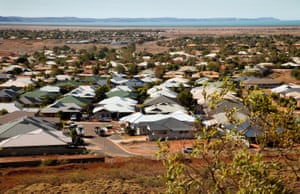
Homes in the mining town of Karratha in the Pilbara region. Photograph: Bloomberg via Getty Images
There are streets in Port Hedland where every house is owned by BHP Billiton, inhabited by a BHP Billiton employee who has been encouraged by the company to vote against Grylls.
At
the southern edge of the electorate sits Newman, a town founded by BHP
to house workers for the Mount Whaleback mine in the late 1960s. Mount
Whaleback was established under a state agreement in 1964 and is one of
the projects for which the special lease fee applies.
On Wednesday BHP Billiton stepped up its campaign, comparing the
proposed mining tax to cost pressures faced by the Australian car
industry, and again warning that Brazil could capture the market.
“The automotive industry here was not competitive globally and look
what the consequences were,” Mike Henry, head of BHP Billiton’s minerals
division in Australia, told the ABC. “We need to ensure that our industry remains competitive, [and is] able to compete with the Brazilians and others globally.”
Henry also suggested the company’s funding to community projects would have to be cut to make up the cost.
Despite the industry campaign, which Grylls said had been
“surprising” in its level of “personal vitriol”, he said he had received
“strong support” for the proposal on the campaign trail.
A ReachTel poll conducted for Fairfax Media
on Saturday found 39.4% of voters surveyed supported the policy and
37.1% opposed, a result both Grylls and the mining lobby quickly parsed
into a victory for their cause by each claiming the undecided 23.5%.
The $0.25 a tonne charge, called the special lease rental fee, was
negotiated in the 60s and never updated. It applies to mines operated by
BHP Billiton and Rio Tinto, the two biggest mining companies in
Australia, as well as the smaller Cliffs Natural Resources.
Under the proposal by the National party the fee increase would apply
only to BHP Billiton and Rio, companies that had successfully reduced
their cost of production to below US$30 a tonne in an attempt to
undercut their smaller competitors. With iron ore back trading around
US$90 a tonne, after dropping dangerously low in 2015-16, those
companies ought to be able to bear the extra cost.
In return the WA government would be able to recoup an extra $2.3bn a
year and attempt to plug the hole in the state budget, which crashed
along with commodities prices and is now headed towards a $3bn deficit
and a net debt of $41bn by 2020.
On
paper, it makes sense. Advertising by the National party compares the
increase to the change in the price of milk. The special lease fee was
set more than 50 years ago and is still referred to in some agreements
as two and sixpence, they argue. Why should it not be increased?
According to the mining lobby, the cost of imposing the tax would far
outweigh its value as a revenue source. In a report commissioned by the
Minerals Council of Australia, economists from Deloitte Access
Economics predicted it would cause the Australian economy to shrink by
$2.9bn a year and cause 7,200 job losses Australia-wide, of which 3,400
would be in WA and 2,900 would be in the Pilbara.
BHP Billiton and Rio Tinto together employ about 17,500 people in
their iron ore divisions in WA and a further 15,000 contractors.
The report also warned that unilaterally changing a state
agreement, which is a contractual arrangement set out in an act of
parliament, increased sovereign risk, made WA less attractive to
investors and could be unconstitutional.
“It really goes to the heart of sovereign risk and that’s why I think
there is the support [from the industry],” Reg Howard-Smith, chief
executive of the Chamber of Minerals and Energy of Western Australia,
tells Guardian Australia. “People have parked their competitive issues
and raised the bar and said: no, this is part of how the resource
industry operates in WA.”
Howard-Smith says despite Australia’s incredibly low sovereign risk
rating, compared with its direct competitors in iron ore, the increased
risk caused by unilaterally changing a state agreement, combined with an
additional cost that he put at $3bn a year, will make Australia a less
attractive place to do business.
Both mining companies already pay, at a conservative estimate, US$19 a tonne on royalties, taxes and other charges.
He also says there’s a strong argument that the special lease fee is
no longer applicable to the agreements as they operate today, because it
was imposed to help the state government recoup the set-up costs of
establishing towns and roads to support new mining projects, and those
towns are no longer company-controlled.
It’s a familiar playbook for the mining industry, which used many of
the same arguments, with great success, to oppose both the resources
super profits tax and the mineral resources rent tax.
In both cases the campaign played a significant role in the downfall
of a prime minister, first Kevin Rudd in 2010 then Julia Gillard in
2013.
“The whole story of the MRRT and Rudd and Gillard was that it worked,” says JeffreyWilson,
a senior lecturer in international political economy at Murdoch
University. “They basically brought down the prime minister on this. So
if it worked then, they’ll just give it another go.”
In a paper in the Australian Journal of Political Science,
published this month, Wilson analysed the campaign against the MRRT and
found there was no evidence the tax posed a direct threat to the
sustainability of the mining industry.
He also found that when it comes to the success of a campaign of this nature, the evidence, or lack of it, does not matter.
That’s particularly true in WA, he says, where mining companies
occupy some of the tallest towers in Perth’s St Georges Terrace business
district. “They own the Terrace and they own the WA Liberal party
completely,” he said.
The Liberal party, which has shared government with the Nationals for
the past nine years under the premier, Colin Barnett, but is not a
formal Coalition partner as the Liberal and National parties are in the
eastern states, opposes the lease increase. So too does the Labor party,
under the opposition leader, Mark McGowan, and One Nation, which has
targeted the Pilbara as part of a campaign to gain ground in regional WA
electorates.
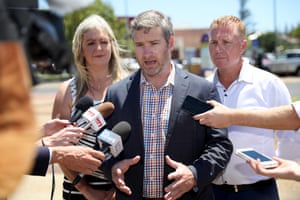
Brendon Grylls: ‘I wouldn’t have campaigned on [the
mining tax] if I thought it would put my seat of the Pilbara at risk.’
Photograph: Richard Wainwright/AAP
If Grylls retains his seat on Saturday, with the help of his existing
11.5% margin, the National party would have to get the balance of power
to have any chance of shepherding the proposed changes through
parliament.
“Whoever wins government is going to have to frame a budget in very
tricky financial circumstances for Western Australia,” he says.
“Household fees and charges are going to have to increase substantially
if you don’t have a new revenue source. Government programs are going to
have to be cut to try and stabilise the state’s finances.
“At that point every West Australian who has been bombarded on the TV
screen from the mining company’s ads is going to say, ‘Explain to me
again why we’re losing government services and infrastructure spending
and why our fees and charges are going up but BHP and Rio’s seem to be
quarantined and quarantined with the support of both Mark McGowan and
Colin Barnett?’ I think they’re going to find that very difficult to
defend.”

No comments:
Post a Comment