Contemporary politics,local and international current affairs, science, music and extracts from the Queensland Newspaper "THE WORKER" documenting the proud history of the Labour Movement.
MAHATMA GANDHI ~ Truth never damages a cause that is just.
Wednesday, 6 November 2019
Most countries' climate plans 'totally inadequate' – experts
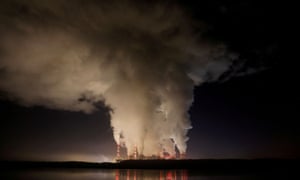
Smoke and steam billows from Bełchatów power station in Poland, Europe’s largest coal-fired power plant.
Photograph: Kacper Pempel/Reuters
The world is on a path to climate disaster, with three-quarters of
the commitments made by countries under the Paris agreement “totally
inadequate”, according to a comprehensive expert analysis.
Four nations produce half of all carbon emissions but the US has gone
into reverse in tackling the climate emergency under Donald Trump while
Russia has failed to make any commitment at all.
Other major oil-producing nations, including Saudi Arabia, United
Arab Emirates and Kuwait have set no targets to reduce emissions. China
and India are cleaning up their energy systems but their surging
economies mean emissions will continue to grow for a decade.
Under the 2015 Paris deal, countries agreed to limit global heating
to 2C, or 1.5C if possible. Each country makes a voluntary pledge of
climate action, but to date these would result in global temperatures
rising by a disastrous 3-4C. The Intergovernmental Panel on Climate
Change (IPCC) concluded in 2018 that emissions, which are still rising,
must fall by 50% by 2030 to be on track for 1.5C.
Only the 28 countries of the European Union and a few others
including Norway, Switzerland and Ukraine are on track. Of the 184
national Paris pledges made, 136 are judged insufficient in the report,
published by the Universal Ecological Fund.
Another problem is many pledges are unlikely to be met, due to the US withdrawing from the Paris agreement,
Brazil’s president, Jair Bolsonaro, reversing environmental policies,
or because poorer nations do not get the funding they need – the US and
Australia have stopped making such contributions.
“The
current pledges made under the Paris agreement are totally inadequate
to put us on a pathway to meet either the 1.5C or the 2C goal,” said the
report’s author, Prof Sir Robert Watson, a former IPCC chair and
scientific adviser to the UK and US governments. “With just 1C warming
so far, we are already seeing some very significant effects. The effects
at 3-4C will be very profound on people around the world.”
“When you see a country like Russia not even putting a pledge on the
table, it is extremely disturbing,” he said. “Saudi Arabia and Russia
rely heavily on their fossil fuels but that is no excuse. Those that
have not effectively made any pledges yet really should be shamed into
being part of the solution.”
Harvard University’s James McCarthy, a co-author of the report, said:
“Failing to reduce emissions drastically and rapidly will result in an
environmental and economic disaster from human-induced climate change.”
Failing to halve emissions by 2030 means the number of hurricanes,
severe storms, wildfires and droughts are likely double in number and
intensity, the scientists said, costing $2bn (£1,55bn) a day within a
decade. To avoid this, the scale of climate change action must double or
triple, they said.
The Paris agreement does allow for nations to ratchet up their commitments. “This report demonstrates we need to ratchet badly, and as quickly as possible,” said Watson.
China and India should be applauded for improving their energy
systems, he said, but their emissions must peak. However, Watson said it
was difficult to expect leadership from these nations when those with
the biggest historical emissions, like the US, were not doing so.
The report concluded that countries that had pledged between 20-40%
emission reductions by 2030 needed to do much better, including
Australia, Canada and Japan.
“Leaders need to adopt new policies to close coal-fired power plants
and promote renewable and carbon-free power sources such as wind, solar
and hydropower,” said McCarthy. That means closing 2,400 coal-fired
power stations around the world in the next decade and tackling the 250
new coal-powered units that are under construction.
Improved energy efficiency is also critical, said co-author Prof
Nebojsa Nakicenovic, at the International Institute for Applied Systems
Analysis in Austria, potentially saving households around the world
$500bn a year in energy bills.
From cars to homes to industry, he said, the potential of energy
efficiency was so great that if implemented no extra energy would be
required in 2030, despite the fact that global population was expected
to be 1.2bn higher than today.

No comments:
Post a Comment