Extract from The Guardian
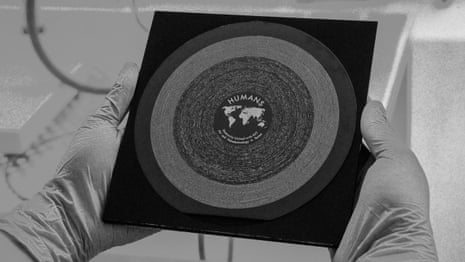
Following in the wake of the original Golden Records, a new deep-space delivery hopes to introduce a ‘mostly harmless’ humanity to alien life
-
Get our breaking news email, free app or daily news podcast
Do you have a message you want to shout out to the universe? Or whisper into the ear-equivalent of an alien?
In interstellar space, more than 20bn km from Earth, the Voyager spacecraft are whizzing along at more than 50,000 km/h.
Launched in 1977, they each carry a Golden Record – a gold-plated copper phonograph disk that contains information to introduce the human race to extraterrestrial beings.

The cover details instructions on how to play the record, a pulsar star map to show how to find our solar system (which could go terribly wrong) and a guide to when the craft was launched. The record itself has spoken greetings in 55 languages, and music from different cultures and eras – including two songs from Yolngu people, the traditional owners of Arnhem Land.
Humans are mostly harmless, however people eat pineapple on pizza. Don’t judge
Almost 50 years later, Australians have the chance to record a new message to send into deep space, in answer to the question: “What would you like the universe to remember about our story on Earth?”
More than 1,700 people have already contributed through the Humanity United with MIT Art and Nanotechnology in Space (HUMANS) Deep Space Message project via its collaboration with Sydney’s Powerhouse Museum.
People recorded messages at last year’s International Astronautical Congress, and have until 27 February to add their own voice note to far-flung civilisations through the Powerhouse’s portal.
“Hello friends in space, I’m nine years old and I live on Earth. I love looking at the stars at night and imagining who might be out there,” one says. “I want you to know that we’re curious about you and hope you are happy where you are.
“Earth is OK. Full of oceans, trees, animals and people.”

Another says “humans are really stupid and feeble and tiny, but that is what makes us so great”. “The fact that we can find meaning and life in small things, that our lives can amount to nothing but mean everything all at once. We are a speck in the universe but that is OK.”
Sign up: AU Breaking News email
And a third is set to import one of Earth’s biggest controversies into an alien world.
“Humans are mostly harmless, however people eat pineapple on pizza,” it says.
“Don’t judge.”
The project has previously launched messages to the International Space Station and to the moon, while the current project will be launched on a space mission to mark the Voyagers’ 50th anniversary next year, with the audio then broadcast into deep space.

The contents of the original Golden Record were picked by a committee chaired by the late, great scientist and science communicator Carl Sagan, while the HUMANS project is far more democratic.
“It makes you focus on what it is about me, my world, and my place in the world that you want to tell about humans and human life,” the chief executive officer of the Powerhouse Museum, Lisa Havilah, says.
“Even that word ‘human’ connects us deeply … we are one – it shows the sameness of us all even in our extreme diversity.”
Dr Maya Nasr, a Harvard University science engineer and the project lead and co-founder, collaborated with Massachusetts Institute of Technology researchers who developed the silicone nano wafer that will carry the audio.
She says the messages are “really, deeply human”, with themes including love of family and friends, hope and the future, identity, culture, language and belonging, and everyday life on Earth. Some are playful, some talk about peace and unity, some describe the planet, its oceans and animals, and some are more existential, about time and mortality.
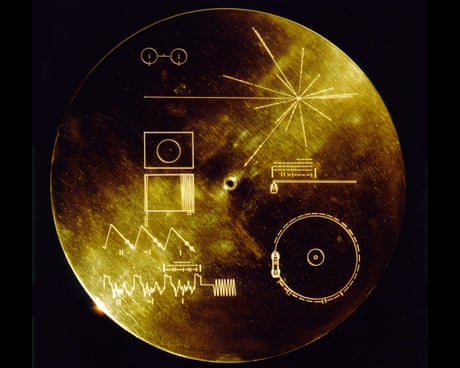
“The Golden Record was always an outward gesture of who we were in the 1970s to extraterrestrials, if they existed,” she says.
“And HUMANS was really inspired by that legacy, but what we really want is to be an inward reflection of who we are, and to connect people through that.
“Right now, when the world feels very fragmented, this project reminds us of the importance of finding some element of a shared story as humanity.”

Nasr says the message will travel out into deep space, and degrade to become part of the pattern of the universe, but that the project is more about thinking about the question of the Earth’s story.
“I think the act of thinking about this … makes us more aware of how fragile and rare life on Earth is, even if we are alone … The silence of the universe kind of asks us more about who we are, when no one answers back.”
But she does think it’s likely there is life out there, considering the vastness of space.
“It would be really extraordinary if life only existed once,” she says.
“I think it’s really hard to believe that we’re the only experiment that life ever tried.”
Nasr, who is Lebanese, recorded her message for the universe in Arabic. It translates as: “I would like the universe to remember that we carried contradictions within us while searching for meaning. That we were human beings who dreamed, made mistakes, loved, and created memories.
“That our story was not only about our achievements, but about the small moments between us, our love, our uncertainty, our constant attempts, because that is what made life worth living.”

No comments:
Post a Comment