Contemporary politics,local and international current affairs, science, music and extracts from the Queensland Newspaper "THE WORKER" documenting the proud history of the Labour Movement.
MAHATMA GANDHI ~ Truth never damages a cause that is just.
Thursday, 9 March 2017
Renewable energy spike led to sharp drop in emissions in Australia, study shows
Surge in October last year helped greenhouse gas emissions fall by 3.57m tonnes in December quarter
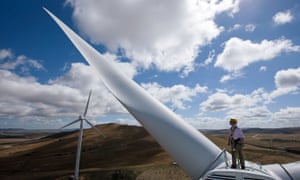
Australia’s greenhouse gas emissions fell in the three months to
December, putting them back on track to meet quarterly commitments made
in Paris.
Photograph: Bloomberg via Getty Images
A sharp drop in Australia’s greenhouse gas emissions at the end of
last year came courtesy of a spike in renewable energy generation in a
single month, according to a new study.
Australia’s emissions fell by 3.57m tonnes in the three months to
December, putting them back on track to meet quarterly commitments made
in Paris after a blowout the previous quarter.
The fall is the largest for the quarter since the government began
recording emissions in 2001. The report’s authors said this was entirely
due to record levels of hydro and wind generation in October. This
brought emissions for the year to December to below the year to December
2015.
But projected emissions for the December quarter were still 6.89m
tonnes over levels demanded by scientifically based targets set by the
government’s Climate Change Authority.
And, long term, the results show Australia is set to run more than
300m tonnes over what is required to meet its Paris targets in 2030.
The analysis was produced by Ndevr Environmental, which analyses data
for all Australia’s major emissions sources and compares the results
with the government’s commitments made in Paris and the cuts recommended
by the Climate Change Authority.
It aims to produce a more timely account than the government’s, which is six to nine months behind.
In the four years to December 2016, Australia emitted 20.7% of its
share of what the world can emit between 2013 and 2050 if it intends to
maintain a good chance of keeping warming to below 2C.
If Australia continues to emit carbon pollution at the average rate
of the past year, it will spend its entire carbon budget by December
2031. Projected to the current second, the graphic shows how much of the
carbon budget has been spent.
Matt Drum, the managing director of Ndevr Environmental, said the
figures showed renewable energy was “the only thing that’s keeping us in
the ballgame” of meeting climate commitments.
Wind power supplied 6.4% of all national electricity market
generation in October. The contribution of hydro electricity was “due in
big part to all the rainfall around the Snowy mountains catchment area
in NSW, which saw NSW emissions intensity figures drop significantly”,
Drum said.
With the electricity sector the largest and most variable factor in
Australia’s emissions, these October spikes in renewables were alone
enough to drive the quarter “under the trajectory we need for Paris”, he
said.
But Drum said this was likely an aberration, with the return to power
sector reliance on black coal, particularly for NSW, set to push the
trajectory up again over a summer with record temperatures across the
east coast.
“We’re still churning through our carbon budget pretty quickly and,
if you run a trend line from when we made our Paris commitment, we’re
still way over and getting further and further behind,” Drum said.
He said renewable energy was the single key factor driving down
Australia’s emissions profile, ironically at a time when the sector was
under attack from the federal government.
Coalition government figures have sought to blame renewables for blackouts in South Australia, despite others pointing to energy market failures.
Government figures including the prime minister, Malcolm Turnbull,
have attacked more ambitious state renewables targets as unfeasible and
talked up the benefits of new coal-fired power stations and channelling “clean energy” funding towards them.
Drum said the government was “undermining the only policy lever that’s having any impact on our emissions trajectory”.
“The only thing that’s keeping us in the ballgame at all is our
renewable energy generation,” he said. “This makes sense when there’s no
other feasible carbon policy on the table at the moment. ERF [the
emissions reduction fund] isn’t doing it. Direct Action more broadly
isn’t going anywhere near it …
“But if they want to peel back renewables, there’s nothing left.”
An independent review of the state of Australia’s environment released on Monday found the impacts of climate change were increasing and some could be irreversible.
The environment minister, Josh Frydenberg, in a column for Guardian Australia,
said the report “makes clear that, for the world to meet its Paris
goals, there is much more to do”. He noted carbon emissions per capita
had declined from 24.1 tonnes in 2011 to 22.2 tonnes in 2015.
But the report showed Australia needed to “put in place a
coordinated, comprehensive, well-resourced, long-term response” or risk
leaving “a legacy to future generations that is inferior to the one we
have inherited”, Frydenberg said.
Late last year the government began a review of its Direct Action climate policy, which has been widely criticised by experts as inadequate if Australia is to meet its Paris targets.
Shortly afterwards Frydenberg was forced to rule out converting Direct Action to a form of carbon trading after an internal Coalition revolt. Many experts and institutional investors
argue carbon trading would allow Australia to cut emissions in line
with Paris commitments at the least cost to households and businesses.
The carbon budget recommended by the Climate Change Authority, which it described as “equitable and feasible”,
was never agreed to by the government but represents the authority’s
view of Australia’s fair share if global warming is to be kept under 2C.
Direct Action is the federal government’s primary carbon reduction
tool, which pays polluters to pollute less through a reverse auction –
the emissions reduction fund.
There is no evidence the emissions bought through that fund, now
largely spent, reduce overall emissions and many of the emissions the
government pays to avoid are unlikely to have occurred anyway.

No comments:
Post a Comment