Contemporary politics,local and international current affairs, science, music and extracts from the Queensland Newspaper "THE WORKER" documenting the proud history of the Labour Movement.
MAHATMA GANDHI ~ Truth never damages a cause that is just.
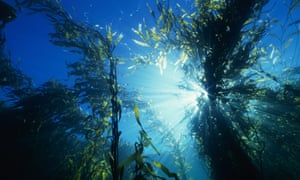
Ocean heatwaves destroy kelp forests, which provide food and shelter for many other species.
Photograph: Thomas Schmitt/Getty Images
The number of heatwaves affecting the planet’s oceans has increased
sharply, scientists have revealed, killing swathes of sea-life like
“wildfires that take out huge areas of forest”.
The damage caused in these hotspots is also harmful for humanity,
which relies on the oceans for oxygen, food, storm protection and the
removal of climate-warming carbon dioxide the atmosphere, they say.
Global warming is gradually increasing the average temperature of the
oceans, but the new research is the first systematic global analysis of
ocean heatwaves, when temperatures reach extremes for five days or
more.
The research found heatwaves are becoming more frequent, prolonged
and severe, with the number of heatwave days tripling in the last couple
of years studied. In the longer term, the number of heatwave days
jumped by more than 50% in the 30 years to 2016, compared with the
period of 1925 to 1954.
As heatwaves have increased, kelp forests, seagrass meadows and coral
reefs have been lost. These foundation species are critical to life in
the ocean. They provide shelter and food to many others, but have been
hit on coasts from California to Australia to Spain.
“You
have heatwave-induced wildfires that take out huge areas of forest, but
this is happening underwater as well,” said Dan Smale at the Marine
Biological Association in Plymouth, UK, who led the research published in Nature Climate Change.
“You see the kelp and seagrasses dying in front of you. Within weeks or
months they are just gone, along hundreds of kilometres of coastline.”
As well as quantifying the increase in heatwaves, the team analysed
116 research papers on eight well-studied marine heatwaves, such as the
record-breaking “Ningaloo Niño” that hit Australia in 2011 and the hot
“blob” that persisted in the north-east Pacific from 2013 to 2016. “They
have adverse impacts on a wide range of organisms, from plankton to
invertebrates, to fish, mammals and seabirds,” Smale said.
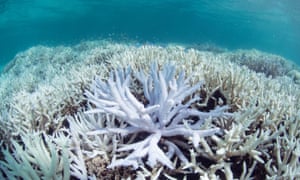
Bleached coral in New Caledonia in the southern Pacific. Photograph: AP
The scientists compared the areas where heatwaves have increased most
with those areas harbouring rich biodiversity or species already near
their temperature limit and those where additional stresses, such as
pollution or overfishing, already occur. This revealed hotspots of harm
from the north-east Atlantic to the Caribbean to the western Pacific. “A
lot of ocean systems are being battered by multiple stresses,” Smale
said.
The
natural ocean cycle of El Niño is a key factor in pushing up
temperatures in some parts of the ocean and the effect of global warming
on the phenomenon remains uncertain, but the gradual overall heating of
the oceans means heatwaves are worse when they strike.
“The starting temperature is much higher, so the absolute
temperatures [in a heatwave] are that much higher and more stressful,”
said Smale. Some marine wildlife is mobile and could in theory swim to
cooler waters, but ocean heatwaves often strike large areas more rapidly
than fish move, he said.
The researchers said ocean heatwaves can have “major socioeconomic
and political ramifications”, such as in the north-west Atlantic in
2012, when lobster stocks were dramatically affected, creating tensions
across the US-Canada border.
“This [research] makes clear that heatwaves are hitting the
ocean all over the world … The ocean, in effect, is spiking a fever,”
said Prof Malin Pinsky, at Rutgers University, US, and not part of the
team. “These events are likely to become more extreme and more common in
the future unless we can reduce greenhouse gas emissions.”
Dr Éva Plagányi at the Commonwealth Scientific and Industrial
Research Organisation (CSIRO) in Australia also likened ocean heatwaves
to wildfires. “Frequent big hits can have long-lasting effects,” she
said. “This study shows that record-breaking events are becoming the new
normal.”
The damage global warming is causing to the oceans has also been
shown in a series of other scientific papers published in the last week.
Ocean warming has cut sustainable fish catches by 15% to 35% in five regions, including the North Sea and the East China Sea, and 4% globally, according to work published by Pinsky and colleagues.
“We were stunned to find that fisheries around the world have already
responded to ocean warming,” he said. Another study showed that
achieving the 2C climate change target set out in the Paris agreement
would protect almost 10m tonnes of fish catches each year, worth tens of billions of dollars.
Separate work by Plagányi’s team showed that climate change will reverse the recovery of whales in the Southern Ocean
by damaging the krill on which they feed. “Models predict concerning
declines, and even local extinctions by 2100, for Pacific populations of
blue and fin whales, and Atlantic and Indian Ocean fin and humpback
whales,” they said.
“In the space of one week, scientific publications have underscored
that unless we take evasive action, our future oceans will have fewer
fish, fewer whales and frequent dramatic shifts in ecological structure
will occur, with concerning implications for humans who depend on the
ocean,” said Plagányi.

No comments:
Post a Comment