Australia’s six hottest days on record were all in December 2019 and
average rainfall across the country that month was the lowest on record
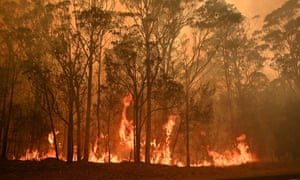
More than three-quarters of the Australian continent experienced the
worst fire weather conditions on record last month as 2019 set new
benchmarks for heat and dryness across the country.
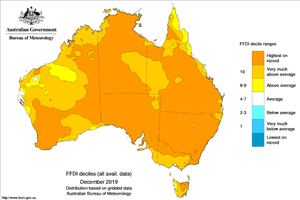
Nearly all of New South Wales, Queensland and South Australia, most of the Northern Territory, significant parts of Victoria including east Gippsland and populated areas in south-western Western Australia and north-eastern Tasmania set new records for accumulated fire risk for December, the Bureau of Meteorology says.
Most of the rest of the country, including southern Victoria and Tasmania, had scores on the forest fire danger index that were “very much above average” – in the worst 10% recorded.
Nearly all of New South Wales, Queensland and South Australia, most of the Northern Territory, significant parts of Victoria including east Gippsland and populated areas in south-western Western Australia and north-eastern Tasmania set new records for accumulated fire risk for December, the Bureau of Meteorology says.
Most of the rest of the country, including southern Victoria and Tasmania, had scores on the forest fire danger index that were “very much above average” – in the worst 10% recorded.
Average rainfall across the country in December was the lowest on record. Across the year it was 277.6 millimetres, about 40% below average. It was 11% lower than the previous record, set in 1902.
Australia’s six hottest days on record were all in December 2019. The average maximum temperature across the continent was above 40C on 11 days in the month, smashing the previous annual record of seven, set in 2018. Only four days between 1910 and 2017 averaged more than 40C, two in 1972-73 and two in 2013.
Karl Braganza, the bureau’s head of climate monitoring, said: “That’s really quite stark.”
Across the year, Australian temperatures were 1.52C above the long-term average and 0.19C warmer than 2013, the previous record holder. Maximum temperatures were hotter still: 2.09C above average. The data is drawn from the bureau’s long-term ACORN-SAT data.
Braganza said there were clear decades-long trends of maximum, minimum and average temperatures increasing across Australia.
Average temperatures have increased about 1.4C since 1910. There are fewer colder than average days and five times more days of extreme heat than in the middle of last century.
He said there was also quite clear evidence that rainfall in south-western Western Australia and parts of the south-east of the country had decreased. The fire season was months longer in some locations, particularly along the south-coast and in east Gippsland, and there was more dangerous fire weather during the fire season.
Asked about the role of hazard reduction in preventing bushfires, Braganza said climate change interacted with other risks, including reducing the window of time in which safe hazard reduction could be carried out.
He said dry and warm conditions were often coupled, but this was the first year on record to set a new benchmark for both heat and dryness. “When the continent is dry and soil moisture is very low you get less evaporative cooling and the temperatures tend to go up,” he said.
Australia’s national bushfire crisis has burned 10.7m hectares of land, killed at least 26 people and pushed countless species towards extinction.
Across the globe, 2019 was the second hottest year on record and the warmest without an El Niño event over the Pacific Ocean.
Looking ahead, Braganza said there were signs the delayed northern monsoon that brings rain to northern Australia was starting to get active, but people should not expect widespread above average rainfall. He said temperatures were expected to continue to be above average.

No comments:
Post a Comment