Scott Morrison says the final cost of the Australia fires is likely to rival the $5.6bn for cyclone Yasi and the Brisbane floods
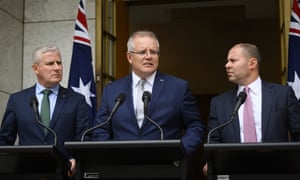
The prime minister, Scott Morrison,
has announced at least $2bn for bushfire recovery, as the government
steps away from its pledge to deliver a budget surplus amid the ongoing
crisis.
Warning that the fires would keep burning over the coming months, Morrison said further government funds may yet be forthcoming as the economic toll from the horror fire season continued to rise.
“The fires are still burning, and they will be burning for months to come,” Morrison said. “If further funds are required, further funds will be provided.”
He said that across government “significant and massive” financial commitments were being made, with the final cost likely to rival the $5.6bn paid out in disaster recovery assistance over six years following cyclone Yasi and the Brisbane floods.
After meeting on Monday morning, cabinet signed off on an initial
$2bn for a national bushfire recovery fund to be used to support the
rebuilding of community infrastructure and to help affected farmers and
businesses.Warning that the fires would keep burning over the coming months, Morrison said further government funds may yet be forthcoming as the economic toll from the horror fire season continued to rise.
“The fires are still burning, and they will be burning for months to come,” Morrison said. “If further funds are required, further funds will be provided.”
He said that across government “significant and massive” financial commitments were being made, with the final cost likely to rival the $5.6bn paid out in disaster recovery assistance over six years following cyclone Yasi and the Brisbane floods.
This would include funding for roads and telecommunications, the restocking and replenishing of livestock for primary producers, mental health support, funding to attract tourists back to the regions and environmental restoration.
The $2bn is in addition to disaster recovery payments and allowances for those affected, which have so far totalled more than $100m.
The government also announced 20 Service Australia pop-ups would be set up to help people access government disaster payments, while mutual obligation and debt recovery for welfare payments in nominated areas would also be suspended.
“Today’s cabinet was one of great resolve; it was one where we stood together and said, ‘whatever it takes, whatever it costs, we will ensure the resilience and future of this country’, and we will do it by investing in the work that needs to be done,” Morrison said.
When asked if the economic impact of the fires could jeopardise the $5bn surplus forecast for the 2019-20 year – the first in 12 years and a key election promise – Morrison said the government was not focused on the financial cost.
“The surplus is of no focus for me, what matters to me is the human cost and meeting whatever costs we need to meet,” he said.
“I can tell you this: being in the position of strength we are in now enables us to give what is one of the most significant, if not most significant, response to a crisis of this kind the country has seen.”
Morrison argued that the government was putting the surplus “straight to work” to meet the needs of Australians, without having to put in place extra levies or make cuts.
The treasurer, Josh Frydenberg, said it was “too early to tell” what the full economic cost of the bushfires would be, but emphasised the government had never seen the surplus as an “end in itself”, despite it being a prominent feature of this year’s budget.
Frydenberg said he would be meeting with the Australian Insurance Council, regulators and company chiefs on Tuesday to ensure insurance payments flowed to affected individuals as quickly as possible, with 6,000 payments totalling almost $400m already paid out.
The treasurer also said the Australian Taxation Office had agreed to a two-month deferral for the tax obligations of people living in fire-affected areas, and banks were also assisting.
“People should not be concerned about their tax affairs at this time,” he said.
Earlier, Greg Mullins, who chairs the Emergency Leaders for Climate Change group, welcomed extra resources from the federal government, but said they had been snubbed when a request was first made in April.
“It’s great to see things finally moving but I hope in the future this government will learn to listen to people on the front line,” Mullins said.
He also criticised the government’s inaction on climate change, saying it was a “load of rubbish” that the Coalition was taking strong action, with its ability to meet the Paris emission reduction targets based on its earlier “weak” Kyoto targets.
“I worry for my grandchildren, their grandchildren. If this is how it is now, this is driven by climate change, imagine what future generations are up against.”
Morrison was again asked on Monday about the Coalition’s climate change policies, which the former Liberal deputy leader Julie Bishop had criticised for lacking in global leadership.
“We should be showing leadership on the issue of climate change. I attended a number of international conferences and countries do look to Australia for direction, for guidance and leadership. And I believe we should be showing leadership on the issue of climate change,” Bishop told Nine’s Today show.
Morrison said his focus was on the $2bn package.
“The government will continue to work to meet and beat the commitments we have made for emission reductions,” Morrison said, emphasising that Bishop was part of the cabinet that signed off on the Coalition’s policy.
The opposition leader, Anthony Albanese, supported the funding for the recovery agency, saying Labor had been calling for greater federal assistance.
“It’s good that the government is now making a number of announcements that we have argued for, including the need for a national response, including the economic compensation for volunteer firefighters, including the upgrade of our aerial firefighting capacity, and the increased use of the defence force,” Albanese said.

No comments:
Post a Comment