Contemporary politics,local and international current affairs, science, music and extracts from the Queensland Newspaper "THE WORKER" documenting the proud history of the Labour Movement.
MAHATMA GANDHI ~ Truth never damages a cause that is just.
Monday, 16 September 2019
The world has a third pole – and it's melting quickly
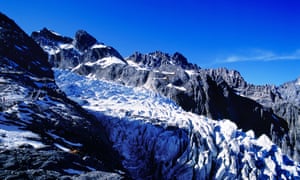
The Mingyong glacier at the foot of Khawa Karpo.
Photograph: Tao Images Limited/Alamy Stock Photo
Many moons ago in Tibet, the Second Buddha transformed a fierce nyen (a malevolent mountain demon) into a neri
(the holiest protective warrior god) called Khawa Karpo, who took up
residence in the sacred mountain bearing his name. Khawa Karpo is the
tallest of the Meili mountain range, piercing the sky at 6,740 metres
(22,112ft) above sea level. Local Tibetan communities believe that
conquering Khawa Karpo is an act of sacrilege and would cause the deity
to abandon his mountain home. Nevertheless, there have been several
failed attempts by outsiders – the best known by an international team
of 17, all of whom died in an avalanche during their ascent on 3 January
1991. After much local petitioning, in 2001 Beijing passed a law
banning mountaineering there.
However,
Khawa Karpo continues to be affronted more insidiously. Over the past
two decades, the Mingyong glacier at the foot of the mountain has
dramatically receded. Villagers blame disrespectful human behaviour,
including an inadequacy of prayer, greater material greed and an
increase in pollution from tourism. People have started to avoid eating
garlic and onions, burning meat, breaking vows or fighting for fear of unleashing the wrath of the deity.
Mingyong is one of the world’s fastest shrinking glaciers, but locals
cannot believe it will die because their own existence is intertwined
with it. Yet its disappearance is almost inevitable.
Khawa Karpo lies at the world’s “third pole”. This is how glaciologists refer to the Tibetan plateau, home to the vast Hindu Kush-Himalaya ice sheet,
because it contains the largest amount of snow and ice after the Arctic
and Antarctic – about 15% of the global total. However, a quarter of its ice has been lost since 1970. This month, in a long-awaited special report on the cryosphere
by the Intergovernmental Panel on Climate Change (IPCC), scientists
will warn that up to two-thirds of the region’s remaining glaciers are
on track to disappear by the end of the century. It is expected a third
of the ice will be lost in that time even if the internationally agreed
target of limiting global warming by 1.5C above pre-industrial levels is
adhered to.
Whether we are Buddhists or not, our lives affect, and are affected
by, these tropical glaciers that span eight countries. This frozen
“water tower of Asia” is the source of 10 of the world’s largest rivers,
including the Ganges, Brahmaputra, Yellow, Mekong and Indus, whose
flows support at least 1.6 billion people directly – in drinking water,
agriculture, hydropower and livelihoods – and many more indirectly, in
buying a T-shirt made from cotton grown in China, for example, or rice
from India.
Joseph
Shea, a glaciologist at the University of Northern British Columbia,
calls the loss “depressing and fear-inducing. It changes the nature of
the mountains in a very visible and profound way.”
Yet the fast-changing conditions at the third pole have not received
the same attention as those at the north and south poles. The IPCC’s
fourth assessment report in 2007 contained the erroneous prediction that
all Himalayan glaciers would be gone by 2035.
This statement turned out to have been based on anecdote rather than
scientific evidence and, perhaps out of embarrassment, the third pole
has been given less attention in subsequent IPCC reports.
There is also a dearth of research compared to the other poles, and
what hydrological data exists has been jealously guarded by the Indian
government and other interested parties. The Tibetan plateau is a vast
and impractical place for glaciologists to work in and confounding
factors make measurements hard to obtain. Scientists are forbidden by
locals, for instance, to step out on to the Mingyong glacier, meaning
they have had to use repeat photography to measure the ice retreat.
In the face of these problems, satellites have proved
invaluable, allowing scientists to watch glacial shrinkage in real time.
This summer, Columbia University researchers also used declassified
spy-satellite images from the cold war to show that third pole ice loss
has accelerated over this century and is now roughly double the melt
rate of 1975 to 2000, when temperatures were on average 1C lower.
Glaciers in the region are currently losing about half a vertical metre
of ice per year because of anthropogenic global heating, the researchers concluded.
Glacial melt here carries significant risk of death and injury – far
more than in the sparsely populated Arctic and Antarctic – from glacial
lake outbursts (when a lake forms and suddenly spills over its banks in a
devastating flood) and landslides caused by destabilised rock. Whole
villages have been washed away and these events are becoming
increasingly regular, even if monitoring and rescue systems have
improved. Satellite data shows that numbers and sizes of such risky
lakes in the region are growing. Last October and November, on three
separate occasions, debris blocked the flow of the Yarlung Tsangpo in
Tibet, threatening India and Bangladesh downstream with flooding and
causing thousands to be evacuated.
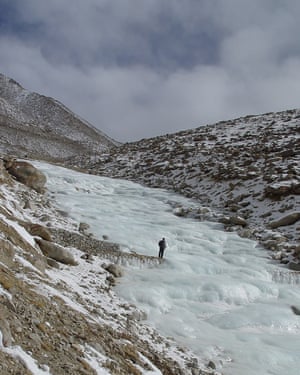
An artificial glacier in Ladakh, created by engineer and farmer Chewang Norphel. Photograph: Chewang Norphel
One
reason for the rapid ice loss is that the Tibetan plateau, like the
other two poles, is warming at a rate up to three times as fast as the
global average, by 0.3C per decade. In the case of the third pole, this
is because of its elevation, which means it absorbs energy from rising,
warm, moisture-laden air. Even if average global temperatures stay below
1.5C, the region will experience more than 2C of warming; if emissions
are not reduced, the rise will be 5C, according to a report released earlier this year
by more than 200 scientists for the Kathmandu-based International
Centre for Integrated Mountain Development (ICIMOD). Winter snowfall is
already decreasing and there are, on average, four fewer cold nights and
seven more warm nights per year than 40 years ago. Models also indicate
a strengthening of the south-east monsoon, with heavy and unpredictable
downpours. “This is the climate crisis you haven’t heard of,” said
ICIMOD’s chief scientist, Philippus Wester.
There is another culprit besides our CO2 emissions in this warming story, and it’s all too evident on the dirty surface of the Mingyong glacier: black carbon, or soot. A 2013 study
found that black carbon is responsible for 1.1 watts per square metre
of the Earth’s surface of extra energy being stored in the atmosphere
(CO2 is responsible for an estimated 1.56 watts per square
metre). Black carbon has multiple climate effects, changing clouds and
monsoon circulation as well as accelerating ice melt. Air pollution from
the Indo-Gangetic Plains – one of the world’s most polluted regions –
deposits this black dust on glaciers, darkening their surface and
hastening melt. While soot landing on dark rock has little effect on its
temperature, snow and glaciers are particularly vulnerable because they
are so white and reflective. As glaciers melt, the surrounding rock
crumbles in landslides, covering the ice with dark material that speeds
melt in a runaway cycle. The Everest base camp, for instance, at 5,300
metres, is now rubble and debris as the Khumbu glacier has retreated to the icefall.
The immense upland of the third pole is one of the most ecologically
diverse and vulnerable regions on Earth. People have only attempted to
conquer these mountains in the last century, yet in that time humans
have subdued the glaciers and changed the face of this wilderness with
pollution and other activities. Researchers are now beginning to
understand the scale of human effects on the region – some have
experienced it directly: many of the 300 IPCC cryosphere report authors
meeting in the Nepalese capital in July were forced to take shelter or
divert to other airports because of a freak monsoon.
But
aAside from such inconveniences, what do these changes mean for the 240
million people living in the mountains? Well, in many areas, it has
been welcomed. Warmer, more pleasant winters have made life easier. The
higher temperatures have boosted agriculture – people can grow a greater
variety of crops and benefit from more than one harvest per year, and
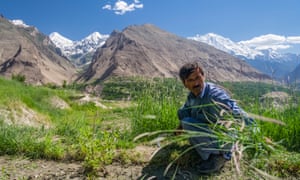
that improves livelihoods. This may be responsible for the so-called Karakoram anomaly,
in which a few glaciers in the Pakistani Karakoram range are advancing
in opposition to the general trend. Climatologists believe that the
sudden and massive growth of irrigated agriculture in the local area,
coupled with unusual topographical features, has produced an increase in
snowfall on the glaciers which currently more than compensates for their melting.
Elsewhere, any increase in precipitation is not enough to counter the
rate of ice melt and places that are wholly reliant on meltwater for
irrigation are feeling the effects soonest. “Springs have dried
drastically in the past 10 years without meltwater and because
infrastructure has cut off discharge,” says Aditi Mukherji, one of the
authors of the IPCC report.
A man tends a vegetable plot in the Karakoram range. Photograph: Luis Dafos/Getty Images
Known as high-altitude deserts, places such as Ladakh in
north-eastern India and parts of Tibet have already lost many of their
lower-altitude glaciers and with them their seasonal irrigation flows,
which is affecting agriculture and electricity production from
hydroelectric dams. In some places, communities are trying to
geoengineer artificial glaciers that divert runoff from higher glaciers
towards shaded, protected locations where it can freeze over winter to
provide meltwater for irrigation in the spring.
Only a few of the major Asian rivers are heavily reliant on glacial
runoff – the Yangtze and Yellow rivers are showing reduced water levels
because of diminished meltwater and the Indus (40% glacier-fed) and
Yarkand (60% glacier-fed) are particularly vulnerable. So although
mountain communities are suffering from glacial disappearance, those
downstream are currently less affected because rainfall makes a much
larger contribution to rivers such as the Ganges and Mekong as they
descend into populated basins. Upstream-downstream conflict over
extractions, dam-building and diversions has so far largely been averted
through water-sharing treaties between nations, but as the climate
becomes less predictable and scarcity increases, the risk of unrest
within – let alone between – nations grows.
Towards
the end of this century, pre-monsoon water-flow levels in all these
rivers will drastically reduce without glacier buffers, affecting
agricultural output as well as hydropower generation, and these stresses
will be compounded by an increase in the number and severity of
devastating flash floods. “The impact on local water resources will be
huge, especially in the Indus Valley. We expect to see migration out of
dry, high-altitude areas first but populations across the region will be
affected,” says Shea, also an author on the ICIMOD report.
As the third pole’s vast frozen reserves of fresh water make their
way down to the oceans, they are contributing to sea-level rise that is
already making life difficult in the heavily populated low-lying deltas
and bays of Asia, from Bangladesh to Vietnam. What is more, they are
releasing dangerous pollutants. Glaciers are time capsules, built
snowflake by snowflake from the skies of the past and, as they melt,
they deliver back into circulation the constituents of that archived
air. Dangerous pesticides such as DDT (widely used for three decades before being banned in 1972) and perfluoroalkyl acids are now being washed downstream in meltwater and accumulating in sediments and in the food chain.
Ultimately the future of this vast region, its people, ice sheets and
arteries depends – just as Khawa Karpo’s devotees believe – on us: on
reducing our emissions of greenhouse gases and other pollutants. As
Mukherji says, many of the glaciers that haven’t yet melted have
effectively “disappeared because in the dense air pollution, you can no
longer see them”.

No comments:
Post a Comment