A personal view of Australian and International Politics

Contemporary politics,local and international current affairs, science, music and extracts from the Queensland Newspaper "THE WORKER" documenting the proud history of the Labour Movement. MAHATMA GANDHI ~ Truth never damages a cause that is just.

Tuesday, 31 December 2019

The environment in 2050: flooded cities, forced migration – and the Amazon turning to savannah

Extract from The Guardian

The world in 2050
Climate change

Unless we focus on shared solutions, violent storms and devastating blazes could be the least of the world’s troubles. Civilisation itself will be at risk
Jonathan Watts
@jonathanwatts
Mon 30 Dec 2019 17.00 AEDT Last modified on Tue 31 Dec 2019 00.10 AEDT

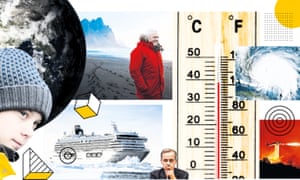
What the world will look like in 2050 if we continue to burn oil, gas, coal and forests at the current rate?
What the world will look like in 2050 if we continue to burn oil, gas, coal and forests at the current rate? Composite: Guardian Design; Filippo Monteforte/AFP; Patra Kongsirimongkolchai/Getty Images/EyeEm; Alex Board/BBC NHU; deepblue4you/Getty Images/iStockphoto; 
NOAA/AFP/Getty Images; Mike Eliason/Santa Barbara County Fire Depart/AFP; Will Oliver/EPA

‘Good morning. Here is the shipping forecast for midday, 21 June, 2050. Seas will be rough, with violent storms and visibility ranging from poor to very poor for the next 24 hours. The outlook for tomorrow is less fair.”
All being well, this could be a weather bulletin released by the Met Office and broadcast by the BBC in the middle of this century. Destructive gales may not sound like good news, but they will be among the least of the world’s problems in the coming era of peak climate turbulence. With social collapse a very real threat in the next 30 years, it will be an achievement in 2050 if there are still institutions to make weather predictions, radio transmitters to share them and seafarers willing to listen to the archaic content.
I write this imaginary forecast with an apology to Tim Radford, the former Guardian science editor, who used the same device in 2004 to open a remarkably prescient prediction on the likely impacts of global warming on the world in 2020.
Journalists generally hate to go on record about the future. We are trained to report on the very recent past, not gaze into crystal balls. On those occasions when we have to venture ahead of the present, most of us play it safe by avoiding dates that could prove us wrong, or quoting others.
Radford allowed himself no such safe distance or equivocation in 2004, which we should remember as a horribly happy year for climate deniers. George W Bush was in the White House, the Kyoto protocol had been recently zombified by the US Congress, the world was distracted by the Iraq war and fossil fuel companies and oil tycoons were pumping millions of dollars into misleading ads and dubious research that aimed to sow doubt about science.
Radford looked forward to a point when global warming was no longer so easy to ignore. Applying his expert knowledge of the best science available at the time, he predicted 2020 would be the year when the planet started to feel the heat as something real and urgent.
“We’re still waiting for the Earth to start simmering,” he wrote back in that climate-comfortable summer of 2004. “But by 2020 the bubbles will be appearing.”
The heat of the climate movement is certainly less latent. In the past year, the world has seen Greta Thunberg’s solo school strikes morph into a global movement of more than six million demonstrators; Extinction Rebellion activists have seized bridges and blocked roads in capital cities; the world has heard ever more alarming warnings from UN scientists, David Attenborough and the UN envoy for climate action, Mark Carney; dozens of national parliaments and city councils have declared climate emergencies; and the issue has risen further to the fore in the current UK general election than any before it. With only weeks to go until 2020, the bubbles of climate anxiety are massing near the surface.
Radford’s most precise predictions relate to the science. Writing after the record-breaking UK heat of 2003, he warned such scorching temperatures would become the norm. “Expect summer 2020 to be every bit as oppressive.” How right he was. Since then, the world has sweltered through the 10 hottest years in history. The UK registered a new high of 38.7C this July, which was the planet’s warmest month since measurements began.
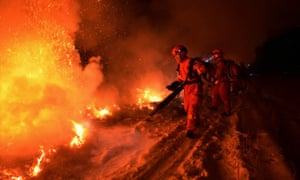
Hostile world: tackling forest fires in China.
Hostile world: tackling forest fires in China. Photograph: Costfoto/Barcroft Media

He also correctly anticipated how much more hostile this would make the climate – with increasingly ferocious storms (for the first time on record, there have been category 5 hurricanes, such as Dorian and Harvey, for four years in a row), intensifying forest fires (consider the devastating blazes in Siberia and the Amazon this year, or California and Lapland in 2018) and massive bleaching of coral reefs (which is happening with growing frequency across most of the world). All of this has come to pass, as have Radford’s specific predictions of worsening floods in Bangladesh, desperate droughts in southern Africa, food shortages in the Sahel and the opening up of the northwest passage due to shrinking sea ice (the huge cruise liner, Crystal Serenity, is among the many ships that have sailed through the Bering Strait in recent years – a route that was once deemed impossible by even the most intrepid explorers).
A couple of his predictions were slightly premature (the snows on Kilimanjaro and Mt Kenya have not yet disappeared, though a recent study said they will be gone before future generations get a chance to see them), but overall, Radford’s vision of the world in 2020 was remarkably accurate, which is important because it confirms climate science was reliable even in 2004. It is even more precise today, which is good news in terms of anticipating the risks, but deeply alarming when we consider just how nasty scientists expect the climate to become in our lifetime. Unless emissions are slashed over the next decade, a swarm of wicked problems are heading our way.
How wicked? Well, following Radford’s example, let us consider what the world will look like in 2050 if humanity continues to burn oil, gas, coal and forests at the current rate.
The difference will be visible from space. By the middle of the 21st century, the globe has changed markedly from the blue marble that humanity first saw in wondrous colour in 1972. The white northern ice-cap vanishes completely each summer, while the southern pole will shrink beyond recognition. The lush green rainforests of the Amazon, Congo and Papua New Guinea are smaller and quite possibly enveloped in smoke. From the subtropics to the mid-latitudes, a grimy-white band of deserts has formed a thickening ring around the northern hemisphere.
Coastlines are being reshaped by rising sea levels. Just over 30cm at this stage – well short of the 2 metres that could hit in 2100 – but still enough to swamp unprotected stretches of land from Miami and Guangdong to Lincolnshire and Alexandria. High tides and storm surges periodically blur the boundaries between land and sea, making the roads of megacities resemble the canals of Venice with increasing frequency.
On the ground, rising temperatures are changing the world in ways that can no longer be explained only by physics and chemistry. The increasingly hostile weather is straining social relations and disrupting economics, politics and mental health.
Generation Greta is middle aged. Their teenage fears of the complete extinction of the human race have not yet come to pass, but the risk of a breakdown of civilisation is higher than at any previous time in history – and rising steadily. They live with a level of anxiety their grandparents could have barely imagined.
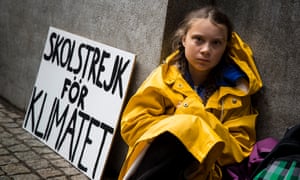
The climate activist Greta Thunberg leads a school strike outside of the Swedish Parliament in 2018.
The climate activist Greta Thunberg leads a school strike outside of the Swedish Parliament in 2018. Photograph: Michael Campanella/The Guardian

The world in 2050 is more hostile and less fertile, more crowded and less diverse. Compared with 2019, there are more trees, but fewer forests, more concrete, but less stability. The rich have retreated into air-conditioned sanctums behind ever higher walls. The poor – and what is left of other species – is left exposed to the ever harsher elements. Everyone is affected by rising prices, conflict, stress and depression.
This is a doorway into peak climate turbulence. Global heating passed the 1.5C mark a couple of years earlier and is now accelerating towards 3C, or possibly even 4C, by the end of the century. It feels as if the dial on a cooker has been turned from nine o’clock to midnight. Los Angeles, Sydney, Madrid, Lisbon and possibly even Paris endure new highs in excess of 50C. London’s climate resembles Barcelona’s 30 years earlier. Across the world, droughts intensify and extreme heat becomes a fact of life for 1.6bn city dwellers, eight times more than in 2019. For a while, marathons, World Cups and Olympics were moved to the winter to avoid the furnace-like heat in many cities. Now they are not held at all. It is impossible to justify the emissions and the world is no longer in the mood for games.
Extreme weather is the overriding concern of all but a tiny elite. It wreaks havoc everywhere, but the greatest misery is felt in poorer countries. Dhaka, Dar es Salaam and other coastal cities are hit almost every year by storm surges and other extreme sea-level incidents that used to occur only once a century. Following the lead set by Jakarta, several capitals have relocated to less-exposed regions. But floods, heatwaves, droughts and fires are increasingly catastrophic. Healthcare systems are struggling to cope. The economic costs cripple poorly prepared financial institutions. Insurance companies refuse to provide cover for natural disasters. Insecurity and desperation sweep through populations. Governments struggle to cope.
“By 2050, if we fail to act, many of the most damaging, extreme weather events we have seen in recent years will become commonplace,” warns Michael Mann, the director of the Earth System Science Center at Pennsylvania State University. “In a world where we see continual weather disasters day after day (which is what we’ll have in the absence of concerted action), our societal infrastructure may well fail … We won’t see the extinction of our species, but we could well see societal collapse.”
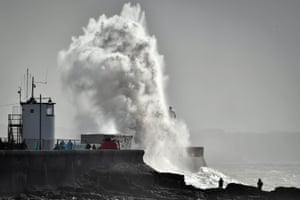
Huge waves at Porthcawl, Wales: there will be more extreme storms and longer droughts.
Huge waves at Porthcawl, Wales: there will be more extreme storms and longer droughts. Photograph: Ben Birchall/PA

Adding to the anxiety is the erratic temperature of the planet. Instead of rising smoothly it jolts upwards, because tipping points – once the stuff of scientific nightmares – are reached one after another: methane release from permafrost; a die-off of the tiny marine organisms that sequestered billions of tonnes of carbon; the dessication of tropical forests. People have come to realise how interconnected the world’s natural life-support systems are. As one falls, another is triggered – like dominos or the old board game, Mouse Trap. In some cases, they amplify one another. More heat means more forest fires, which dries out more trees, which burn more easily, which releases more carbon, which pushes global temperatures higher, which melts more ice, which exposes more of the Earth to sunlight, which warms the poles, which lowers the temperature gradient with the equator, which slows ocean currents and weather systems, which results in more extreme storms and longer droughts. It is also now clear that positive climate feedbacks are not limited to physics, but stretch to economics, politics and psychology. The Amazon is turning into a savannah because the loss of forest is weakening rainfall, which makes harvests lower, which gives farmers an economic motivation to clear more land to make up for lost production, which means more fires and less rain.
On our current course, carbon concentrations in the atmosphere will pass 550 parts per million by midcentury, up from around 400ppm today. Katharine Hayhoe, an atmospheric scientist and director of the Climate Science Center at Texas Tech University, explains how this stacks the odds in favour of disaster.
“By 2050, we’d be seeing events that are far more frequent and/or far stronger than we humans have ever experienced before, are occurring both simultaneously and in sequence.”
Her greatest concern is that food production and water supply systems could buckle under the strain, with dire humanitarian consequences in areas that are already vulnerable.

"Generation Greta live with a level of anxiety their grandparents could barely have imagined"

Hunger will rise, perhaps calamitously. The United Nations’ International Panel on Climate Change expects food production to decline by 2% to 6% in each of the coming decades because of land-degradation, droughts, floods and sea-level rise. The timing could not be worse. By 2050, the global population is projected to rise to 9.7 billion, which is more than two billion more people to feed than today.
When crops fail and starvation threatens, people are forced to fight or flee. Between 50 and 700 million people will be driven from their homes by midcentury as a result of soil degradation alone, the Intergovernmental Science-Policy Platform on Biodiversity and Ecosystem Services (IPBES) estimated last year. Fires, floods and droughts will prompt many others to migrate within and across borders. So will the decline of mountain ice, which is a source of meltwater for a quarter of the world’s population. The poorest will be worst affected, though they have the least responsibility for the climate crisis. For the US author and environmentalist, Bill McKibben, this injustice will make the greatest impact in 2050.
“Forcing people to move from their homes by the hundreds of millions may do the most to disrupt the world. And, of course, it’s a deep tragedy, because these are precisely the people who have done the least to cause the problem,” he says.
In 2050, climate apartheid goes hand-in-hand with increasingly authoritarian politics. Three decades earlier, worried electorates voted in a generation of populist “strongmen” in the hope they could turn back the clock to a more stable world. Instead, their nationalism made a global solution even harder to achieve. They preferred to focus on the immigration consequences of global heating rather than the carbon-capital causes. When voters realised their mistake, it was too late. The thugocracy refused to give up power. They no longer deny the climate crisis; they use it to justify ever-more repressive measures and ever-wilder efforts to find a technological fix. In the past 20 years, nations have tried volcano mimicking, cloud brightening, albedo modification and carbon dioxide removal. Most were expensive and ineffective. Some made weather circulation even less reliable. Powerful countries now threaten rivals not just with nuclear weapons, but with geo-engineering threats to block sunlight or disrupt rainfall patterns.
This is not an inevitable future. Unlike Radford’s prediction for 2020, this vision of 2050 factors in human behaviour, which is more volatile and less predictable than the laws of thermodynamics. Many of the horrors above are already baked into the climate, but our response to them – and each other – is not predetermined. When it comes to the science, the dangers can be substantially reduced if humanity shifts decisively away from business-as-usual behaviour over the next decade. When it comes to the psychology and politics, we can make our situation better immediately if we focus on hope in shared solutions, rather than fears of what we will lose as individuals.
That means putting faith in institutions, warning one another about risks, and treasuring shared eccentricities and traditions – a bit like the shipping forecast.


A storm is certainly brewing. The science is clear on that. The question now is how we face it.
Posted by The Worker at 7:00:00 am
Email ThisBlogThis!Share to XShare to FacebookShare to Pinterest

No comments:

Post a Comment

Newer Post Older Post Home
Subscribe to: Post Comments (Atom)

About Me

My photo
The Worker
I was inspired to start this when I discovered old editions of "The Worker". "The Worker" was first published in March 1890, it was the Journal of the Associated Workers of Queensland. It was a Political Newspaper for the Labour Movement. The first Editor was William "Billy" Lane who strongly supported the iconic Shearers' Strike in 1891. He planted the seed of New Unionism in Queensland with the motto “that men should organise for the good they can do and not the benefits they hope to obtain,” he also started a Socialist colony in Paraguay. Because of the right-wing bias in some sections of the Australian media, I feel compelled to counter their negative and one-sided version of events. The disgraceful conduct of the Murdoch owned Newspapers in the 2013 Federal Election towards the Labor Party shows how unrepresentative some of the Australian media has become.
View my complete profile

Translate

Search This Blog

Popular Posts

  • Trump wants Venezuela's airspace closed — but international law stands in the way.
    Extract from  ABC News By Elissa Steedman with wires  Topic: World Politics 17 hours ago President Donald Trump said Venezuela's airspa...
  • The first Australian-made car, the Holden 48-215, was introduced to the world on this day.
    Extract from  ABC News By Tim Callanan Today in History Topic: Automotive Industry 1 hours ago One of the surviving Holden 48-215s. (Supplie...
  • Australia's emissions have dropped, but we've got our work cut out to reach targets.
    Extract from  ABC News By climate reporter Jo Lauder Topic: Energy Policy 23 hours ago "Net zero" has become a political slogan, b...
  • England's Ashes demolition job of Australia in Brisbane's first ever cricket Test match at the Ekka.
     Extract from  ABC News By Simon Smale Topic: Sport 2 hours ago England completed destroyed Australia in the first ever Ashes Test in Brisba...
  • Australia to provide Ukraine with $95m funding boost.
    Extract from  ABC News By defence and national security correspondent Olivia Caisley Topic: War 7 hours ago The additional funding for Ukrai...
  • Trump says airspace above and surrounding Venezuela to be closed in its entirety.
    Extract from  ABC News Topic: World Politics 5 hours ago Donald Trump said "Airlines, Pilots, Drug Dealers, and Human Traffickers"...
  • Big haul of 170yo Indigenous artefacts unearthed in North West Queensland.
     Extract from  ABC News By Abbey Halter By Maddie Nixon ABC North West Qld Topic: Cultural Artefacts 19m ago 19 minutes ago Yinika Perston i...
  • Photographer Lyn Alcock captures wild antics of Dryandra's numbat population over 20 years.
    Extract from  ABC News By Asha Couch and Andrew Collins ABC Great Southern Topic: Animals 17 hours ago Lyn Alcock has recorded photographs ...
  • Ukraine hits two Russian 'shadow fleet' oil tankers with naval drones in the Black Sea.
    Extract from  ABC News Topic: Unrest, Conflict and War 11 hours ago Naval drones could be seen speeding towards hulking tankers followed by ...
  • Lebanese hopeful Pope Leo will bring peace as he visits the country.
    Extract from  ABC News By Middle East correspondent Eric Tlozek and Chérine Yazbeck in Lebanon Topic: Religion 1 hours ago Billboards welc...

Favourite Links

  • Australian Council of Trade Unions
  • Australian Labor Party
  • Queensland Council of Unions
  • ALP Queensland
  • Whitlam Institute
  • Chifley Research Centre
  • John Curtin Prime Ministerial Library
  • The Australia Institute
  • Tim Flannery ~ Australian Climate Council
  • Dr. James E. Hansen explains Climate Change
  • David Suzuki Foundation
  • The Environment Time capsule
  • Solar Citizen
  • Cape Grim Greenhouse Gas Data
  • The Jane Goodall Institute Australia
  • RenewEconomy
  • Basic income Earth Network
  • Skeptical Science
  • Lucinda's Song and Dance

Blog Archive

  • ►  2025 (1066)
    • ►  December (28)
    • ►  November (104)
    • ►  October (111)
    • ►  September (150)
    • ►  August (125)
    • ►  July (106)
    • ►  June (101)
    • ►  May (78)
    • ►  April (66)
    • ►  March (77)
    • ►  February (59)
    • ►  January (61)
  • ►  2024 (921)
    • ►  December (60)
    • ►  November (69)
    • ►  October (79)
    • ►  September (64)
    • ►  August (45)
    • ►  July (74)
    • ►  June (72)
    • ►  May (80)
    • ►  April (68)
    • ►  March (110)
    • ►  February (101)
    • ►  January (99)
  • ►  2023 (877)
    • ►  December (101)
    • ►  November (82)
    • ►  October (70)
    • ►  September (91)
    • ►  August (56)
    • ►  July (90)
    • ►  June (55)
    • ►  May (60)
    • ►  April (55)
    • ►  March (84)
    • ►  February (72)
    • ►  January (61)
  • ►  2022 (1195)
    • ►  December (84)
    • ►  November (107)
    • ►  October (45)
    • ►  September (83)
    • ►  August (129)
    • ►  July (137)
    • ►  June (84)
    • ►  May (82)
    • ►  April (87)
    • ►  March (116)
    • ►  February (135)
    • ►  January (106)
  • ►  2021 (2138)
    • ►  December (101)
    • ►  November (286)
    • ►  October (236)
    • ►  September (150)
    • ►  August (116)
    • ►  July (168)
    • ►  June (171)
    • ►  May (161)
    • ►  April (138)
    • ►  March (220)
    • ►  February (221)
    • ►  January (170)
  • ►  2020 (1868)
    • ►  December (145)
    • ►  November (156)
    • ►  October (98)
    • ►  September (152)
    • ►  August (145)
    • ►  July (164)
    • ►  June (146)
    • ►  May (158)
    • ►  April (99)
    • ►  March (150)
    • ►  February (190)
    • ►  January (265)
  • ▼  2019 (1888)
    • ▼  December (207)
      • Fact checking Angus Taylor: does Australia have a ...
      • When Greta Thunberg met Sir David Attenborough
      • Sydney lord mayor says climate change is the issue...
      • 'It's nice to meet you': Greta Thunberg and David ...
      • Victoria bushfires: hellish wait for those who fle...
      • Greta Thunberg: 'I wouldn't have wasted my time' s...
      • The environment in 2050: flooded cities, forced mi...
      • 'You have utterly no clue': why 'climate emergency...
      • Greta Thunberg and David Attenborough unite to cal...
      • DANGEROUS SUMMER: ESCALATING BUSHFIRE, HEAT AND DR...
      • Explainer: Australian Federal Government Fails on ...
      • Meet Daisy, Student Striker
      • Australia's environment minister says up to 30% of...
      • Climate change denial was defeated in 2019. But wh...
      • 'You have utterly no clue': why 'climate emergency...
      • Volunteer NSW firefighters to be compensated, gove...
      • Scott Morrison announces compensation payments for...
      • Betelgeuse: The Eventual Supernova
      • We cannot indulge in the luxury of despair. We nee...
      • Australian miners hit by lowest thermal coal price...
      • Is Betelgeuse, the red giant star in the constella...
      • Hot blob: vast patch of warm water off New Zealand...
      • Wheels of Justice - James Hansen
      • More US voters than ever care about climate – but ...
      • From Mediscare to Chisholm’s signs: it’s time for ...
      • Science made astonishing progress. It was also hij...
      • Rising temperatures could imperil future of Boxing...
      • PM’s office refuses to release drought reports Bar...
      • I've been a firefighter for 20 years. The Blue Mou...
      • Australians create 67 million tonnes of waste each...
      • Extreme heat due to climate change could send cric...
      • Yes, Australia has always had bushfires: but 2019 ...
      • Silicosis cases in Australia rising, with thousand...
      • Cape Grim Greenhouse Gas Data - CSIRO
      • Australians aren’t asking for miracles from Scott ...
      • An end to Morrison’s mean-spiritedness is the Chri...
      • Australian bushfires: the story so far in each state
      • Factcheck: why Australia’s monster 2019 bushfires ...
      • NSW bushfires destroy almost 1,000 homes as Christ...
      • Bushfires see RFS volunteers skip Christmas festiv...
      • Earth to Scott Morrison! Michael Pascoe gives the ...
      • South Australia’s clean-energy shift brings lowest...
      • ‘I never understood wind’: Trump goes on bizarre t...
      • Home affairs warned Australian government of growi...
      • Scott Morrison says compensation for volunteer fir...
      • Scott Morrison says Hawaii holiday was like taking...
      • The humming of Christmas beetles was once a sign o...
      • I lived through Aids denialism in South Africa. Sc...
      • Australia has changed its historic data on carbon ...
      • Waiting for a megafire: the battle against Austral...
      • SA premier says 72 homes destroyed in Cudlee Creek...
      • Scott Morrison returns from holiday and signals no...
      • Prime minister, you need a credible climate policy...
      • The Australian Prime Minister Morrison has shown i...
      • NSW fires live: PM concedes link between extreme w...
      • It's been a lost decade for progressives and for t...
      • Australian bushfires: death toll rises as fires sw...
      • McCormack concedes Australia must do more to fight...
      • Fireball Earth: The Permian Extinction - History D...
      • Carl Sagan - Cosmos 4 - "Heaven and Hell"
      • Shields and Brooks on Trump’s impeachment reaction...
      • Nova: Permian Extinction
      • Carl Sagan - Pale Blue Dot
      • Scott Morrison's Hawaii horror show: how a PR disa...
      • I'm the 13-year-old police threatened to arrest at...
      • Dutch supreme court upholds landmark ruling demand...
      • Can Morrison's 'she'll be right' strategy on clima...
      • Australian bushfire crisis deepens with record bre...
      • How big are the fires burning on the east coast of...
      • No relief in sight from Australian bushfire crisis...
      • Climate of chaos: the suffocating firestorm engulf...
      • Prime Minister Scott Morrison pulls pin on Hawaii ...
      • Should volunteer firefighters get paid?
      • As the nation breaks new heat records, the Governm...
      • Goldman Sachs abandons coal as investors look to l...
      • Stephen Colbert: 'Trump's presidency is just a TV ...
      • 2019 wasn't just protests and Fleabag: it was the ...
      • Scientists fear surge in supersized bushfires that...
      • Temperature hits 49.9C and roads melt in remote SA...
      • Climate, economy, drought, bushfires and the elect...
      • Donald Trump's impeachment might seem like politic...
      • Is Donald Trump still President? What does his imp...
      • Too hot for humans? First Nations people fear beco...
      • Martin Parkinson on Australia's decade of climate ...
      • Pelosi says Democrats have 'no choice' but to impe...
      • Australia and world not moving fast enough to avoi...
      • Climate crisis: Australian businesses back net zer...
      • Australia's heatwave registers new hottest day on ...
      • Sydney facing day of oppressive heat, smoke and fi...
      • What does Donald Trump's impeachment mean? Five qu...
      • Scott Morrison's holiday is not the problem, his l...
      • 'Hugely disappointed' emergency chiefs to hold bus...
      • More than 700 historians call for Trump to be impe...
      • Australia weather: records forecast to be broken a...
      • Australia found to be much less divided on need to...
      • Climate change has cut Australian farm profits by ...
      • End Permian, 251 million years ago, 96% of species...
      • What you’d spend to prevent climate change — and w...
      • Climate change denial is delusion, and the biggest...
      • NSW bushfires: 60-70m flames confront firefighters...
    • ►  November (216)
    • ►  October (202)
    • ►  September (193)
    • ►  August (151)
    • ►  July (151)
    • ►  June (87)
    • ►  May (120)
    • ►  April (166)
    • ►  March (156)
    • ►  February (122)
    • ►  January (117)
  • ►  2018 (1793)
    • ►  December (207)
    • ►  November (193)
    • ►  October (212)
    • ►  September (195)
    • ►  August (162)
    • ►  July (189)
    • ►  June (175)
    • ►  May (139)
    • ►  April (33)
    • ►  March (126)
    • ►  February (94)
    • ►  January (68)
  • ►  2017 (2094)
    • ►  December (70)
    • ►  November (97)
    • ►  October (109)
    • ►  September (123)
    • ►  August (161)
    • ►  July (217)
    • ►  June (201)
    • ►  May (223)
    • ►  April (170)
    • ►  March (243)
    • ►  February (302)
    • ►  January (178)
  • ►  2016 (1016)
    • ►  December (165)
    • ►  November (163)
    • ►  October (103)
    • ►  September (109)
    • ►  August (66)
    • ►  July (44)
    • ►  June (57)
    • ►  May (68)
    • ►  April (61)
    • ►  March (74)
    • ►  February (50)
    • ►  January (56)
  • ►  2015 (874)
    • ►  December (72)
    • ►  November (69)
    • ►  October (73)
    • ►  September (109)
    • ►  August (71)
    • ►  July (104)
    • ►  June (102)
    • ►  May (80)
    • ►  April (44)
    • ►  March (51)
    • ►  February (32)
    • ►  January (67)
  • ►  2014 (1022)
    • ►  December (65)
    • ►  November (88)
    • ►  October (104)
    • ►  September (90)
    • ►  August (73)
    • ►  July (60)
    • ►  June (87)
    • ►  May (120)
    • ►  April (77)
    • ►  March (128)
    • ►  February (67)
    • ►  January (63)
  • ►  2013 (730)
    • ►  December (50)
    • ►  November (70)
    • ►  October (51)
    • ►  September (48)
    • ►  August (52)
    • ►  July (83)
    • ►  June (116)
    • ►  May (91)
    • ►  April (44)
    • ►  March (36)
    • ►  February (45)
    • ►  January (44)
  • ►  2012 (137)
    • ►  December (20)
    • ►  November (32)
    • ►  October (43)
    • ►  September (24)
    • ►  August (18)
Simple theme. Powered by Blogger.