Contemporary politics,local and international current affairs, science, music and extracts from the Queensland Newspaper "THE WORKER" documenting the proud history of the Labour Movement.
MAHATMA GANDHI ~ Truth never damages a cause that is just.
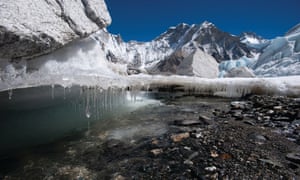
Melting ice on Khumbu glacier in the Everest-Khumbu region. Himalayan glaciers are a water source for 250 millions people.
Photograph: Alex Treadway/ICIMOD
At least a third of the huge ice fields in Asia’s towering mountain
chain are doomed to melt due to climate change, according to a landmark report, with serious consequences for almost 2 billion people.
Even if carbon emissions are dramatically and rapidly cut and succeed
in limiting global warming to 1.5C, 36% of the glaciers along in the
Hindu Kush and Himalaya range will have gone by 2100. If emissions are
not cut, the loss soars to two-thirds, the report found.
The glaciers are a critical water store for the 250 million people
who live in the Hindu Kush-Himalaya (HKH) region, and 1.65 billion
people rely on the great rivers that flow from the peaks into India, Pakistan, China and other nations.
“This is the climate crisis you haven’t heard of,” said Philippus Wester of the International Centre for Integrated Mountain Development
(Icimod), who led the report. “In the best of possible worlds, if we
get really ambitious [in tackling climate change], even then we will
lose one-third of the glaciers and be in trouble. That for us was the
shocking finding.”
Wester said that, despite being far more populous, the HKH region had
received less attention than other places, such as low-lying island
states and the Arctic, that are also highly vulnerable to global
warming.
Prof Jemma Wadham, at the University of Bristol, said: “This is a
landmark piece of work focused on a region that is a hotspot for climate
change impacts.”
The new report, requested by the eight nations the mountains span, is
intended to change that. More than 200 scientists worked on the report
over five years, with another 125 experts peer reviewing their work.
Until recently the impact of climate change on the ice in the HKH region
was uncertain, said Wester. “But we really do know enough now to take
action, and action is urgently needed,” he added.
The
HKH region runs from Afghanistan to Myanmar and is the planet’s “third
pole”, harbouring more ice than anywhere outside Arctic and Antarctica.
Limiting the global temperature rise to 1.5C above pre-industrial levels
requires cutting emissions to zero by 2050. This is felt to be
extremely optimistic by many but still sees a third of the ice lost,
according to the report. If the global rise is 2C, half of the glaciers
are projected to melt away by 2100.
Since the 1970s, about 15% of the ice in the HKH region has
disappeared as temperatures have risen. But the HKH range is 3,500km
long and the impact of warming is variable. Some glaciers in Afghanistan
and Pakistan are stable and a few are even gaining ice, most probably
due to increased cloud cover that shields the sun and changed winds that
bring more snow. But even these will start melting with future warming,
Wester said.
The melting glaciers will increase river flows through to 2050 to 2060, he said, pushing up the risk of high-altitude lakes bursting their banks
and engulfing communities. But from the 2060s, river flows will go into
decline. The Indus and central Asian rivers will be most affected.
“Those areas will be hard hit,” said Wester.
Lower flows will cut the power from the hydrodams that generate much
of the region’s electricity. But the most serious impact will be on
farmers in the foothills and downstream. They rely on predictable water
supplies to grow the crops that feed the nations in the mountains’
shadows.
But the changes to spring melting already appear to be causing the
pre-monsoon river flow to fall just when farmers are planting their
crops. Worse, said Wester, the monsoon is also becoming more erratic and
prone to extreme downpours. “One-in-100 year floods are starting to
happen every 50 years,” he said. The new report highlights how vulnerable many mountain people are,
with one-third living on less than $1.90 a day and far away from help if
climate disaster strikes.
Political tensions between neighbouring nations such as India
and Pakistan could add to the difficulties. “There are rocky times
ahead for the region. Because many of the disasters and sudden changes
will play out across country borders, conflict among the region’s
countries could easily flare up,” said Eklabya Sharma, the deputy
director general of Icimod.
Hamish Pritchard, a glaciologist at the British Antarctic Survey and
not part of the report, said it is “a substantial piece of work” that
takes due note of the uncertainties resulting from the limited snowfall
and ice measurements in the high mountains.
He said glaciers currently provide an essential buffering role as
their meltwater flows into the rivers during the summer, which is when
water is in greatest demand downstream and periodic droughts have the
deadliest impacts on populations. “Take the ice away and those people
are exposed to serious water stress and the consequences of that are
local, regional and potentially global, in terms of conflict and
migration,” he said.

No comments:
Post a Comment